It starts as an innocent downward notch on your weekly trend graph. A number you’ve protected for months is suddenly sliding backward. If you’re seeing VO2 Max dropping on your running watch, your first instinct might be to blame the wrist sensor and argue with the algorithm. But with the newest generation of wearable optics and machine-learning models, the more honest answer is often: the watch might be right. What matters is why the number is falling. Hot weather, poor sleep, a heavy training block, and even a simple change in how you wear the watch all leave different fingerprints on the estimate — and only some of them are a real reason to worry.
What Your Watch Is Actually Measuring
Your watch isn’t measuring oxygen exchange. It’s estimating it. In a laboratory, VO2 max is the volume of oxygen your body can use during maximal effort, measured by breathing into a mask while running on a treadmill. On your wrist, the metric is a proxy computed from your heart rate response against your pace, combined with your resting heart rate and heart-rate variability (HRV) trends. The sensor tracks your heartbeat, the GPS tracks your speed, and the algorithm asks a simple question: How efficient is this runner’s heart compared to how fast they’re moving?
That’s why the number is surprisingly sensitive. Anything that makes your heart beat faster for the same speed — heat, caffeine, dehydration, stress — will make the estimate drift downward. Once you know that, the drop becomes a puzzle worth solving rather than a red alert.
The Real Physiological Causes of a Falling Score
Heat and Humidity Are the Most Common Culprits
In summer months, your cardiovascular system works overtime to cool your core. Blood is redirected to your skin, your heart rate rises, and your body feels like it’s working harder at the same pace. The watch doesn’t know it’s hot outside — it only sees a heart rate climbing faster than it did for the same speed a month ago. The result is a temporary VO2 max drop of 3 to 5 points that returns as soon as you acclimatize. If your score started sliding alongside a heat wave, your body isn’t detraining. It’s thermo-regulating.
Sleep Debt and Life Stress Leave a Signature
Wearable algorithms increasingly incorporate resting HR and HRV as inputs. When you sleep poorly night after night, your resting heart rate rises and your HRV falls. That combination is read by the algorithm as a less fit, less recovered cardiovascular system. This is one of the few cases where the watch might be genuinely right about a current state — you might not have lost aerobic fitness in the training sense, but your body’s ability to express it is compromised. The number falls because your nervous system is carrying extra load.
Overtraining and the Fatigue Trap
Here’s the scenario that trips up committed runners: you do four hard workouts in a row, your legs feel heavy, and on the fifth day your watch says your VO2 max has dropped two points. You don’t listen. You push harder. The score drops again. What you’re seeing is likely real evidence of functional overreaching — the watch has detected that your heart rate is elevated at easy paces and your recovery metrics are declining. It’s not permanently losing fitness; it’s flagging that your training is outpacing your recovery. The fix isn’t more intensity, it’s a reset.
When the Algorithm Is the Problem, Not Your Fitness
Firmware Updates and Back-End Changes
Watch brands periodically refresh their algorithms, and those updates change how the score is computed. A firmware update in the middle of the night can quietly shift your baseline by a point or two, with no physiological change. In 2026, several major running watches also started combining their older pace-and-heart-rate–based estimate with HRV trend data, which means past scores aren’t directly comparable to current ones. If your number dropped sharply immediately after an update, check the brand’s release notes before you schedule a lab test.
Strap Fit, Sensor Position, and Measurement Noise
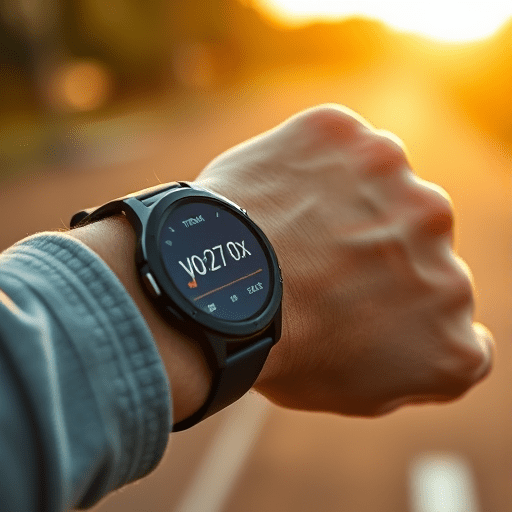
Optical heart rate sensors are better than ever, but they are not infallible. A slightly loose strap, a watch worn when sweat pools under the sensor, or an off-wrist position during a hard interval can all generate noisy data. If your watch starts logging erratic heart-rate spikes on one specific run, the resulting VO2 max estimate for that day is untrustworthy. Some newer watches now offer a motion-cancellation feature that cleans up cadence and arm swing artifacts, but you need the watch snug — not too tight, not too loose — for it to work. Try wearing a chest strap for a few runs if you rely heavily on the metric; the accuracy difference is still significant.
How to Verify the Drop Before You Panic
Before you make any training changes, run a simple verification protocol. It takes less than a week and eliminates most of the false alarms.
- Check your recovery status first. If resting HR is trending upward and HRV is trending downward, the VO2 max slide is consistent with fatigue, and that shifts your response toward recovery rather than more training.
- Do a controlled benchmark run. Choose a flat, familiar route in cool, calm conditions. Run 30 minutes at a steady pace, then compare your average heart rate to a similar run from two to three weeks earlier. If your heart rate is within a few beats, your fitness is intact.
- Look at the trend, not the daily number. Daily VO2 max readings can wander by as much as 2–3 points because of measurement noise. A genuine drop is defined by a consistent downward direction across two to three weeks, not a single red day.
- Resync the watch with a GPS outdoor run. If your last several runs were on a treadmill, the watch may not have had enough GPS data to calibrate its pace-to-heart-rate model. One or two outdoor runs with satellite lock can often nudge the estimate back up.
How to Fix a Real Drop
Give the Body What It’s Asking For
If the fatigue indicators support the number, the most effective response is to drop your training load by about 30 percent for the next five to seven days. Keep the easy runs easy — genuinely easy — and replace one intense session with a long walk or a light cross-training session. In most cases, the watch’s score stabilizes once your rest and sleep rebalance the stress/recovery equation.
Rebuild on Zone 2, Not on More Intensity
Once the acute fatigue clears, the most reliable way to lift a suppressed VO2 max estimate is to spend more time in the low aerobic zone. Zone 2 running improves your body’s ability to clear lactate and build mitochondrial density, and it’s also the pace that produces consistent, clean heart-rate data for the algorithm to use. If the watch says your score is low, it may be because you’ve been running most of your miles in a gray zone — not easy enough to recover, not hard enough to stimulate change.
Use the Post-Run Breathing Metric
Newer watches now calculate respiratory rate after runs. If you can run at a pace where your breathing rate stays steady and controlled, you’re keeping your heart rate lower and your oxygen delivery more efficient. Watching that metric during an easy run and adjusting your pace to keep respiration calm helps the cardiovascular system stay within the efficiency zone the algorithm expects.
Know When the Number Shouldn’t Lead
There’s a strange irony in the modern running watch: it’s better at detecting a loss of efficiency than it is at detecting a gain. That’s because the algorithm relies primarily on steady-state heart-rate-to-pace relationship. When you add interval training, strength work, or hill repeats, your body becomes fitter, but the metric waits until you run another long, steady effort to update. Some of the biggest real VO2 max improvements — the kind that come from five weeks of threshold intervals — show up on the watch only after a single easy long run. If you’ve been training hard and the score has barely moved, don’t read that as stagnation. Your watch is simply slower at praising you than at scolding you.
The Bottom Line
When VO2 Max dropping appears on your watch, treat it as a question, not a verdict. Look at the context: hot weather, sleep debt, heavy training blocks, strap slippage, and firmware updates all produce the same downward arrow for completely different reasons. Verify with a real-world benchmark run before you overreact. If the drop is genuine, shift your training toward recovery and zone 2 volume for the next week or two. The score you see on the screen is a tool — a useful, imperfect one — designed to help you understand your body, not to define it.