Most cyclists treat knee pain as a signal to stop pedaling, but the training week doesn’t have to fall apart. If you’re wondering how to swim with a pull buoy when cycling knee pain flares up, the answer is rooted in smart movement selection and a clear recovery plan. A pull buoy isn’t just a foam accessory; it’s a bridge that keeps your aerobic engine running while your knee gets the rest it needs. For athletes who can’t stomach a week of complete inactivity, it’s a practical way to train around the injury rather than through it. This guide explains why pull-buoy swimming works, how to structure effective sessions, and how to return to the bike without losing the fitness you’ve built.
Why Cycling Knee Pain and Swimming Kicks Don’t Mix
Cycling knee injuries often involve the patellofemoral joint, the IT band, or the patellar tendon. These structures are sensitive to repeated flexion under load. The flutter kick in freestyle, especially when done forcefully or with a straight leg, creates similar quadriceps tension and can send pain signals straight to the knee. That’s why many athletes find that even gentle kicking makes their knee ache the next morning.
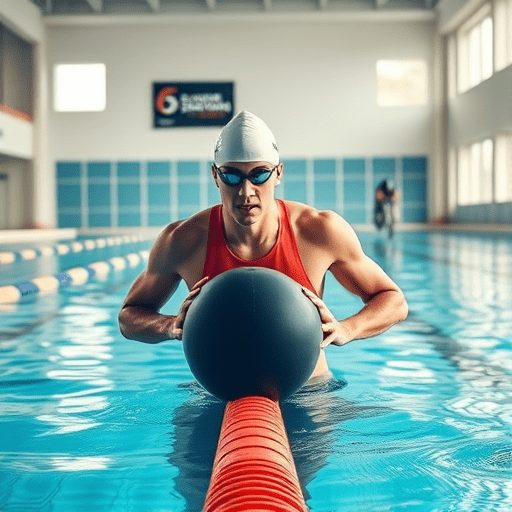
Swimming with a pull buoy removes the lower body from the equation. The buoy sits between the thighs and keeps your legs near the surface without active kicking. This lets you maintain your stroke rhythm and heart rate without loading the knee structures that cycling has already irritated. It turns the pool into a sanctuary for the knee while still giving your heart and lungs a serious workout. This is especially valuable for cyclists with patellofemoral pain, where quadriceps tension is the main driver of symptoms. Removing that tension while still moving the body is the core idea behind cross-training during injury.
How a Pull Buoy Changes Your Swim Mechanics
Sliding a pull buoy between your legs changes how your body moves through the water. Your hips float higher, reducing drag and forcing your upper body to work harder. Without the flutter kick, your arms become the sole source of propulsion, so effort shifts to your lats, shoulders, and chest.
Your stroke must also become more rotation-based. Because the legs aren’t providing balance, you rely on core rotation to stay streamlined. If you swim flat, your hips sink and your lower back arches. Good pull-buoy technique involves a long spine, engaged glutes, and a steady roll from side to side. This is a skill in itself, and mastering it carries over to a stronger bike position later. Many swimmers discover that their stroke actually improves during this period because they can no longer rely on the kick to cover up an inefficient pull. The arms are forced to be precise, which often translates to a more balanced freestyle once the kick is reintroduced.
Building a Pull-Buoy Swim Workout That Preserves Cycling Fitness
To maintain fitness, you don’t need to swim for hours. A focused 40-to-50-minute session, three to four times per week, is enough to preserve aerobic capacity and muscular endurance. The key is structuring the workout around continuous effort, not sprinting.
Here’s a practical session:
- 300–400 easy choice swim to warm up
- 6 × 50 pull with the buoy, moderate effort, 20 seconds rest
- 5 × 100 pull, breathing every 3 or 5 strokes, 30 seconds rest
- 10 × 25 pull at a smooth, strong pace, 15 seconds rest
- 100–200 easy cool-down without the buoy
This structure keeps total volume around 1,500 to 1,800 meters while giving the upper body what it needs. Newer swimmers can reduce the main set to 8 × 100 and build up. Use a standard pull buoy, not a pull kickboard combo, and consider swim paddles only if your shoulders can handle the added load.
For pace, stay in Zone 2 or Zone 3 effort — able to speak in short sentences, not gasping. The goal is to maintain blood flow, promote joint mobility, and keep your cardiovascular system accustomed to sustained effort, not to set a personal best in the 100-meter freestyle. If you’re a cyclist who isn’t used to swimming, don’t worry about swimming fast. Worry about swimming relaxed. A relaxed swimmer covers more distance with less energy, which matters when you still have to fit in recovery work for the knee.
Technique Tips to Avoid Shoulder Fatigue and Lower Back Strain
Using a pull buoy places a heavy load on the shoulders and lower back. The most common mistake is overreaching at the front of the stroke, which can cause shoulder impingement. Keep your hand entry at 11 and 1 o’clock relative to your head, and focus on catching the water early rather than stretching forward aggressively.
Lower back strain happens when the legs float too high and the hips hyperextend. To prevent this, engage your core as if bracing for a light crunch and squeeze the buoy with your thighs. This keeps the legs passive without letting them rise too high. If you feel your lower back arching, shorten your distance, drop the buoy, and recheck your position.
You can also use a smaller buoy or place it between your ankles instead of your thighs. The ankle position forces the legs to stay together but places more stress on the knees. For cycling knee pain, the thigh position is generally safer and more comfortable.
When and How to Return to Cycling Without Reinjuring the Knee
Pull-buoy swimming is not a permanent replacement for cycling; it’s a maintenance tool while the knee heals. The return to the bike should be gradual and guided by symptoms, not calendar dates.
Start with a 20-minute ride on flat terrain, low resistance, and a cadence of 85–95 RPM. Avoid seated climbs and high-gear efforts until you’ve completed several pain-free rides. Pay attention to knee discomfort during or after the ride, and check your bike fit for issues like a low saddle, excessive cleat float, or cranks that are too long.
If you’ve had knee pain for more than two weeks, or if the pain is sharp rather than dull, it’s worth having a physiotherapist assess the knee before you resume training. They can help identify the root cause, whether it’s a training-load issue, a strength imbalance, or a bike-fit problem. Returning too soon is the most common reason cycling knee injuries become chronic.
As the knee improves, keep one or two pull-buoy swim sessions in your weekly routine. They preserve your swimming baseline, give your knee a lower-impact recovery day, and add variety to your training. If the pain returns, step back to swimming-only for a few days before reintroducing the bike.
Ultimately, the goal isn’t just to survive an injury — it’s to return stronger. Swimming with a pull buoy when cycling knee pain flares up lets you stay in control of your fitness while respecting the tissue that needs time to heal. It’s not a compromise but a smarter way to train.