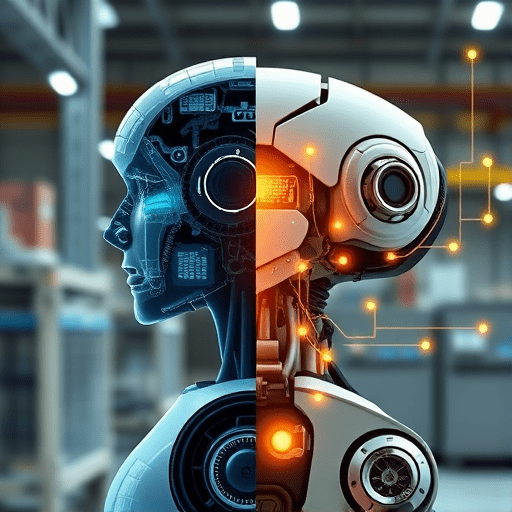
Fixing digital twin drift with live sensor streams has become the defining reliability challenge for manufacturers in 2026. A digital twin is only as valuable as its alignment with physical reality—and that alignment decays quietly, daily, through thermal effects, tool wear, material variation, and unrecorded operator decisions. The old practice of recalibrating every quarter or after a major incident is no longer viable. Factories now generate terabytes of sensor data per shift, and a twin that lags behind its physical counterpart is not merely inaccurate; it is actively misleading, causing operators to trust predictions that have silently gone stale. The solution is not to eliminate drift—that is impossible—but to make recalibration a continuous, automated, and computationally grounded process.
Why Digital Twins Drift Faster Than Ever
Drift is not a one-dimensional problem. In modern factories, it emerges from four converging pressures. First, the physical asset itself evolves: a robotic arm loses stiffness, a conveyor belt stretches, a pump impeller erodes. Second, the environment shifts: seasonal humidity, ambient temperature, and even subtle changes in floor vibration alter operating characteristics. Third, the digital model degrades because the assumptions baked into its initial calibration—material properties, friction coefficients, response latencies—are approximations that fade in validity. Fourth, and most critically in 2026, the sensor ecosystem itself becomes a source of drift as edge devices age, sample rates fluctuate, and data pipelines lose precision.
These forces compound faster than any manual audit can track. A 2026 factory floor might have thousands of IoT endpoints feeding a twin that updates every second. When drift goes unnoticed, the twin begins to produce confident but wrong answers: predicted energy consumption that is off by 12 percent, recommended maintenance schedules that are too early or too late, and quality-control thresholds that falsely flag good products. This is downstream of a deeper issue—the twin has become a historical record rather than a live mirror.
The Signal in the Noise: Drift as Diagnostics
Here is the mindshift that separates mature manufacturers from those stuck in reactive mode: drift is not just an error to be corrected, but a carrier of diagnostic information. When the live sensor stream diverges from the digital twin’s prediction, that residual contains clues about what physically changed. A persistent positive offset in a motor’s current draw, for instance, might indicate bearing friction, not calibration error. A growing variance in vibration data could signal structural loosening or an impending imbalance condition.
This framing turns recalibration from a burden into a continuous diagnostic opportunity. Every divergence is a candidate event—a chance to decide whether the model needs updating, the asset needs attention, or the sensor is lying. The goal of automated recalibration, therefore, is not just to keep the twin honest, but to use the twin as an instrument for observing the production line itself.
A Practical Architecture for Automated Recalibration
Building a system that self-corrects in near real time requires four components working in concert: a streaming sensor layer, a drift detection engine, a recalibration orchestrator, and a verification loop. Each piece is now mature enough to be deployed in a mid-sized factory without a custom research team.
Step 1: Establish a Drift Baseline with Observability Metrics
Before you can automate recalibration, you need to define what drift looks like as a number. This means tracking forecasting errors as a statistical process, not as isolated incidents. Common baselines include the mean absolute error (MAE) between the twin’s predicted value and the actual measured value, the residual distribution’s standard deviation, and the frequency of threshold violations. For each sensor group and asset type, set a drift threshold that is physically meaningful—not just statistically significant, but tied to economic impact.
A useful technique is to compute a rolling baseline over a moving window of, say, 168 hours, then compare the current error distribution to that baseline. This is preferable to using a static threshold set at commissioning, because the production itself drifts seasonally, and the baseline should reflect the asset’s current healthy behavior.
Step 2: Let Sensor Streams Trigger Recalibration Events
Rather than recalibrating on a fixed schedule, the system should listen for early warning signs. Exponentially weighted moving average (EWMA) and cumulative sum (CUSUM) control charts are exceptionally well suited to this task because they can detect small, persistent shifts in error signals that ordinary threshold checks miss. When the drift detection engine flags a sustained deviation from the baseline, it emits a recalibration event with a payload containing the relevant sensor stream segments and the time window of the anomaly.
This is where live sensor streams earn their keep. The automation layer should subscribe to measurement data via an MQTT or Kafka pipeline, buffer a short window of context, and feed the detector. The detector does not need high-resolution data for every variable; it needs a carefully selected subset—temperature, pressure, vibration, current, and throughput—that covers the dominant operating modes of the asset.
Step 3: Recalibrate in Place, Not Just in the Cloud
Latency and data sovereignty demands in 2026 mean that recalibration cannot rely on round-trips to a cloud data center. A well-designed system pushes the drift detection and a lightweight local model update step to an edge gateway that sits next to the asset. The edge gateway maintains a small training cache, runs an incremental learning algorithm—such as online ridge regression or a lightweight neural network with a frozen feature extractor—and produces a recalibrated model that is deployed back to the twin within seconds.
This in-place approach has a massive advantage: it reduces the volume of data that must be shipped to a central server, which addresses security concerns and lowers bandwidth cost. More importantly, it enables factory-floor responsiveness, so that the twin is updated within minutes of a drift event, not after a human data scientist wakes up and reviews a dashboard. The cloud, meanwhile, is reserved for what it does best: periodic deep retraining on accumulated data, model versioning, and cross-factory comparison.
Step 4: Close the Loop with Verification and Human Oversight
Automated recalibration does not mean removing humans from the loop entirely. It means shrinking the loop and making the human role strategic. After the system recalibrates the twin, it should automatically validate the updated model against a held-out segment of the live sensor feed for a short probation period. If the new model’s error is within the prescribed tolerance, the system logs the update and continues. If the error remains high, the system escalates to a process engineer with a concise diagnostic summary.
Critical safety parameters should be excluded from fully autonomous recalibration, or at least subject to strict guardrails. For example, a twin used for predictive maintenance on a high-speed turbine could receive automatic updates on efficiency coefficients, but not on vibration limit thresholds. The architecture should allow per-variable recalibration privileges, with human approval required only for those variables that affect safety or regulatory compliance.
The Economics of Staying Honest
The cost of ignoring drift is not theoretical. In a typical continuous manufacturing line, a 5 percent deviation in the digital twin’s temperature predictions can force operators to manually override setpoints weekly, reducing production efficiency by 3 to 7 percent over a year. When drift goes unchecked for months, the false confidence leads to missed warning signs, premature bearing failures, and scrapped batches. Automated recalibration pays for itself quickly. The infrastructure—sensors, edge gateways, and a drift detection framework—represents a modest capital expense compared to the operational losses avoided and the preventative maintenance gains achieved.
From Set-and-Forget to Continuously Verified
The philosophical shift in 2026 is that a factory digital twin is no longer a deliverable, but a process. It acknowledges that no model is ever final, and that honesty is a property maintained fresh, shift by shift, using the abundant live sensor data already flowing through the facility. Fixing digital twin drift with live sensor streams is not about chasing perfection—perfection is the wrong target. It is about building the plumbing for continuous questioning: Is this model still true? What changed? What should I adjust? With the right architecture, those questions receive immediate, grounded answers.
The factories that recover from drift fastest will not be the ones with the most elegant data science, but the ones that build a resilient loop between sensor data and model updates, and then let that loop run behind every production decision. Automated recalibration is the quiet engine that keeps the twin honest in a world where physical and digital realities are constantly in tension.
Adopting this playbook is a practical move. Start with one critical asset, map its dominant drift signatures, deployan edge-based detector, and let the live stream drive the update cadence. That is the path to a twin that does not silently lie—and a factory that can trust what it sees.