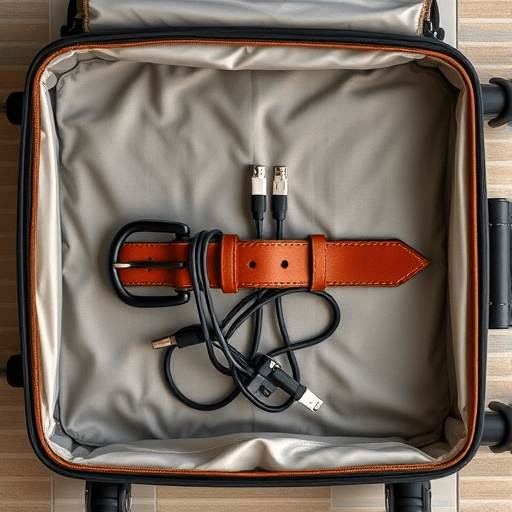
If you travel with a camera, laptop, power bank, and phone, you know the chaos of loose charging cables in a carry-on. No matter how carefully you pack, cords seem to multiply and tangle into a knot by the time you reach security. The solution is surprisingly simple: use a belt to organize charging cables in your carry-on. By wrapping each cord around the buckle and securing the end, you transform an everyday accessory into a lightweight, reusable cable management system that frees up space and preserves your sanity.
Why the Belt Method Beats Other Cable Organizers
Most travelers reach for zip pouches, silicone straps, or dedicated cable organizers. These work, but they add bulk, cost money, and can be cumbersome when you need a quick charge during a layover. A belt is already in your luggage or around your waist, so it costs nothing extra and takes up zero additional space. The wide surface area of the belt strap also acts as a stable base for wrapping, while the buckle provides a natural anchor point.
From a physics perspective, the belt method eliminates tangling because each cord is individually wrapped and held in place by tension. Unlike a loose bundle in a pocket, cables wrapped around a rigid structure cannot twist around each other. This is the same reason electrical cords are often stored on spools. The belt buckle becomes your portable spool.
Space Efficiency in a Carry-On
Every inch of a carry-on matters, especially when you’re flying with a personal item only. A belt takes up no additional volume—it’s either on you or flat in your bag. By wrapping cables around it, you compress flexible cords into a single, flat-ish bundle that can slide against the inside wall of your suitcase. You no longer need a dedicated organizer pouch, which frees up a small but valuable pocket for other essentials.
Security Check Portability
At airport security, you often need to remove electronics and cables from your bag. With the belt method, all your charging cords are easily visible and accessible. Instead of digging through a tangle, you simply lift the belt out, show it, and place it back. This is a huge time-saver for frequent flyers.
Choosing the Right Belt for Cable Management
Not all belts work equally well. The ideal belt is one you already own, but if you’re planning to buy a belt for travel, consider these characteristics.
Belt Material Matters
Leather belts are sturdy but can be stiff and heavy. Woven or canvas belts are lighter and provide a slightly textured surface that grips cables and prevents sliding. Elastic belts are less ideal because they stretch under tension, creating a less stable anchor. For the best results, choose a medium-width belt—about 3 to 4 centimeters—that gives enough surface area to wrap several cables without overlapping too much.
Buckle Types That Help
The buckle is your anchor. A classic frame buckle with a prong works well because you can wrap the cord around the belt body and then tuck the end through the center gap. A ratchet or magnetic buckle also works, but avoid oversized or heavily textured buckles that could snag cable ends. A smooth, rounded buckle is easier to work with and less likely to damage your cords.
Travel-Friendly Belt Features
If you’re specifically looking for a belt to double as a cable organizer, consider a belt with a quick-release buckle. This allows you to remove the belt without threading the whole strap through your pants loops—a nice feature when you’re in a hurry. Some belts are made with a webbing strip that has a buckle at both ends, similar to a camera strap, which opens up even more wrapping possibilities.
Step-by-Step: Wrapping Cords Around the Buckle
Here’s a practical method for turning your belt into a cable tidy. It takes less than a minute once you get the hang of it.
- Lay the belt flat. Place the belt on a table or the floor of your hotel room, buckle side up.
- Separate your cables. Group them by length or device type. For example, keep a USB-A to USB-C cable separate from a lightning cable and a charging adapter.
- Start with the first cable. Position one end of the cable at the base of the buckle, where the strap enters the buckle frame.
- Wrap the cord around the belt strap. Work your way from the buckle down the length of the belt, wrapping the cord in tight, even loops. Keep the wraps close together to prevent slipping.
- Secure the end. When you reach the end of the cable, tuck the connector through the last loop, or feed it under a wrap to lock it in place. For extra security, form a small loop with the connector and slide it under the previous wrap.
- Repeat for other cables. Space them along the belt. If you have a long belt, you can fit several cables in a row. For shorter belts, wrap multiple cables around the same section, but alternate directions to keep the bundle uniform.
- Store the belt. Once all cables are wrapped, you can fold the belt over itself and place it in a side compartment. Or, wear the belt with the cables hidden under your clothes—though that might be uncomfortable for a long flight.
This technique works especially well with cables that have a thicker connector head, like a USB-C cable with a large housing. The connector head acts as a stopper that prevents the wrap from unraveling.
Beyond the Belt: Complementary Carry-On Cable Strategies
The belt method is excellent for the main charging cables you need on a daily basis. For more complex setups—such as a travel router, external SSD, and multiple power adapters—you might want to combine the belt with a few other simple techniques.
Use Small Rubber Bands or Velcro Straps
While wrapping cables around the belt prevents tangles, adding a small rubber band or a narrow velcro strap around each coil can provide extra stability. This is particularly useful for very short cables that you don’t want to wrap around the entire belt width. Just wrap the cable into a circle, then secure it to the belt with a separate loop.
Designate a Cable Pouch for Non-Belt Cables
If you carry a few extra cables that you don’t use daily, keep them in a slim zippered pouch that sits alongside the belt in your carry-on. This dedicated pouch can be the same one you used before, but now it’s only for backups and accessories, not for the cords you need at every stop. The belt handles the high-frequency items.
Pair with a Power Strip or Multi-Port Charger
Reducing the number of chargers is the best companion to the belt method. If you carry a single multi-port GaN charger, you only need one output cable for each device, and the belt keeps them organized. This cuts down on the total number of cables, making the belt method even more efficient.
Common Mistakes to Avoid
This hack is simple, but there are a few pitfalls that can turn it into a frustrating experience.
- Using a belt that’s too narrow. A very thin belt provides less surface area, so cables tend to bunch up and slide off. Stick to a belt that’s at least 3 centimeters wide.
- Overwrapping the belt. You don’t need to cover the entire belt with cables. Leaving some empty space keeps the bundle flexible and easier to fold. A good rule is to limit the wrapped section to two-thirds of the belt’s length.
- Wrapping cables with sharp bends. Avoid bending cables at extreme angles near the connector. If you wrap too tightly around a narrow belt, you may stress the wire. Use a gentle, even tension and start near the connector, not too close to it.
- Forgetting to unplug before wrapping. Always disconnect your cables from devices before wrapping. We’re all guilty of leaving a phone charger attached while rolling it up—this eventually frays the connection.
Is This Hack Right for Your Travel Style?
If you’re a minimalist traveler who prefers to carry only a backpack and a personal item, the belt method is a natural fit. It eliminates the need for separate organizers and keeps your essential cables within reach. For those who carry a lot of gear—say, a full camera setup with multiple batteries and a drone—you’ll likely need more than one belt or a dedicated organizer. But you can still use the belt as a quick-access solution for your phone and laptop cables while larger pouches handle the rest.
The belt method also works for other flexible items, not just charging cables. You can wrap a small travel extension cord, a USB‑C to HDMI adapter cable, or even a pair of wired earbuds around the same belt. This versatility makes it a clever packing technique for 2026, where reducing single-use plastic and repurposing items you already own is a smart approach to sustainable travel.
In the end, the humble belt proves that the best travel hacks are often the simplest. By using a belt to organize charging cables in your carry-on, you save space, prevent frustration, and make your gear more functional. The next time you pack, look at your own wardrobe first—the solution might be wrapped around your waist.