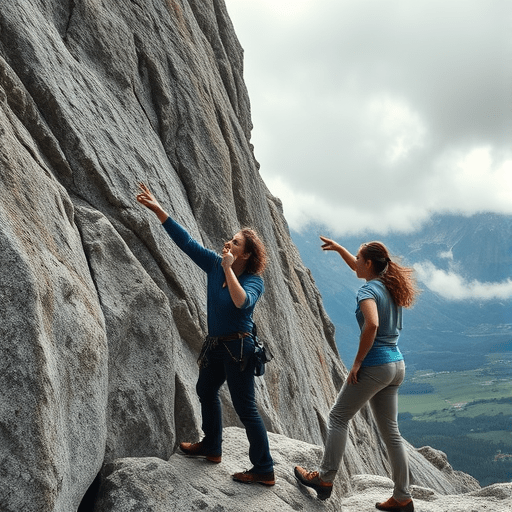
You’re at the base of a route that’s two grades above your comfortable limit. The weather is shifting, your hands are cold, and something in your gut says this is wrong. Then your partner turns to you, already clipped in, and says, “Come on, we’ve got this. Don’t chickened out now.” That pressure is as real as the rock itself — and it has sent countless climbers into dangerous situations they never wanted. Knowing how to refuse a risky climb when your partner pushes is not just a social skill; it’s a core climbing safety technique. In 2026, with more climbers heading into alpine environments and pushing grades, the ability to say “no” clearly and without guilt has become as essential as knowing how to place gear. This article offers a practical framework using pre-set boundaries and objective checklists to override peer pressure and keep both partners safe.
Why Peer Pressure Is the Real Hazard on the Mountain
Climbing decisions are rarely purely rational. The fear of being judged, the desire to please your partner, and the sunk cost of a long approach all conspire to make you say “yes” when every data point says “no.” Psychologists call this the normalcy bias — the tendency to underestimate risk because everyone around you is acting as if it’s fine. On a climbing wall, that bias is amplified by adrenaline and the social hierarchy of experience. A more skilled partner may unintentionally intimidate you into doing something you’d never choose on your own.
Recognizing these dynamics is the first step. The risk isn’t just the objective danger of the route — it’s the social environment that suppresses your own risk assessment. When your partner pushes, they’re not necessarily being reckless. They may be in a different physical or emotional state, or they may simply not perceive the same signals you do. But you are the only person who can feel your body, see your fear, and judge your readiness. Your “no” is a legitimate piece of information, not a sign of weakness.
Set Your Boundaries Before You Rope Up
The worst time to decide where your line is drawn is when someone is pulling you to cross it. Boundaries need to be set in the parking lot, at home, or during the planning phase — before the vertigo and peer pressure kick in. Start by writing down your personal red lines. These might include maximum grade, max route length, allowed conditions (wind, rain, snow), or a rule that you will never climb with a partner who argues more than twice after you say no.
Make these boundaries concrete. Instead of saying “I’ll decide when I get there,” use a simple rating system. For example, define your go/no-go weather thresholds: if the wind is above 25 mph, you don’t climb. If you haven’t climbed in the past month, you drop a full grade from your usual limit. If your partner cannot agree to these thresholds before the climb, that’s a red flag. Your boundaries aren’t about controlling the team — they’re about ensuring that decisions are made with a cool head and a shared baseline.
Share your checklist with your partner before you leave home. This turns a potential conflict into a pre-agreed procedure. When you’re at the crag and things start to feel dicey, you don’t need to argue. You can simply say, “Remember our threshold? The wind is above it. That’s the rule we agreed to.” The boundary becomes a team rule, not a personal rejection.
The Checklist Technique: Turning ‘No’ Into a Data-Driven Decision
A checklist is the ultimate antidote to peer pressure because it removes emotion from the decision. In high-stakes fields like aviation and surgery, checklists are used specifically to override the human tendency to rationalize risky actions in the moment. Climbing checklists work the same way. They give you an objective reference point that doesn’t care about how your partner is staring at you.
Build your own climb/no-go checklist with three categories. First, route and conditions: What is the expected grade? Current weather? Actual route condition? Time of day and daylight remaining? Second, team status: Are both partners feeling physically strong? Has anyone had a bad day, minimal sleep, or significant stress? Is the emotional dynamic calm? Third, gear and backup: Is all essential gear present and in good repair? Do you have a backup plan if the climb goes wrong? Is your phone and emergency kit accessible?
Use a simple 0-5 scoring system for each item, and set a total threshold below which the climb is automatically off. The list doesn’t need to be complex — it just needs to be yours. When your partner pushes, you can say, “We’re at a 2 on route conditions. That’s below our threshold. I’m not going.” That’s not an opinion; it’s a result. There is no negotiation. This technique is your best defense because it converts your gut feeling into a concrete, shareable number that even a frustrated partner can’t argue with.
What to Say When Your Partner Pushes: Scripts and Phrases
Even with boundaries and checklists, you’ll still face the moment where your partner says, “Let’s just do one pitch.” You need a few rehearsed, low-emotion response scripts that keep the conversation constructive. Remember, the goal is not to prove who is right — it’s to end the conflict without making your partner feel disrespected.
- The checklist anchor: “I hear you, but this is below our go threshold. I’m not comfortable. Let’s look for a different climb.” This acknowledges their input and restates the rule.
- The time-delay: “I’m not deciding now. Let’s wait fifteen minutes, check the conditions again, and then look at the checklist.” This disengages from the pressure and lets the adrenaline subside.
- The reversal: “If you were in my position, what would you do?” Often, your partner’s own risk assessment reveals that they’re only pushing because you’re the one who is “holding them back.” They may admit they also wouldn’t go.
- The one-word no: “No.” Then stop talking. You don’t need to explain or justify. Silence is a powerful boundary.
Practice these scripts in non-mountaineering contexts too. The more you rehearse “no” in low-stakes situations, the easier it becomes during the real thing. You can even role-play with your partner on a rest day, deliberately going through a scenario to confirm that both of you know how to handle a refusal.
When Checklists Fail: Handling Emotional Manipulation
Unfortunately, not every pushy partner will respect a well-reasoned checklist. Some may use guilt, sarcasm, or mockery to override your boundaries. Phrases like “You’re not being a good partner” or “I can’t climb with someone so scared” are not negotiation — they’re emotional manipulation. In these cases, the checklist is still useful, but you need a higher-level response.
The first step is to name the behavior. “That feels like guilt-tripping. I’ve said no, and I need you to accept that.” This calls out the manipulation without being accusatory. The second step is to remove yourself from the decision-making space. Unclip, step back from the rock, and say, “I’m not going to continue this conversation here. We can talk about it in the car.” If your partner refuses to accept your no, that’s a serious relationship signal — not just about climbing. It means they prioritize completing the route over your safety, your comfort, and your autonomy. Consider whether this is a person you want to roped up with at all.
Ultimately, a partner who truly cares about your well-being will appreciate your firmness. The best teams are built on the knowledge that either member can call a stop at any time, without argument. That trust is what allows you to push your limits in a healthy way on easier days. When you enforce your “no” consistently, you teach your partner that your word is real, and that reduces pressure on every future climb.
Conclusion
Refusing a risky climb when your partner pushes is not about being negative or lacking courage. It’s about taking responsibility for your own life and the well-being of your climbing team. The courage required to say “no” in a high-pressure moment is often greater than the courage needed to clip a bolt or trust a cam. By setting boundaries before the climb, relying on objective checklists, and rehearsing your refusal scripts, you transform a fragile social negotiation into a calm, data-backed decision. The mountains will always offer another day, another route, another chance. But there is no second chance if you go up when every part of you says to turn back. Choose the climb that keeps you alive, and let your partner see that your boundaries are not a wall between you — they are the foundation of a partnership that lasts.