Deciding whether to choose QMS or De Novo for SaMD in trials is one of the most consequential regulatory decisions a clinical development team can make. The classification you select influences validation timelines, data integrity expectations, audit burden, and how quickly sites can adopt the software. A general-purpose electronic data capture (EDC) platform does not face the same regulatory question as a novel AI-based diagnostic algorithm embedded in a trial workflow. In 2026, sponsors are increasingly building custom software for decentralized trials, remote monitoring, and AI-assisted endpoint assessment — and many are surprised to learn that the FDA does not treat all trial software the same. This article offers a decision map for comparing three regulatory paths: a QMS-only approach, a De Novo classification request, and a traditional 510(k) submission, illustrated with real-world-style trial software examples.
The Regulatory Fork: Why Trial Software Is Not Just Software
Software used in clinical trials can fall into several categories. Some tools are purely administrative, such as randomization schedules or site payment trackers, and never touch patient data in a way that affects diagnosis or treatment decisions. But software that processes physiological signals, interprets medical images, or generates endpoint values can easily cross the line into Software as a Medical Device (SaMD). Under FDA’s framework, SaMD is defined as software intended to be used for one or more medical purposes without being part of a hardware medical device. The intended use and claims in your protocol determine whether the software is regulated — not your development workflow.
The common mistake is treating every trial app as if it were the same. A patient-reported outcome (ePRO) symptom diary that simply records pain scores using a numeric slider is unlikely to require premarket review. But a mobile app that automatically interprets speech patterns to detect depression symptoms may be deemed an SaMD. Similarly, an algorithm that recommends an insulin dose based on continuous glucose monitor (CGM) data is unequivocally a medical device in the eyes of regulators. Your choice between QMS and De Novo begins with a single question: what exactly does the software claim to do?
Path 1: QMS-Only for Non-Device Trial Software
The first regulatory path is not a device clearance path at all. A quality management system (QMS) approach — aligned with ISO 13485 or 21 CFR Part 820 — is sufficient when the software is used within a trial but does not meet the definition of SaMD. This includes software that stores, transmits, or displays data without altering its clinical meaning, as long as no diagnostic or treatment recommendation is generated.
Consider a real example: a sponsor developed a custom ePRO app for collecting daily migraine frequency and severity in a Phase 2 headache study. The app asks patients to rate pain on a 0–10 scale and logs the timestamped responses into a secure cloud database. Because the app does not interpret, diagnose, or recommend treatment, the sponsor classified it as clinical trial software rather than SaMD. Nonetheless, the sponsor maintained a QMS that covered software development lifecycle controls, risk management (ISO 14971), and data integrity checks aligned with 21 CFR Part 11. The QMS gave FDA inspectors confidence that the tool was fit for purpose, while avoiding the burden of a De Novo submission.
This path works best for moderate-risk digital health tools that are ancillary to the clinical investigation. It is also the fastest route when the trial is the intended market — meaning the software is only used in the study and will not be commercialized as a standalone product. If you plan to market the software after the trial, a QMS-only approach is rarely sufficient, especially if new claims will be introduced.
Path 2: De Novo Classification for Novel Low- to Moderate-Risk SaMD
When your trial software has no legally marketed predicate device, the De Novo pathway is the primary route to establish a new classification. De Novo is designed for SaMD that is low or moderate risk and fills a gap in the regulatory taxonomy. For trial sponsors, this path is increasingly relevant because modern trial software often pushes into brand-new clinical territory — such as AI-powered digital biomarkers or remote monitoring algorithms.
Take a realistic example: a medtech startup builds a retinal imaging AI tool intended to detect early signs of diabetic retinopathy in a large cardiovascular outcomes trial. The software analyzes fundus images captured by a smartphone adapter and flags images that warrant reading center review. Because the algorithm makes a clinical inference about a disease state, it is SaMD. After a search, the team finds no predicate device with the same intended use and technological characteristics. The startup submits a De Novo request, including clinical validation data generated from the trial’s reading center, and proposes a new classification for AI-based retinal screening tools. Once granted, that classification becomes the basis for future 510(k) submissions by other sponsors.
De Novo offers a clear benefit: it removes the need for a predicate while still allowing the software to be commercialized. But it demands rigorous evidence. The FDA will want to see analytical validation, clinical validation, and strong usability documentation, often leveraging the very trial data the software produces. In 2026, sponsors should also expect questions about algorithm transparency, bias assessment, and real-world performance across diverse populations.
Path 3: 510(k) for Substantially Equivalent Trial Software
The third path applies when your SaMD has a predicate — a legally marketed device with the same intended use and similar technological characteristics. A 510(k) submission is typically less burdensome than De Novo because the evidence focuses on demonstrating substantial equivalence rather than establishing a brand-new classification.
For example, consider a company that develops automated QT interval analysis software to measure cardiac safety endpoints in a Phase 1 oncology study. Since similar QT analysis tools have been cleared under the 510(k) pathway as ECG analysis software, the company can benchmark its algorithm against a predicate. The clinical trial itself becomes an ideal environment for generating equivalence data: the software is run side-by-side with the predicate on the same ECGs, and the results are compared using predefined acceptance criteria. If equivalence is demonstrated, the 510(k) is cleared, and the sponsor is then permitted to market the software to other trial sites.
The 510(k) route is attractive for trial software that iterates on existing technologies — such as enhanced ePRO analytics, improved blood pressure algorithms, or updated image-quality assessment tools. However, the challenge lies in the predicate search. If your software’s intended use adds a new clinical claim, even a small one, the predicate may not hold, pushing you back to De Novo.
QMS or De Novo? A Step-by-Step Decision Map
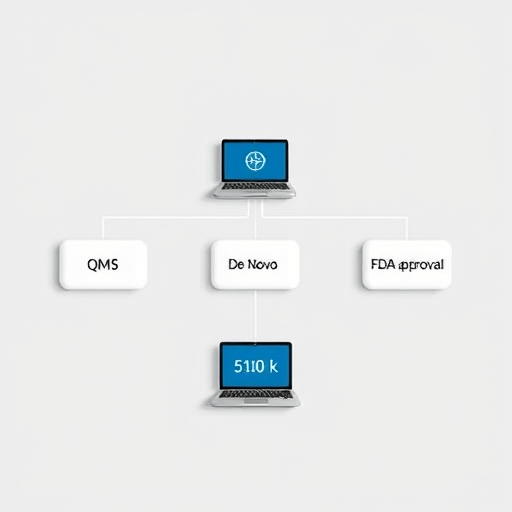
The following decision map condenses the three pathways into a practical checklist that sponsors can use early in the trial planning phase.
- Step 1 — Define the intended use. Write a short end-user claim. If the software is purely administrative, proceed with a QMS-only approach and continue through your organization’s standard validation workflow.
- Step 2 — Determine whether the software interprets or recommends. If the software analyzes patient data to generate a clinical conclusion, classify it as SaMD and move to Step 3. If not, the QMS-only path remains viable.
- Step 3 — Search for a predicate. Identify any legally marketed SaMD with the same intended use and similar technology. If a predicate exists, the 510(k) path is likely appropriate.
- Step 4 — Assess risk and novelty. If no predicate exists and the risk is low to moderate, De Novo classification is the logical route. If the risk is high, a premarket approval (PMA) may be required — a fourth scenario that is rare in early-stage trials but still possible for certain interventional software.
- Step 5 — Align evidence with the selected path. QMS-only requires lifecycle documentation and data integrity verification; De Novo requires a full classification justification with clinical evidence; 510(k) requires comparative performance testing against the predicate.
Mapping the Three Regulatory Paths Side by Side
Choosing between QMS, De Novo, and 510(k) becomes clearer when the differences are laid out together.
- QMS-only: Best for ePRO diaries, site management tools, and data dashboards; no FDA premarket submission; fastest to deploy; cannot be marketed as a medical device.
- De Novo: Best for novel AI-based diagnostic algorithms, digital biomarkers, and remote monitoring tools with no predicate; requires classification request and clinical evidence; grants a new classification after approval.
- 510(k): Best for incremental improvements to existing SaMD, such as ECG analysis, image processing, or vital sign monitoring; requires substantial equivalence demonstration; typically lighter than De Novo but constrained by the predicate.
For most trial sponsors, the decision is not simply QMS versus De Novo. It is a portfolio decision. You may have one software module that is QMS-only and another that requires De Novo within the same trial platform. In those situations, modular regulatory planning becomes essential. Each module’s claim, risk profile, and predicate status should be documented separately in the sponsor’s device master record.
Common Mistakes When Choosing a Regulatory Path for SaMD in Trials
One recurring error is making the regulatory decision late in the development cycle. If you build your trial software as QMS-only and later discover its algorithm renders a diagnosis, you face a significant corrective action. The FDA’s digital health guidance is clear that the intended use controls classification, regardless of how the developer markets the tool internally.
Another mistake is relying too heavily on the word “research use” as a shield. The FDA may still enforce compliance for SaMD used in clinical investigations, particularly if the software’s output informs patient management, eligibility, or primary endpoint conclusions. The research-use-only designation has limits, and interactive software that gives direct patient feedback is especially likely to draw scrutiny.
Finally, sponsors often underestimate the data requirements for De Novo. A De Novo request includes not just product descriptions and labeling but also bench testing, human factors validation, and clinical evidence. In a trial setting, you can be strategic by embedding the validation studies into the trial itself — for example, collecting audio recordings during a speech-based depression assessment trial to support both the endpoint and the De Novo submission.
Choosing the right path is ultimately a question of claim clarity, predicate availability, and evidence strategy. The QMS-only route serves non-device trial software well, while De Novo and 510(k) each offer a commercial route for true SaMD. By mapping your clinical software to one of these three paths early, you avoid expensive pivots and give yourself a clear validation roadmap. This decision map is not just a regulatory exercise — it is a practical framework for de-risking software innovation in clinical trials.