The race to modernize clinical trial oversight has reached a pivotal moment in 2026, where adaptive AI models are reshaping how sponsors navigate the FDA’s Precertification Pilot for Software as a Medical Device (SaMD). Rather than treating each algorithm update as a static resubmission, the pilot now embraces iterative learning systems that can evolve under continuous regulatory oversight. This shift promises shorter review cycles, fewer trial delays, and ultimately, faster patient access to refined digital diagnostics and therapeutic decision-support tools.
Why Adaptive AI Demands a Different Regulatory Pathway
Traditional medical device review assumes a frozen version of the product. A locked algorithm, a validated dataset, and a static intended use all get bundled into a single submission package. Adaptive AI, however, is defined by its capacity to adjust in production based on incoming data, new populations, or drift in the underlying clinical environment. When that algorithm powers a clinical trial endpoint, biomarker interpretation, or patient stratification decision, every update can materially affect participant safety and study integrity.
The FDA recognized this reality in earlier SaMD guidance, but the Precertification Pilot launched in earnest to test a hands-on, organizational rather than product-specific approach. Sponsors that demonstrate mature software engineering, quality systems, and real-world performance monitoring earn a streamlined review relationship. Adaptive AI models map onto that philosophy neatly because they already require continuous post-market surveillance, structured change control, and transparent performance reporting.
The Core Principle: Trust Through Demonstrated Capability
Instead of auditing every line of retraining code, the pilot assesses whether a developer can repeatedly ship safe, effective updates. That is where the concept of a “Good Machine Learning Practice” lifecycle becomes non-negotiable. Documentation of training data provenance, model bias checks, locked-down deployment pipelines, and rollback procedures all feed into a trust score that the FDA uses to triage submission depth.
Inside the Precertification Pilot Workflow for SaMD Updates
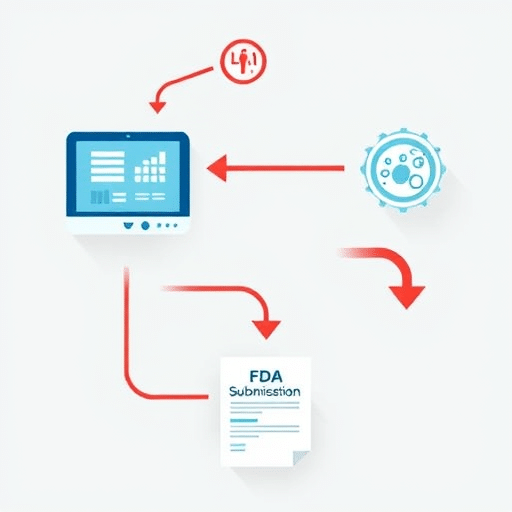
Sponsors operating inside the pilot follow a tiered review process that scales with the magnitude of an algorithm change. A tweak to a non-decision-support feature, such as a UI enhancement for clinician dashboards, may only require an internal change record. A reweighting of a survival prediction model used in a randomized oncology trial, on the other hand, triggers a streamlined pre-spec review with abbreviated documentation.
Adaptive AI models benefit from this proportionality. Sponsors can pre-register likely update scenarios, define acceptance criteria in advance, and route changes through pre-approved pathways. This dramatically shortens turnaround when a model starts to underperform on underrepresented subgroups or when a new biomarker emerges mid-trial.
Key Submission Artifacts
- Update Impact Assessment describing the scope and risk level of the change
- Validation Summary Report comparing pre-update and post-update performance on locked test sets
- Real-world Performance Dashboard excerpt showing monitoring metrics from recent deployments
- Change Control Log entries demonstrating traceability of design, training, and review decisions
- Predetermined Change Control Plan (PCCP) covering anticipated retraining triggers and approval gates
How Adaptive AI Models Stay Compliant During Clinical Trial Operation
Adaptive algorithms used in trial settings must straddle two regulatory worlds simultaneously: the trial protocol’s locked statistical analysis plan, and the SaMD update framework that allows controlled model evolution. The pilot resolves this tension by explicitly permitting predetermined adaptive behaviors that the sponsor declares up front.
For instance, a sponsor running a cardiovascular outcomes trial may submit a baseline model for primary endpoint adjudication, along with a PCCP that allows quarterly recalibration against accumulated event data. The pilot’s reviewers focus less on each individual recalibration and more on whether the sponsor’s process reliably detects when a recalibration crosses into clinically meaningful territory. When it does, the sponsor escalates to a streamlined review rather than a full de novo submission.
Monitoring That Travels With the Code
Continuous performance monitoring is the connective tissue of adaptive SaMD inside the pilot. Teams are expected to maintain dashboards that surface metrics such as calibration drift, subgroup disparity indices, prediction latency, and human override rates. These dashboards are reviewed during periodic FDA touchpoints rather than buried in dense regulatory documents. When monitoring flags a problem, sponsors can pause auto-deployment and roll back to the prior version within hours, preserving trial integrity without waiting for paperwork.
What 2026 Has Changed in Practice
Earlier cohorts of pilot participants spent much of their energy negotiating basic terms: what counts as a “minor” change, how to document retraining data, and how to format real-world performance reports. By 2026, the conversation has matured. The FDA has clarified expectations around foundation-model-derived components, cross-site learning across federated deployments, and the use of synthetic control arms in rare-disease trials.
Adaptive AI models in particular have benefited from clearer rules around when a model can be considered “locked” for primary analysis versus when it may continue learning in a non-inferential role. This distinction matters enormously for trials exploring novel endpoints where label noise and reader variability can otherwise obscure treatment effects. Sponsors no longer have to choose between using the most accurate available model and locking down the statistical plan; they can specify a hierarchy of model roles inside the trial protocol itself.
Concrete Wins Reported by Pilot Sponsors
- Reduction in median review time for algorithm updates from several months to under six weeks
- Ability to ship fairness audits for underrepresented demographic cohorts without halting the trial
- Streamlined inclusion of newly validated biomarkers into patient stratification logic
- Closer alignment between protocol amendments and software change controls, cutting duplicate documentation
Remaining Friction Points and Open Questions
Despite the progress, adaptive AI models still expose gaps in the pilot’s coverage. International sponsors operating across the European Union’s AI Act and FDA jurisdictions must reconcile differing rules about when recalibration triggers a conformity reassessment. Smaller developers without mature quality systems can struggle to earn the trust thresholds that unlock streamlined review, even when their models are clinically excellent. And the question of how to handle emergent model behaviors from large foundation-model backbones remains a live research area.
There is also ongoing debate about the appropriate level of transparency around training data composition when adaptive models ingest site-specific data during a trial. The pilot encourages documentation over disclosure, but academic and patient-advocate stakeholders have called for more visible summaries suitable for trial participants and ethics committees.
What Sponsors Should Do Before the Next Pilot Wave
For organizations preparing to enter or expand their footprint in the Precertification Pilot, a few practical moves stand out. First, invest in monitoring infrastructure that produces regulator-ready dashboards from day one, not as an afterthought after the first update. Second, write the Predetermined Change Control Plan alongside the trial protocol rather than retrofitting it later, so adaptive AI model behaviors are fully described in the documents ethics committees and the FDA both review.
Third, treat every model update as a chance to demonstrate organizational maturity: clean diff logs, locked evaluation datasets, subgroup performance breakdowns, and clear rollback stories. Reviewers quickly differentiate between sponsors who patch on the fly and those running a disciplined lifecycle. Finally, participate actively in pilot working groups. The rules continue to evolve in 2026 and beyond, and the loudest voices in those discussions tend to shape the next iteration of expectations.
Looking Ahead
Adaptive AI models are no longer a curiosity at the edge of medical device regulation. Within the FDA’s Precertification Pilot, they have become a proving ground for a broader question: can regulatory oversight move at the speed of software without compromising patient safety? The answer so far in 2026 is cautiously yes, provided sponsors invest in the lifecycle discipline the pilot rewards. As the framework matures and spreads to additional therapeutic areas, adaptive SaMD updates for clinical trials may become the default rather than the exception, fundamentally reshaping how evidence generation keeps pace with algorithmic progress.