The conversation around patient-generated wearable data in regulatory submissions has shifted from speculative to operational. Sponsors no longer ask whether continuous sensor data belongs in a real-world evidence (RWE) package for the FDA; they ask how to convert a noisy, multi-device data lake into a structured, traceable submission artifact by the time a pre-submission meeting wraps up. As of 2026, the practical playbook for that conversion has matured, and several sponsor teams have moved from isolated pilots to portfolio-level strategies. This article walks through the steps, decisions, and documentation patterns that make wearable-derived RWE defensible during FDA review.
Why the FDA Is Paying Closer Attention to Continuous Sensor Data
Two shifts forced the change. First, the 21st Century Cures framework continues to push the agency toward accepting real-world data (RWD) as primary or supportive evidence when randomized data is impractical. Second, wearables now capture endpoints that matter to regulators, such as step count variability in heart failure, tremor frequency in movement disorders, and nocturnal oxygen saturation in respiratory disease. Reviewers want to see the data, but they also want to see the engineering.
The practical implication is straightforward: if a sponsor can demonstrate that a wearable stream was collected under a controlled protocol, transformed through a documented pipeline, and analyzed with pre-specified statistical methods, the FDA increasingly treats it as admissible evidence. If the pipeline is opaque, even large volumes of high-resolution data become hard to weigh.
The Five Pillars of a Wearable-Ready RWE Package
A submission-quality wearable RWE program rests on five pillars: device qualification, data integrity, endpoint mapping, statistical prespecification, and traceability. Each pillar has a corresponding section in the cover letter, clinical study report appendix, or dedicated RWE dossier.
1. Device Qualification and Sensor Validation
Begin by documenting the analytical validity of every sensor producing data in the study. For novel endpoints, sponsors are increasingly submitting a qualification package alongside the pivotal study. The package should address accuracy against a reference standard, precision across repeated measures, and the operating envelope of the device (temperature, motion, skin tone, body habitus). When a consumer-grade device is used, include a justification for why its performance is adequate for the targeted claim.
FDA’s Qualification of Medical Device Development Tools pathway remains the most defensible route when an endpoint will appear in multiple programs, though a study-specific qualification opinion is more common for first-time submissions.
2. Data Integrity Across the Continuous Stream
Raw wearable output is rarely clean. Gaps occur when participants remove devices, charge them, or travel. Spikes occur when a sensor detaches or encounters environmental interference. A regulator-ready pipeline defines acceptable data quality thresholds before unblinding and applies them uniformly. This typically includes:
- Daily wear-time minimums (for example, at least 80% of waking hours for gait endpoints)
- Maximum allowable gap duration within a valid day
- Pre-specified imputation rules for missing data
- Outlier detection thresholds based on physiological plausibility, not statistical convenience
Document these thresholds in the statistical analysis plan and reference them in the data management section of the RWE dossier. Reviewers will look for consistency between protocol, SAP, and the actual analysis dataset.
3. Endpoint Mapping to Clinical Meaning
A raw accelerometer trace is not an endpoint. The endpoint is a derived quantity such as daily active minutes, step variability over 7 days, or percentage of sleep spent in REM. Each derivation should be mapped to a clinical concept with citation, ideally drawing from published consensus statements or prior FDA qualification opinions. When no precedent exists, the sponsor should provide a rationale linking the derived endpoint to disease activity or functional status.
This is also where digital biomarker qualification efforts from consortia like the Digital Medicine Society (DiMe) can shorten internal review cycles.
4. Pre-Specifying the Statistical Analysis
Continuous sensor data tempts exploratory analysis. The FDA expects pre-specification. That means the primary derived endpoint, the analysis window, the handling of intra-day variability, and the handling of inter-device variability (when participants use different hardware) should all be locked before the dataset is locked. Multi-level models that account for repeated measures within participants are standard; mixed-effects models with participant as a random effect appear in nearly every accepted wearable RWE submission reviewed this year.
For sponsors using patient-reported outcomes alongside sensor data, the SAP should clarify how missing sensor days are handled when paired with PROM entries that do indicate symptoms.
5. Traceability from Sensor to Submission
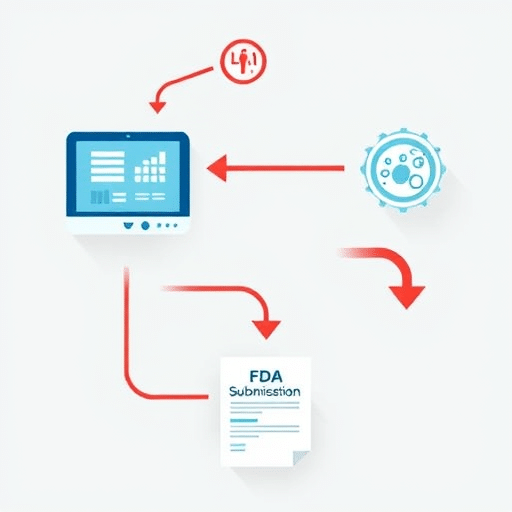
The most underestimated requirement is end-to-end traceability. Every datapoint in the clinical study report should be linkable, via a documented chain, to the raw sensor packet that produced it. This typically means retaining raw device output (not just derived endpoints), preserving transformation code in a version-controlled repository, and generating an audit trail that captures each pipeline run with timestamps and operator identifiers. CDISC standards are evolving to accommodate sensor data through the SDTM wearable and device subject domains, and sponsors that adopt them early report fewer review queries.
Operational Workflow: From Participant Consent to Submission Artifact
A practical workflow that has held up across multiple 2025 and 2026 submissions looks roughly like this:
- Consent and onboarding. Participants receive a provisioned device or install an app that gates access to consumer hardware. Onboarding collects baseline demographics and confirms eligibility.
- Continuous collection. Data flows from device to cloud through a validated ingestion API. Schema validation occurs at ingest, not after the fact.
- Daily quality monitoring. A study team dashboard flags participants with sub-threshold wear time so site coordinators can intervene before data loss compounds.
- Periodic interim locks. Rather than a single end-of-study lock, sponsors increasingly perform rolling data locks every quarter, with derived endpoints frozen against the lock.
- Final analysis and CSR assembly. The clinical study report appendix includes the data lineage diagram, the SAP, the device qualification summary, and a table mapping each derived endpoint to its source variables.
This structure mirrors what FDA reviewers expect when they open a submission. It also makes Type B and Type C pre-submission meetings more productive, because the agency can comment on a concrete pipeline rather than an abstract intent.
Common Pitfalls in Wearable RWE Submissions
A few pitfalls appear repeatedly in query letters and refuse-to-accept decisions. The first is post-hoc endpoint selection, where the derived endpoint chosen for the primary analysis was not specified in the protocol. The second is silent imputation, where missing data is filled using methods not described in the SAP. The third is device heterogeneity presented as if uniform: when participants used three different watch models, reviewers want that declared and analyzed as a covariate.
A subtler pitfall is the label drift problem. Device manufacturers occasionally update on-device algorithms between protocol finalization and study completion. The submission must disclose which firmware version produced which datapoints, and the impact assessment of any algorithm update belongs in the dossier.
What 2026 Reviewers Are Emphasizing
Recent Q&A transcripts and advisory comments suggest three reviewer priorities for the current cycle. First, representativeness of the wearable cohort: does the population that consents to wear devices resemble the indicated population, or is it skewed toward the digitally engaged? Second, burden and equity: are there provisions for participants without reliable smartphone access or home Wi-Fi, and how are they protected from being systematically excluded? Third, post-market surveillance continuity: if wearable data supported initial approval, the FDA wants a plan to continue the stream into phase 4, not a one-time submission artifact.
Sponsors that pre-emptively address these points in their cover letters tend to receive fewer information requests and faster determination letters.
Conclusion
Wearable-generated real-world evidence has moved from the periphery to the core of regulatory strategy for indications where continuous objective measurement adds value. The path from a wrist-worn sensor to a defended RWE claim is no longer theoretical; it is a documented sequence of validation, ingestion, transformation, and traceability steps that can be assembled into a reviewer-friendly package. Sponsors who invest in pipeline rigor, pre-specification, and transparent cohort characterization are finding that the FDA responds constructively, often requesting expansions of the program rather than fundamental rework. As wearable hardware continues to improve and digital endpoint libraries grow, the submissions of 2027 and beyond will likely look even more continuous, more standardized, and more deeply integrated into the evidence base that supports modern therapeutic claims.