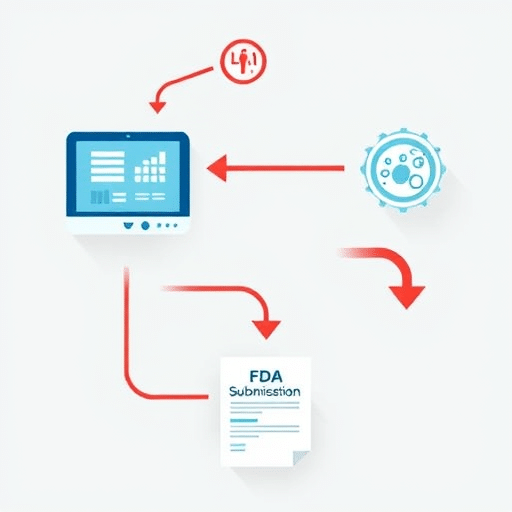
Before you pilot your AI in a live clinical setting, consider running a silent clinical trial with shadow-mode inference. This approach lets you gather real-world baselines without risking patients, giving your team the evidence needed to make confident go/no-go decisions. Instead of deploying AI that directly influences care, shadow mode runs the model in parallel, silently observing what would have happened while clinical teams operate exactly as they always have. The result is a clean, unbiased dataset that exposes your model’s true performance before it ever sees a live patient.
What Makes a Silent Clinical Trial Different?
A silent clinical trial is not a traditional prospective study. It is a form of observational evaluation where the AI system is active but inert. It receives the same inputs as human decision-makers, generates predictions or recommendations, and then stops. Those predictions are logged for analysis, but never displayed to clinicians or incorporated into any workflow. This is fundamentally different from a pilot, where the AI might trigger alerts, populate reports, or guide orders. In shadow mode, the AI is completely passive, acting as a silent observer in the back of the room.
This distinction matters because it changes the ethical and regulatory calculus. Without direct patient interaction, many of the risks associated with AI deployment—misdiagnosis, delayed care, unnecessary interventions—are virtually eliminated. You can test hundreds or thousands of cases with the same confidence you would have in a dry run, but with real clinical data. The silent clinical trial becomes a bridge between offline validation and full-scale piloting, filling the gap that so many AI projects stumble over.
Why Shadow-Mode Inference Solves the Baseline Problem
Every AI pilot faces the same awkward question: what do we compare against? Historical data is often incomplete, biased, or outdated. Concurrent controls are difficult to organize without disrupting care. And simply running the AI live without a baseline makes it nearly impossible to know whether observed outcomes are due to the model or to random variation. A silent clinical trial using shadow-mode inference answers this directly. Because the AI does nothing, the existing standard of care becomes the natural control. Every case has a pair: what the AI predicted and what actually happened.
That pairing is the foundation of a real-world baseline. You can measure accuracy, calibration, and clinical utility in the messy, unpredictable environment of actual practice—not a curated test set. For example, an AI that flags early sepsis might perform beautifully in simulation, but shadow mode reveals it fires false alarms in 40% of busy ED shifts. That insight is exactly what you need before you consider a pilot, and it only comes from observing real flows without interfering.
Designing Your Shadow-Mode Silent Trial
Setting up a successful shadow-mode run takes forethought. It is not enough to just wire the model to the data feed and wait. You need a structured plan that ensures the results are interpretable and actionable. Here are the core steps to build your silent trial.
1. Define Your Endpoints Before You Start
What does ‘success’ look like? Choose specific, measurable outcomes. This could be predictive accuracy, time-to-event detection, or concordance with final diagnoses. Avoid vague goals like ‘the AI seems useful.’ Write down your thresholds for sensitivity, specificity, and clinical congruence ahead of time so you do not move the goalposts once the data starts rolling in.
2. Insert the Shadow Mode at a Safe Junction
Find a point in the clinical workflow where the AI can observe inputs without causing any delay or alert. This is often at the level of the EHR, where orders, notes, and lab results can be streamed to the model in real time. Ensure that the AI writes only to a separate log file that no clinician ever encounters. The infrastructure must guarantee that shadow mode stays silent—even during a system update or partial failure.
3. Collect Rich Ground Truth
Your shadow predictions are only as good as the ground truth you compare them against. That means investing in structured outcome collection: discharge diagnoses, pathology results, 30-day readmissions, or whatever your clinical question demands. The more complete this data, the more convincing your baseline will be to skeptical reviewers.
4. Monitor Drift and Data Quality Continuously
A silent trial can run for weeks or months. During that time, patient populations shift, staff change, and documentation habits evolve. Keep an eye on input distributions and prediction stability. If the data quality degrades midway through, your baseline will be meaningless. Schedule regular checkpoints to review the logs and adjust nothing, but document everything.
Key Metrics to Track Without Intervening
Since you are not affecting patient care, your metrics should focus on model behavior and decision alignment. These measures tell you if the AI is ready for prime time.
- Prediction accuracy: How often does the AI’s top prediction match the final clinical outcome?
- Calibration: Do the AI’s confidence scores align with actual probabilities? A 70% prediction should be right about 70% of the time.
- Clinical actionability: If a clinician had seen the prediction, would it have changed management? Score a sample of cases manually to estimate this.
- False alarm rate: The number of high-priority alerts per hour or per day when compared to real events.
- Failure modes: Which patient subgroups consistently produce wrong predictions? This identifies bias early.
Each of these metrics can be computed from your shadow logs and the corresponding outcomes. Together, they form a comprehensive baseline report that goes far beyond simple ROC curves.
Common Pitfalls in Shadow-Mode Trials
Even with a sound design, silent clinical trials fail if you overlook certain traps. Knowing them in advance saves you weeks of wasted effort.
The AI Learns Non-Replicable Patterns
Shadow mode inherits biases from historical data. If your model learns heuristics like ‘this physician always orders tests, so predict sepsis,’ it will look great in shadow mode but fail when deployed. Check for reliance on proxy variables that have no causal link to outcomes.
You Confuse Inaction with Safety
Shadow mode is safe for patients, but not perfectly safe for your project. A silent model can still expose you to privacy risks if inputs include protected health information. Ensure your logging infrastructure encrypts all data and complies with HIPAA or GDPR from day one.
Overly Long Observation Windows
Waiting six months might give you a huge dataset, but the clinical environment will have shifted so much that your baseline is stale. Aim for a statisticall motivated sample size in a fixed time window—often four to eight weeks is enough for most use cases.
Ignoring the Human Factor
Your clinical staff might hear about the shadow trial and feel uneasy. Be transparent that the AI is not influencing care, but also explain that the data will eventually lead to a decision. Anxious staff will change their behavior, which biases your baseline. If needed, run the trial in a way that keeps the AI completely invisible to them.
Turning Your Silent Trial into a Launch Decision
Once your shadow-mode data collection is complete, your report should do more than summarize accuracy. Build a decision matrix that compares the AI’s predicted performance against your predefined thresholds. For example, if the AI meets your sensitivity target but has a high false alarm rate, that is a clear signal to invest in better tuning or more conservative alert thresholds before piloted. If calibration is poor, you know that clinicians cannot trust the confidence scores, so interface design becomes critical. The baseline is not just a pass/fail test; it is a roadmap for what to fix.
This is where a silent clinical trial becomes a strategic advantage. You are not waiting for a regulatory audit or a lucky breakthrough. You are actively generating the evidence that makes your pilot more likely to succeed, and you are doing it in the real world without jeopardizing a single patient. The next time yourteam debates whether to ‘just try it live,’ pull up the shadow-mode results and let the data argue for you.
Conclusion
Running a silent clinical trial with shadow-mode inference is one of the most effective ways to de-risk AI in healthcare. It gives you a legitimate real-world baseline, uncovers hidden failure modes, and creates the evidence needed to justify a pilot—all while leaving patient care completely untouched. By investing time in this observational phase, you transform an anxious leap of faith into a calculated step forward, one that respects both clinical rigor and patient safety.