Postcard views of Santorini’s blue domes and shimmering caldera don’t showcase the reality of reaching them. Hidden behind those iconic vistas are punishing, slippery, and seemingly endless staircases carved into the cliffside. For travelers staying at the island’s famous hillside hotels, the journey from the street-level drop-off point to the reception desk is a logistical gauntlet. Without a solid strategy, you face exorbitant porter fees, a herniated disc, or a dangerous tumble. This case study follows two travelers, Alex and Jamie, on a 5-day trip to Imerovigli in the 2026 season, and breaks down the exact Santorini stair survival packing tips they used to navigate the descent unscathed, armed with nothing more than lightweight carry-on duffels.
The Reality Check: 300 Steps and a 20kg Suitcase
Alex and Jamie booked a stunning cave hotel in Imerovigli. The listing boasted “panoramic caldera views” and “private plunge pool.” It failed to mention that the property was accessible only via a 300-meter descent of uneven, whitewashed stairs, some of which were steep enough to warrant a handrail, though many were not. After their taxi dropped them at the closest public road, a hotel porter appeared to quote the transfer fee: €20 per suitcase, per trip, for the two of them to be escorted down and up.
It’s a common surprise for unprepared tourists. Many Santorini hotels are entirely pedestrianized. There are no ramps, no elevators, and no baggage trolleys. The only way to get yourself and your belongings down is by human power. This is where packing light for Santorini hillside hotels ceases to be a vague minimalist ideal and becomes a hard financial and safety necessity.
The Stair-Safe Packing Formula: Repacking for Momentum
Instead of paying the porter fee (which would have been over €150 across the stay with arrival and departure trips), Alex and Jamie committed to the ultra-light method. Their strategy wasn’t just about saving money; it was about physics. A heavy suitcase shifts your center of gravity forward, dramatically increasing the risk of a forward fall on a steep descent. Their goal was to ensure that their center of gravity remained close to their core, allowing them to hold onto railings and brace themselves effectively. Here is the exact formula they used.
Choose the Right Carry-On: The “Transit” Duffel
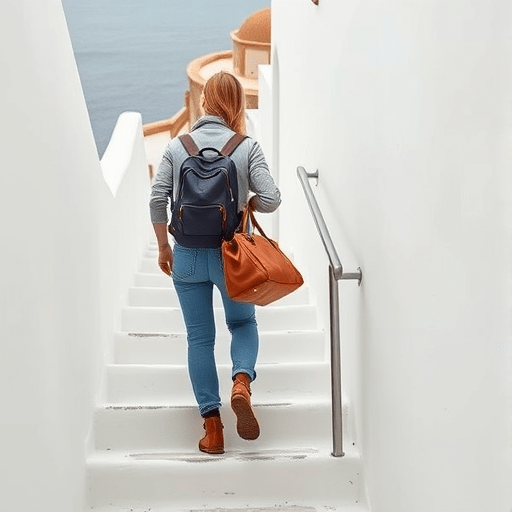
Hard-shell spinners, even small ones, are a liability in Santorini. The wheels are useless on stair edges and are prone to snapping in the gaps. Alex and Jamie chose 35L convertible duffel backpacks. These bags have stowable straps, so they look sleek and stylish when carried over the shoulder, but can be worn as a proper backpack to free up their hands for gripping the steel cable railings. The soft construction also makes them easier to hoist up high ledges when the steps suddenly turn into a narrow switchback.
The “5-4-3-2-1” Wardrobe Engineering
To fit a week’s worth of travel into a 35L bag, Alex and Jamie employed a regimented packing list: 5 tops, 4 bottoms, 3 pairs of socks, 2 pairs of shoes, and 1 swimsuit. They also limited themselves to a strict color palette of white, beige, and black. This eliminated the need to think about outfits and allowed them to mix and match everything. Jamie brought a pair of high-quality trail sandals that could transition from a day of walking on volcanic rock to a night out at a taverna, eliminating the need for heavy fashion footwear. Alex wore their heaviest pair of white sneakers onto the plane, leaving only a pair of thin ballet flats in the bag for dinners.
The “Santorini Tax”: What They Left Behind
Packing light for Santorini means being ruthless about the “what if” items. Alex initially wanted to bring a full-frame camera, a lightweight tripod, and a 15-inch laptop. These alone would have added 8kg of dead weight. Instead, they left the laptop at home, relying solely on their iPhone and a compact power bank. They left the tripod behind, using a small flexible GorillaPod for the one time they needed a stable sunset shot. They also left behind heavy denim jackets, buying a lightweight linen blazer in Fira for the cooler evening breeze. The rule was simple: if it wouldn’t fit inside a single small packing cube, it wasn’t coming.
The 2026 Logistics Hack: Bag Storage and Delivery Services
There is an emerging trend in 2026 that savvy travelers are using to bypass porter fees entirely: luggage transfer services. Rather than dragging bags onto the local KTEL bus or sweating down the caldera steps, companies like Santorini Transfer and local logistics startups now offer “bag-only drop-off” services. Alex and Jamie used a luggage delivery service that picked up their bags directly from the ferry terminal in Fira and delivered them to their hotel’s reception two hours later.
This streamlined their journey dramatically. They walked down the stairs to the hotel completely hands-free, boarded a catamaran cruise for the day, and checked into their room later that evening to find their bags already waiting for them. If you have more than 10kg per person, or if you simply don’t trust your balance on uneven marble, using a delivery service is the most prudent investment you can make.
How to Conquer the Climb Without Wiping Out
Even with a light 7kg bag, the descent into your hotel requires tactical awareness. The staircases in Oia and Imerovigli are shared between hotel guests, local mules (in some areas), porters carrying massive loads, and housekeeping staff. Do not walk two abreast. Stay glued to the right-hand side, closest to the cliff wall. Keep one hand free to hold the railing or brace against the wall. When encountering porters navigating the steps with trolleys carrying 50kg of linens, press your back flat against the wall and let them pass. Avoid the instinct to “hop” down the steps two at a time; a controlled, flat-footed step is safer on the highly polished, weathered marble that loses its grip when dry dust accumulates on it. Finally, take breaks. The journey takes twice as long as you think, so stopping to look at the views is encouraged—just step aside so you don’t become a tripping hazard for the mules.
The Payoff: An Unencumbered Aegean Stay
By the time Alex and Jamie actually made it to their cave hotel terrace, they had not broken a sweat, damaged a wheel, or paid a single euro in porter fees. Their entire relocation strategy—from the ferry port to the deep cliffside—took under thirty minutes. The absence of heavy luggage turned the potentially stressful hike into a scenic introduction to the caldera. They arrived at the plunge pool with enough energy to swim, rather than collapsed on a lounger with strained shoulders. By embracing the constraints of the environment and packing deliberately, they transformed the most notorious obstacle in Greek travel into an opportunity.
The secret to Santorini is not to fight the stairs, but to outsmart them. Forget bringing everything but the kitchen sink. In the Cyclades, your best travel companion isn’t a rolling suitcase—it’s a deeply edited, carefully curated, and ruthlessly organized backpack.