Tired of shuffling behind a wall of audio-guide listeners and waiting ten minutes to see a single canvas? The trick that savvy visitors swear by is deceptively simple: read the floorplan backwards to beat museum crowds. Instead of joining the herd at the grand entrance and following the numbered rooms clockwise, you start at the exit gallery, walk against the flow, and watch the crowd evaporate. In 2026, when record-high visitation and timed entry systems are the norm, this reverse-traffic strategy has become the single most effective way to enjoy world-class art in near solitude.
Why the Traditional Museum Route Creates a Human Glacier
Most museums are designed with a narrative in mind. The curators place their marquee works at points of maximum emotional impact, which typically means the opening galleries and the climactic final hall. A standard floorplan pushes visitors in one smooth, serpentine path. That path works fine for crowd flow in theory — but not when thousands of people all arrive at the same opening hour. Because everyone enters at the same point and moves the same direction, you get a slow-moving block of humanity that compresses and expands unpredictably.
The result is the classic museum experience: you constantly catch up to the same families, the same tour groups, and the same couples taking endless photos. You see the backs of heads more than the art itself. The problem isn’t the art; it’s the geometry of the traffic pattern. When every visitor is a drop of water in the same current, the galleries become a river that you cannot step out of without swimming upstream.
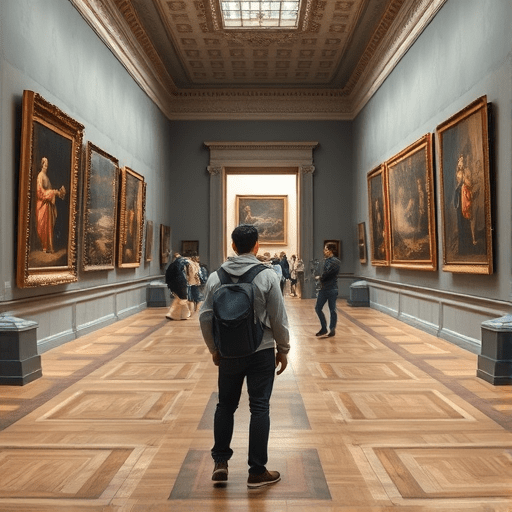
By reversing the flow, you become that upstream swimmer. The crowd ahead of you is not in front of you — it’s behind, moving away. The rooms you enter have just been vacated. The benches are free. The light is the same. The paintings are the same, but your perspective changes from craning to calm.
The Reverse-Entry Method: How It Works
The strategy is not about sneaking into exits or skipping galleries. It’s purely about spatial intelligence. You are not avoiding the content; you are simply reordering your path through it to match the way crowds actually dissipate. Early in the day, the entrance is packed, but the exit gallery is often empty. Midday, the middle galleries fill up while latecomers still trickle in from the start. Late afternoon, the end of the path is crowded with visitors trying to finish before closing. By starting at the end, you hit each section at its quietest moment.
Step 1: Study the Floorplan Before You Arrive
Do this at home, not at the ticket counter. Open the museum’s website and download the PDF floorplan. Look for the arrowed line that suggests a path. Also note any one-way sections, permanent vs. special exhibition spaces, and the location of the main exit. You want to identify the museum’s final gallery — the one that the standard path ends with. That is your starting point. On many museum websites, this is clearly marked as “exit” or “final gallery” in the wayfinding map. If you can’t find a static plan, use their app or interactive map to see the sequence of rooms.
Step 2: Enter Through the Gift Shop? No, Exit Through the Gallery
Enter the museum normally — you still need a ticket and a security check. But once you’re past the welcome area, walk directly to the far end of the museum, passing the first few galleries without stopping. You’re not rushing; you’re strategically repositioning. If the exit gallery is on a different floor, take the elevator or stairs first. This initial walk feels counterintuitive, but it takes less than five minutes in most museums. On your way, you’ll pass all the crowds currently jam-packed in the early rooms. Smile at them. They’ll never know the secret.
Step 3: Walk Against the Arrow
Once you’re standing in the museum’s final gallery, pause. Absorb the grandeur without a single person in your sightline. Then begin your reverse walk. When you leave that gallery and enter the next one, you’ll see the oncoming flow of normal visitors. Step aside politely, let them pass, and continue into the room they just left. That room is your empty reward. Because you are moving counter to the prescribed direction, you’re always entering a space that the crowd has already thinned out of. You get the classic “just us in the gallery” feeling that most people only experience at private previews.
What to Do When the Exit Gallery Is Locked or Pay-Walled
Not every museum makes the reverse route easy. Some institutions have security staff blocking you from entering the final gallery early because they use it as an exit only. Others put the main special exhibition at the end, requiring a separate ticket. You have two workarounds. First, look for a staircase that bypasses the main sequence. Most large museums have multiple stairways and elevators, and they don’t all enforce one-way pedestrian traffic. Second, if the very last gallery is an exhibition upcharge, start your reverse walk at the last free-access gallery instead. You lose one room, but you still gain the temporal advantage.
Another rare obstacle is museums with actual one-way routes, such as the Vatican Museums or certain ancient heritage sites. In those places, going backward is physically blocked by turnstiles or guards. The reverse method won’t work there — but you can still employ a time-based version. Such venues have peak crowd windows, usually mid-morning. By arriving either 30 minutes before closing or immediately at opening, you create a similar effect. For the majority of public museums in the U.S. and Europe, the floorplan is advisory, not mandatory. That lack of enforcement is exactly what makes this trick so reliable.
Pairing Reverse Routing with Modern Museum Tech
In 2026, museum apps and digital guides are more sophisticated than ever, and they can supercharge your backward approach. Many institutions now offer real-time occupancy maps showing which rooms are busiest. Use these apps to confirm that the exit gallery is indeed quiet before you start your reverse walk. Some museums also release timed-entry data through their website, letting you estimate the morning crowd surge. Combine that data with the reverse-floorplan method and you get a near-perfect visit.
Another tip is to align your visit with lunch hours. Between 12:30 and 1:45 p.m., many museum-goers head to cafés or leave the building entirely. Your reversed path naturally places you in the rooms that are emptying out during that window. In an elegant way, you’re always at the right place at the right time. The result is a museum tour that feels almost choreographed: grand halls empty, benches free, and your attention fixed entirely on the work in front of you.
Does It Work for Every Museum? Exceptions and Caveats
Reverse routing works best in large encyclopedic museums with a clear sequential layout, such as the Met, the Louvre, or the Art Institute of Chicago. It works less well in small galleries with only two or three rooms, because there’s no meaningful “path” to reverse. It also loses some power in museums that use a central-hub design, where all rooms radiate from a main atrium. In those spaces, crowds tend to concentrate at the center, so your alternative route should start from the quietest wing, not the exit of a sequence. Study the floorplan and ask yourself: “What direction do most people rotate?” Then go the other way.
One more caveat: if you’re visiting a temporary exhibition, the reverse method rarely applies because you must enter through the designated entrance. But you can reverse your route between exhibitions. Start with the second special exhibition you want to see, then back into the first. The turnstile attendants rarely care about the order in which you visit, only that you have a ticket.
Finally, remember that the best time to reverse is during the first and last hour of opening. If you arrive at 9:30 a.m., the entrance galleries are already shoulder-to-shoulder, but the exit gallery remains tourist-free. That gap widens as the morning progresses. By the time you work your way back to the entrance, that original crowd has moved forward — leaving the spaces behind them clear. It’s a beautiful, self-perpetuating cycle of success.
Why the Backward Strategy Feels Like a Secret in Broad Daylight
Most museum visitors never think to deviate from the numbered path. They follow the arrows like obedient pieces in a board game. But the floorplan is a suggestion, not a law. Reading it backward is not disrespectful to the curatorial intent; it still lets you see every single work in the intended order — just from the opposite direction. In fact, some art historians argue that reverse visits offer a fresh narrative perspective, making you notice connections between early and late works that you usually miss. The visual arc of a collection sometimes hits harder when you feel it backwards, from resolution to introduction.
In 2026, museums are crowded and only getting more so. New immersive exhibitions, blockbuster loans, and global tourism all push to the same gallery at the same time. You cannot control those forces, but you can control your route. By reading the floorplan backwards to beat museum crowds, you transform the most stressful part of the cultural experience — the crush — into a calm, deliberate stroll. You get empty rooms, uninterrupted views, and the rare luxury of thinking about what you’re actually seeing.
Conclusion
Museum-going should be about the art, not the crowd. The reverse-floorplan method gives you an edge that costs nothing and requires no special membership. Before your next visit, pull up the map, find the exit gallery, and plan to start there. Walk against the current. Let the herd move ahead of you, and enjoy the quiet that they leave behind. Reading the floorplan backwards is not a hack to see everything faster — it’s a way to see everything better, with the space to pause, breathe, and truly look.