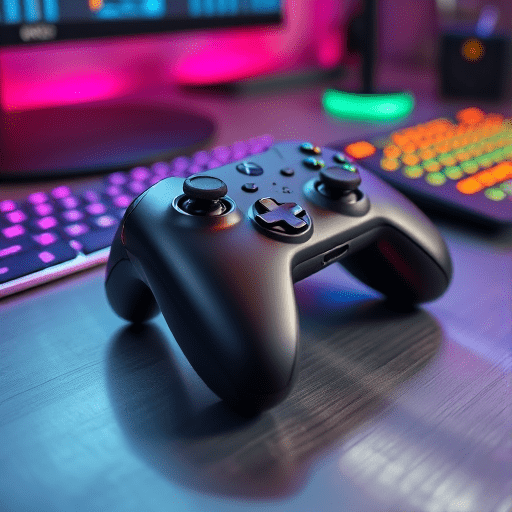
Competitive gamers have long accepted that peak performance requires two hands, a tight grip, and hours of repetitive strain. But a growing wave of players — from esports athletes recovering from injury to streamers with adaptive needs and casual competitors who simply prefer a lighter setup — is proving that ergonomic one-handed controller design can deliver competitive-grade precision without sacrificing reaction time or accuracy. In 2026, hardware designers are finally treating single-handed play as a serious engineering challenge, not a niche workaround.
Why One-Handed Control Is the Next Frontier in Esports Hardware
The conversation around inclusive gaming has matured. What started as a movement for accessibility has evolved into a demand for performance. Players want devices that match their physiology, not the other way around. According to recent industry surveys, nearly 30% of competitive PC and console players report wrist, thumb, or forearm discomfort linked to standard controller layouts. That is not a fringe statistic — it represents a massive segment of the player base looking for better tools.
Forward-thinking manufacturers are responding by treating one-handed layouts as a design constraint that forces innovation. Smaller form factors, repositioned thumbsticks, remapped trigger geometry, and modular grips are no longer experimental. They are arriving as flagship products aimed at players who refuse to choose between comfort and competition.
The Core Engineering Trade-Offs
Designing a controller for one-handed competitive play is an exercise in compromise management. Engineers must balance reach, actuation force, latency, and tactile feedback while keeping the device light enough for marathon sessions. Here are the four trade-offs that define the category.
1. Reach and Thumb Travel Distance
A standard controller spreads inputs across both thumbs. Collapse that into one hand and the thumb has to cover roughly 60% more surface area. Designers solve this with contoured key clusters that arc inward toward the natural pivot point of the thumb. The result is a layout where every essential action sits within a 45-degree sweep, reducing micro-movements that slow down flick shots and combo inputs.
2. Trigger and Bumper Access
For shooter and fighting game fans, trigger access is non-negotiable. The latest single-handed designs use paddle-style back buttons or rear-mounted switches that fall naturally under the index and middle fingers. This frees the thumb for aiming while preserving instant-trigger response times under 5 milliseconds.
3. Weight Distribution and Fatigue
A controller that is even 30 grams heavier than its two-handed counterpart can cause noticeable fatigue over a four-hour ranked session. Modern one-handed models target a sub-180-gram weight class by using magnesium alloy frames and hollow-core thumbsticks. Internal counterweights are tuned so the center of gravity sits directly under the palm.
4. Latency and Input Polling
Competitive integrity depends on input speed. The best 2026-era one-handed controllers ship with 1000 Hz wireless polling, hardware-level macro processing, and direct-to-PC dongles that bypass Bluetooth stack overhead. None of these features can be optional for serious players.
Layout Innovations Worth Studying
Several layout philosophies have emerged as genuine contenders for the competitive one-handed market. Each takes a different bet on what single-handed play should feel like.
The Cluster Concept
Inspired by arcade fight sticks, the cluster approach groups face buttons into a tight diamond around a central analog stick. This minimizes thumb travel between movement and action inputs, which is critical for games that demand rapid direction changes. Players coming from traditional pads often need a short adjustment period, but most report faster execution of advanced combos within a week.
The Horizontal Split
Some designers are experimenting with wide, low-profile controllers that look closer to a computer mouse than a gamepad. Face buttons line up in a row in front of the thumb, while secondary inputs sit under the fingers. This layout excels in MOBAs and strategy titles where hotkey access matters more than analog precision.
The Modular Hybrid
Perhaps the most ambitious approach is the modular hybrid, a controller base that accepts swappable top plates. Players can configure a one-handed layout for a tournament, then snap on a second grip module for casual co-op sessions. For traveling competitors, this versatility reduces the number of devices they need to pack.
Software and Firmware: The Hidden Equalizer
Hardware is only half of the competitive equation. Sophisticated onboard software now lets players tune dead zones, adjust analog stick curves, and remap inputs at the firmware level rather than relying on in-game options. This is especially valuable for one-handed setups where the natural mapping of inputs differs from a traditional pad.
Profiles for popular competitive titles are increasingly community-shared. A player who finds the ideal thumb sensitivity for Valorant or Marvel Rivals can export that profile and load it on a teammate’s identical controller in seconds. This kind of cross-device consistency is reshaping how esports teams approach peripheral standards.
What Adaptive Esports Teaches Mainstream Design
Perhaps the most important lesson from the one-handed controller boom is that adaptive design benefits every player, not just those who require it. Adjustable trigger stops, swappable stick caps, and removable grips were once considered accessibility features. Today they appear on flagship controllers from major brands because competitive players discovered that customization wins matches.
The line between accessibility and competitive edge has effectively dissolved. A player with a smaller hand grip benefits from the same adjustable palm rest that helps a player with carpal tunnel syndrome. A paddle button that assists a one-handed player also speeds up reload inputs for a two-handed player who adds it to their rear.
The Road Ahead for One-Handed Competitive Gear
Looking past the current generation, expect to see haptic feedback modules calibrated specifically for one-handed grips, optical switches rated for 100 million actuations, and even AI-assisted layout suggestion tools that recommend button maps based on a player’s recorded input history. Cloud-synced firmware updates will keep older controllers competitive with newer titles, reducing electronic waste and rewarding long-term investment.
Major esports organizations are beginning to sponsor adaptive players who use one-handed controllers, which will accelerate mainstream acceptance and push development budgets higher. The market is small today but growing at double-digit rates annually.
Conclusion
One-handed controller design has moved beyond accessibility into a legitimate branch of competitive hardware engineering. By focusing on reach geometry, weight reduction, sub-5 ms input latency, and modular customization, designers are proving that single-handed play can match or exceed the precision of traditional gamepads. For competitive gamers in 2026, the question is no longer whether a one-handed controller can keep up — it is which one matches your playstyle and physiology best. The future of competitive peripherals is inclusive by default, and that future is arriving faster than most players expected.