For decades, consoles held a quiet edge over PCs in raw gaming performance per dollar. In 2026, that edge is quietly eroding — not because consoles got slower, but because the memory bandwidth wars reshaping modern GPUs have left fixed hardware at a disadvantage. With GDDR7 graphics memory and increasingly capable unified memory architectures, high-end PCs now offer bandwidth levels that simply cannot be matched by current-generation consoles. Here is what is really going on under the hood, and why it matters for the games you play.
The Hidden Bottleneck: Why Bandwidth Matters More Than You Think
Most gamers obsess over TFLOPS, core counts, and clock speeds. Yet the single most common reason a graphics card or console GPU feels underpowered is not shader throughput — it is memory bandwidth. Every frame, every texture, every lighting calculation must move data between the processor and memory. If the pipe is too narrow, the GPU stalls.
Think of memory bandwidth like a highway. You can have the fastest cars in the world, but if the highway has only two lanes, traffic grinds to a halt. Memory bandwidth is that highway, and modern games are getting wider and wider trucks.
- Open-world games now stream massive amounts of geometry and texture data every frame.
- Ray tracing demands repeated sampling of scene and BVH (bounding volume hierarchy) data.
- AI-driven upscaling and frame generation read and write huge buffers every millisecond.
GDDR7: The New Performance Baseline for Graphics Cards
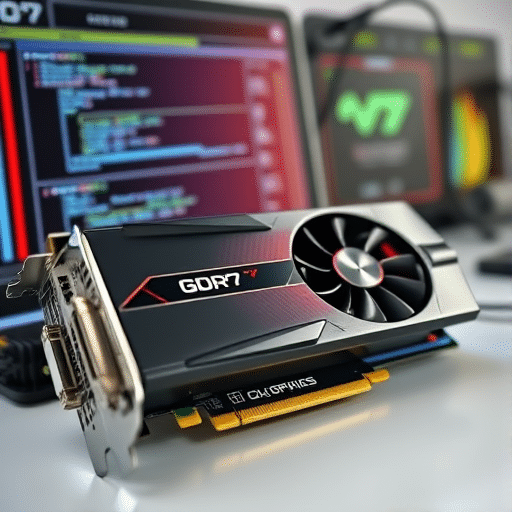
The arrival of GDDR7 in 2025 and its rapid adoption through 2026 has fundamentally shifted what is possible on a desktop GPU. Compared to GDDR6X, GDDR7 offers higher per-module bandwidth, improved signal integrity, and far better power efficiency at speed. That last point matters: GPUs can now run memory at extremely high clocks without melting through their power budget.
In practical terms, flagship PC GPUs in 2026 commonly ship with effective memory bandwidth north of 1.5 TB/s — and in some cases pushing past 2 TB/s. That is a number that would have sounded absurd just a few years ago.
What This Means for Real-World Games
High bandwidth unlocks three things that directly affect what you see on screen:
- Higher native resolutions: 4K and even 8K gaming become achievable without aggressive upscaling.
- Richer ray tracing: More rays per pixel, more dynamic bounces, and more responsive global illumination.
- Faster streaming of open worlds: Less pop-in, more environmental detail, smoother traversal in massive sandboxes.
Unified Memory: The PC’s Secret Weapon
While GDDR7 dominates traditional discrete GPUs, unified memory is the architecture quietly redefining what is possible across the entire PC stack. Modern CPUs and GPUs increasingly share a single, coherent memory pool — much like a console SoC — but with the bandwidth, capacity, and flexibility of a desktop platform.
Unified memory designs in 2026 offer several key advantages:
- Elimination of redundant data copies between system RAM and video memory.
- Larger effective framebuffers, because the system can borrow from system memory as needed.
- Faster asset streaming, since CPU and GPU access the same memory without bus translation penalties.
For tasks like path tracing, neural rendering, and physics simulations that lean heavily on tight CPU–GPU cooperation, unified memory architectures can outperform even raw bandwidth advantages in some scenarios.
Why Consoles Are Stuck in the Slow Lane
Console makers optimize brilliantly for a fixed target, but the laws of physics still apply. A console locked into a specific memory configuration in 2020 or 2021 cannot magically gain bandwidth five years later. Current-generation consoles typically feature memory bandwidth in the range of 500–700 GB/s — impressive at launch, but modest compared to what a $700 graphics card delivers today.
This gap shows up in subtle but visible ways:
- Console versions of cross-platform games often run at lower internal resolutions.
- Ray tracing effects are dimmer, less reflective, or disabled in busy scenes.
- AI-driven features like advanced upscaling arrive later — and at lower quality — on consoles.
The Refresh Problem
Console refreshes used to feel generational leaps. Now, mid-cycle refreshes offer modest GPU bumps, but memory bandwidth improvements are incremental at best. Because console economics depend on long production runs and stable supply chains, manufacturers rarely overhaul memory subsystems mid-generation. The result is a growing capability gap that PC hardware widens every quarter.
Cross-Platform Performance: What Developers Are Quietly Doing
Game developers face an interesting dilemma. They must ship one codebase that runs on consoles, mid-range PCs, and flagship PCs. In 2026, expect to see:
- Asset LODs (levels of detail) tuned higher for PCs, with more geometry, textures, and effects enabled when bandwidth allows.
- Optional path tracing modes exclusive to high-bandwidth hardware.
- Dynamic resolution scaling that targets different memory ceilings on each platform.
These techniques keep parity in broad strokes, but the top-end PC experience increasingly resembles a different game entirely.
The Real-World Impact on Gamers
If you are considering whether to invest in a new console or upgrade your PC this year, bandwidth should be part of the conversation. Here is what the gap looks like in practice:
- A flagship PC GPU in 2026 can move roughly 2–3x the data per frame compared to a current-generation console.
- That advantage compounds in games with heavy ray tracing or open-world streaming.
- AI-driven rendering features lean heavily on bandwidth, often giving PCs a disproportionate edge in features beyond raw resolution.
This does not mean consoles are bad — they remain excellent value and offer stable, curated experiences. But the perception of consoles being “just as powerful” as a high-end PC is increasingly a myth held over from an earlier era.
Looking Ahead: The Next Bandwidth Frontier
The memory bandwidth race is not slowing down. Beyond GDDR7, expect early talk of GDDR7+, stacked memory solutions, and further integration of unified memory in mainstream desktop platforms. Each leap extends the lead PCs hold over fixed-hardware consoles, especially as games lean more heavily on real-time lighting, neural rendering, and massive streaming worlds.
The next console generation will almost certainly close part of this gap with bold memory choices. Until then, the bandwidth wars are firmly a PC story — and one every cross-platform gamer should understand.
Memory bandwidth has quietly become the single biggest differentiator between platforms. What looks like a modest spec sheet upgrade often translates into dramatically better visuals, smoother performance, and access to features consoles simply cannot run at full fidelity. As cross-platform games grow in scope and ambition, that gap will only become harder to ignore.