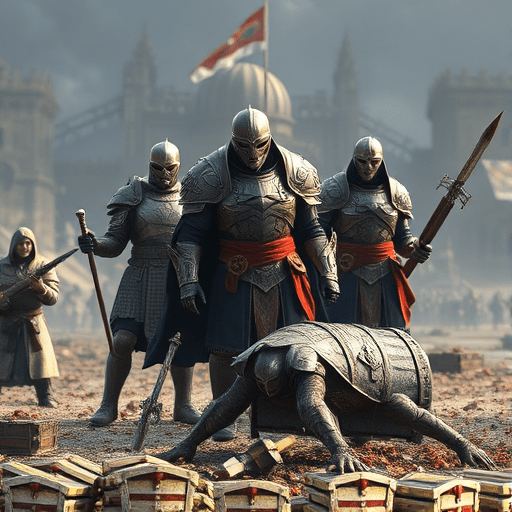
The matchup was lopsided on paper. One side had maxed-out gear, every premium consumable, and a treasury backed by thousands of dollars in real-world purchases. The other side — a scrappy no-spend guild — entered the warzone with zero cash investment, players still holding blue-grade weapons, and a reputation as underdogs. Yet when the siege ended, the wallet-warrior team had been wiped out, their stronghold shattered, and their leader sitting in global chat — incredulous. This isn’t a fantasy. It’s a blueprint for how any disciplined group can win a PvP MMO without spending a single cent.
The win didn’t come from out-gearing anyone. It came from a simple truth that many cash-rich teams overlook: in a competitive MMO, resources extend beyond gold and gear. Time, knowledge, coordination, and even annoyance are all currencies. By applying real-world tactics from fields like asymmetric warfare, behavioral economics, and supply-chain management, this no-spend guild turned a whale-powered juggernaut into a disorganized mess. Here’s how they did it, and how you can too.
The Anatomy of a Wallet-Warrior: Why Money Isn’t a Win Button
Wallet-warriors, or “whales,” typically rely on the same assumption: that winning is purely a function of statistical power. They spend to skip grind, unlock legendary loot boxes, and dominate auctions. What they often miss is that most MMOs are designed with catch-up mechanics and soft caps. Every wild swing in damage still misses the target if the attacker is disabled, blinded, or simply out of position. More importantly, high spending often breeds overconfidence, leading to predictable patterns — siege at the same time, stack on the same flag, push through the same choke point.
This creates an opening. A no-spend guild doesn’t need to match firepower; it needs to create situations where that firepower is ineffective. That requires a shift in mindset. Instead of asking “how do we deal more damage?” the winning question becomes “how do we make their damage irrelevant?”
Five Real-World Tactics That Turned the Tide
Rather than a single brilliant move, the guild used a combination of five tactics. Each tactic is borrowed from a domain outside gaming, but all translate naturally to the virtual battlefield.
Tactic 1: Asymmetric Engagement — Strike Where They’re Weak
In asymmetric warfare, the weaker force avoids frontal attacks and targets the enemy’s vulnerabilities. For the no-spend guild, that meant never meeting the wallet-warriors in a straight-up fight. They studied the enemy’s schedule (more on that later) and found that the whales often left one or two overextended players farming rare materials. Groups of five no-spend players would collapse on those isolated targets, score kills, and vanish before reinforcements arrived. Each kill gave the guild crafting drops and shrunk the enemy’s morale. Over time, the wallet-warriors grew paranoid and started grouping even for simple resource nodes, which slowed their entire operation.
Tactic 2: Economy Warfare — Control the Market, Not the DPS Meter
Whales can buy in-game gold, but they can’t buy what isn’t on the auction house. The no-spend guild invested their limited gold into a different kind of raid: a market raid. They focused on critical consumables — health potions, repair kits, and buff food — and bought out cheap listings from their server. Then they relisted at deliberately low prices to undercut any whale who tried to stockpile, creating a price spiral that made it financially cumbersome for the enemy to sustain a long campaign. The guild also cornered the market on a rare alchemy ingredient, forcing the wallet-warriors to either overpay or go without a key raid buff. By the final siege, the enemy team entered the fight missing 20% of their effective stats, while the no-spend guild had fully stocked its own banks at a fraction of the cost.
Tactic 3: Information Overload — Turn Scouting Into a Weapon
The wallet-warrior team had a dedicated guild page with voice chat, but they treated information as a luxury. The no-spend guild treated it as a weapon. They placed volunteer scouts in enemy guilds using alt characters, tracked every raid time, and recorded which players switched regions at peak hours. That data allowed them to predict where the enemy would strike next — and more importantly, where they wouldn’t. During the decisive battle, the no-spend guild actually sent fake raid announcements in global chat, leading a portion of the whale team to defend a decoy objective while the real assault hit their undefended supply lines. The wallet-warriors fell for it because they never bothered to verify. Their communication was top-down and rigid; the no-spend guild used whisper network tools and shared map markers to stay nimble.
Tactic 4: Time-Zone Advantage — Turn Real-World Geography into a Buff
Many wallet-warriors are serial players who log in for a few hours after work. The no-spend guild, by contrast, had members spread across every major time zone. Instead of fighting for a single peak-time window, they operated in shifts. A small 5-man crew could harass enemy resource runners at 3 AM. Another crew could siege an outpost at 11 AM when most of the whales were still at work. The wallet-warriors couldn’t hold every objective 24 hours a day, and their expensive gear was useless when no one was online to wield it. The no-spend guild rotated responsibilities, shared a real-world schedule via a simple spreadsheet, and used in-game mail to coordinate handoffs. Over the course of a week, they bled the enemy dry of territory and stamina.
Tactic 5: Morale and Psychology — Demoralize the Spenders
Perhaps the most underrated tactic is psychological warfare. Spending money creates a sense of sunk cost; a whale who loses after paying for victory feels twice the sting. The no-spend guild exploited this with a simple rule: never trash-talk in global, but always let the screenshots speak. After each successful ambush, they posted a short clip with a neutral caption like “Nice try.” They also targeted the whale team’s weak links — players who were clearly carried by gear but lacked skill. By singling out those individuals in encounters, the guild made them look foolish in front of their own team. In a matter of days, blame and infighting started to boil over. The wallet-warriors began arguing over who was “worth” their expensive consumables, and their leader lost authority. By the time the final battle arrived, half the enemy team wasn’t even showing up.
Scaling the Strategy: How Any No-Spend Guild Can Apply These Lessons
These tactics aren’t limited to a single server or game. The key takeaway is that spending money buys power, but it doesn’t buy strategy. Any guild with a handful of active players can win a PvP MMO without spending a cent by following three principles.
- Know your enemy better than they know themselves. Use alts, logs, and open-source tools to map their weaknesses. Attack their time zones and their overextended members.
- Make your economy work for you. Even a modest amount of in-game gold can be leveraged to disrupt a whale’s supply chain. Cornering a niche market is often easier than trading in bulk.
- Treat real-world psychology as part of the meta. Sunk cost, ego, and impatience are all exploitables. Force the enemy to spend extra time, not just extra money.
One more lesson from the battle: the no-spend guild didn’t try to become the richest team. They became the most resilient. They adapted their plans based on real-time data, communicated without egos, and never gave up even when a fight looked hopeless. That resilience is harder to buy than any skin or mount.
In the end, the wallet-warrior team’s defeat wasn’t a glitch or a lucky roll. It was the inevitable result when thousands of dollars meet a few hundred hours of smart, coordinated effort. The next time you see a whale strutting through town, remember: they might have the best gear, but you can have the better plan.