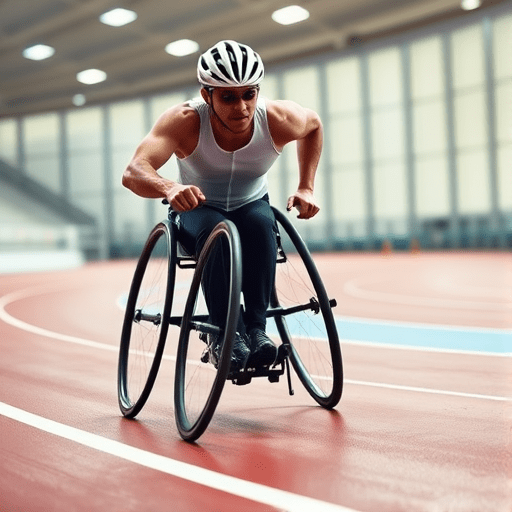
In a Stockholm training facility last month, a former rugby player who lost mobility from the neck down navigated a sprint course in under eleven seconds using nothing more than intention. The technology behind that run, a non-invasive neural-interface wheelchair system, is rapidly reshaping what’s possible in adaptive sports. For quadriplegic athletes, the barrier between thought and motion has never been thinner, and the competitive landscape is shifting in real time.
From Lab Prototype to Race Track in Under Three Years
What makes this moment different from previous attempts at brain-controlled mobility is the convergence of dry-electrode EEG arrays, on-device machine learning, and purpose-built wheelchair chassis. Earlier prototypes required wet electrodes, tethered laptops, and a clinical setting. The current generation slips onto an athlete’s scalp like a flexible cap, pairs with a wheelchair via low-latency Bluetooth, and runs inference locally on a chip smaller than a credit card.
Training an athlete to use the system still takes weeks, not minutes. The model has to learn the specific neural signature of that person’s “move forward” intention versus “turn left” versus “stop.” But once calibrated, response times have dropped from the multi-second delays of 2022-era systems to around 130 milliseconds, fast enough to react to a defender or a course gate.
How Thought Becomes a Turn Signal
The pipeline is conceptually simple, even if the underlying engineering is not. Sensors on the scalp pick up electrical activity from the motor cortex. A small onboard processor filters out noise, extracts relevant features, and feeds them into a classifier trained on the individual user’s neural patterns. The classifier output maps to wheelchair commands through a translation layer that accounts for safety, smoothness, and battery draw.
Three technical advances made this leap possible:
- Dry electrode arrays that maintain signal quality without conductive gel, allowing quick setup before a match
- Personalized on-device models that keep biometric data local and reduce calibration drift during a long competition day
- Predictive intent decoding that anticipates the next command rather than waiting for a full motor signal to complete
Athletes describe the experience as “thinking with a tail.” The chair feels like an extension of intention rather than a tool being operated.
Adaptive Sports Are Becoming the Proving Ground
Adaptive sports have long served as a forcing function for assistive technology. Wheelchair racing, powerchair football, and quad rugby all demand reliability under stress that a hospital or home environment never quite replicates. The new generation of organizers is leaning into that reputation.
The International Paralympic Committee now recognizes several neural-interface wheelchair demonstration events, and national federations from Japan, Brazil, and Germany have begun staging exhibition matches. These aren’t novelty showcases. They use regulation courses, official timing systems, and the same anti-doping infrastructure as conventional adaptive events. The standard for fairness is just as strict.
For athletes, the appeal is obvious. Many quadriplegic competitors rely on sip-and-puff switches, chin-controlled joysticks, or attendant-pushed chairs. Each of those interfaces demands a physical capability the sport itself doesn’t test. Neural-interface wheelchairs level that requirement, making competition about tactics, endurance, and skill rather than which assistive device an athlete happens to have access to.
The Engineering Challenges That Remain
No one involved calls the technology finished. Sweat, helmet impact, and electromagnetic interference from stadium lighting can all degrade signal quality mid-event. Developers are working on hybrid systems that fall back to a secondary input method, such as a subtle head movement or a sip sensor, if the neural signal becomes unreliable. Others are experimenting with implantable arrays that promise cleaner data but bring their own regulatory and ethical weight.
Battery life is another constraint. A full competitive day can run eight hours, and current systems consume meaningful power running inference continuously. Newer neuromorphic chips, which process spikes of data only when relevant rather than scanning continuously, are being tested as a path to all-day operation.
What This Means for the Broader Adaptive Tech Market
The competitive sports angle is also driving a quieter revolution in everyday mobility devices. Several of the component advances, including the dry electrodes, the personalization approach, and the safety translation layer, are already filtering down to consumer-grade wheelchair controllers. A startup in Eindhoven recently demonstrated a neural-interface add-on that lets users navigate a standard powered wheelchair through a grocery store without touching a joystick.
This is the pattern assistive technology has followed for decades. Racing improves safety equipment, which improves consumer cars, which improves safety equipment again. Neural-interface wheelchairs are simply the newest entrant in that feedback loop.
Athletes Are Setting the Pace, Not Waiting for It
Perhaps the most striking shift is who is driving the development. Five years ago, the leading neural-interface wheelchair projects were housed in academic medical centers and pulled athletes in as research participants. Today, several professional quadriplegic competitors hold equity in the companies building their equipment, sit on product advisory boards, and run their own training labs.
One wheelchair rugby captain, who tested an early prototype in 2023 and now competes with a production unit, described the change bluntly: “We used to wait for engineers to decide what was possible. Now we tell them what we need on Tuesday, and we race with it on Saturday.” That compression of the feedback loop is showing up in iteration speed. Software updates that once shipped annually now arrive mid-season.
What to Watch in the Next Eighteen Months
Three developments will determine whether neural-interface wheelchairs move from exhibition sport to fully sanctioned competitive category. First, the international federations need standardized rules around equipment certification, including which electrode placements are legal and what latency thresholds disqualify a chair. Second, insurance and accessibility frameworks outside elite sport have to catch up so that everyday users can obtain the same hardware. Third, the open question of whether implantable systems will be permitted in competition is still unresolved.
What is no longer in question is whether the technology works. The athletes have answered that on the track, on the court, and in front of a growing global audience.
The Course Ahead
Neural-interface wheelchair technology has crossed the line from research curiosity to competitive reality in a remarkably short window. Quadriplegic athletes, long constrained by interfaces that asked their bodies to do work their conditions did not permit, now steer, sprint, and strategize with intention alone. The sport is still young, the rules still being written, and the hardware still improving month by month. What is clear is that the athletes using these systems are not waiting for the future of adaptive competition. They are racing it into the present, one thought at a time.