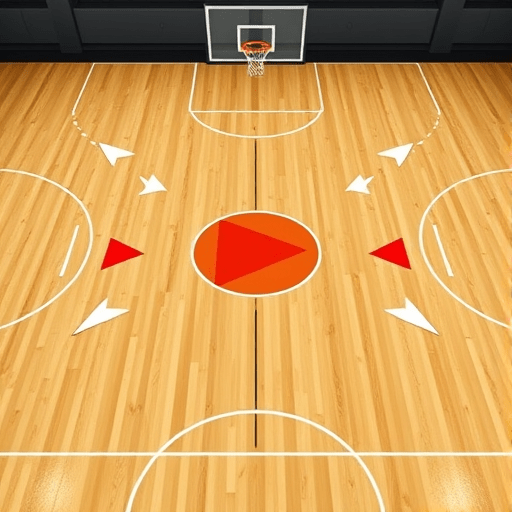
Across the NBA in 2025-26, a quiet revolution is unfolding in transition offense. Coaches from Miami to Sacramento have begun importing ideas that look less like basketball and more like Pep Guardiola’s positional play, Thomas Tuchel’s build-up patterns, or even Johan Cruyff’s old Ajax principles. The specific thing they are importing is press-resistance: the structured, geometry-based methods European football clubs use to bypass a high press. When you watch the Miami Heat jog the ball across half court against a trapping defense this season, the shapes you see forming around the inbounder look eerily like a four-versus-three build-up against a Stuttgart mid-block. What is happening, and why now?
The Trapping Boom That Forced a Counter-Move
Defensive pressure in the NBA has been rising for a decade, but the 2025-26 season marked a noticeable inflection point. Teams like the Cavaliers, Magic, and Rockets are committing two, sometimes three defenders to the inbounder after made baskets, daring opponents to break the press with structured movement rather than raw guard talent. According to tracking data shared publicly by coaching analysts, the average team now faces roughly 11.4 full-court trapping possessions per game, up from about 7.8 just two seasons ago.
The trap is back because the rules favor it. The 2024 rule tweaks widened the defensive three-second area interpretation, allowed more aggressive off-ball contact on cutters, and effectively legalized a level of hand-fighting that used to draw whistles. Aggressive ball-denial wings can now mirror point guards from end line to half court. In response, offenses needed something beyond “give it to the quick guy and let him dribble through it.” The answer, surprisingly, came from a sport played entirely on grass.
What European Press-Resistance Actually Looks Like
In elite European football, pressing resistance is not improvisation. It is a rehearsed choreography of angles, body shapes, and third-man runs designed to pull defenders out of their scheme. There are three core ideas NBA staffs have translated directly.
1. Diagonal Third-Man Support
When a football team plays through a press, the player receiving the ball rarely does so directly backward. He receives at an angle, with a supporting teammate forming a triangle so that the pass is always forward or lateral, never negative. Watch how the Boston Celtics align their small forward and shooting guard at the inbounder’s hip this season. The center rotates to the strong-side elbow, the strong-side wing pins toward the corner, and the entry pass always finds a forward-facing teammate. The geometry mirrors a midfielder checking into a pocket between center-backs.
2. Vertical Body Shape to Protect the Next Pass
European players are taught to receive the ball with their hips facing the next target, not the passer. It shields the ball from the press and eliminates a turnover pivot. NBA wings under coaches like Erik Spoelstra and Mark Daigneault are now being drilled to catch the inbounds and immediately orient their shoulders upcourt, even when pressure is heavy. The old habit of squaring up to the passer for a moment of safety has been replaced by a sprint-ready stance.
3. Decoy Runs as a Press-Dissolving Tool
Football’s classic “dummy run” is now appearing in NBA transition schemes. A weak-side wing will sprint toward the inbounder as if receiving a pass, only to peel off at the last second, dragging a defender out of position and creating a passing lane the trap was designed to close. The Houston Rockets in particular have used this to free their lead guard for an uncontested catch at the second-third of the floor.
Why Football Ideas Translate Better Than Other Basketball Models
It is worth asking why coaches did not simply borrow from older NBA pressing eras. The answer is that modern NBA defenses are structurally closer to a football press than to a 1990s full-court trap. Today, traps trigger on the first pass and are designed to force a predictable outlet rather than a steal. That trigger logic is almost identical to a football press trap: force the ball to one side, collapse, and hope the recovery runs are late. Football coaches have spent twenty years solving this exact problem because the field is bigger, the players are slower relative to the surface, and the cost of a turnover is a counter-attack goal.
The tactical language also helps. A possession in football has a clear naming structure: build-up, progression, final third. NBA assistants who have studied international football use the same vocabulary when scripting dead-ball sets. The result is a shared mental model for players and coaches, which speeds up implementation during a short training camp.
The Schemes You Can Actually See in 2025-26
Three concepts have moved from film study to nightly rotation.
- The “Rest Defense” Outlet: A trail big man who lingers near the defensive backboard acts as a safety valve, mirroring a football sweeper-keeper. If the inbounds pass is denied, the ball goes long to him for a reset. The Indiana Pacers have used this to neutralize late-game trapping sequences.
- Mid-Court Triangle Sets: Three players form a triangle between the eight-second line and half court, offering two angles for the inbounder. The shape pulls trapping defenders out of their lanes because committing to one option leaves two open.
- Switch-and-Slip Counterpress: Borrowed from gegenpressing logic, when a trap is beaten, the recovering defenders immediately counter-press the next pass. This neutralizes fast-break advantages and is showing up in pick-and-roll coverage after an inbounds make.
What Players Think About the Crossover
Players have been surprisingly receptive. Guards who grew up playing soccer casually report that the movement vocabulary feels intuitive. Several lead guards have spoken about watching Champions League film during the offseason, not as a curiosity but as homework assigned by their position coach. For big men, the concepts are more abstract, but the adjustment has been to focus on screening angles measured from the sideline rather than the rim. That subtle change in orientation is a direct import from football’s emphasis on vertical pitch geometry.
The Hidden Trade-Off
Press-resistance schemes are not free. They demand precise spacing, which can lead to slower early offense and fewer early-clock threes. Teams that lean heavily on these structures have seen a small dip in transition efficiency but a meaningful drop in live-ball turnovers. The calculus has shifted: possessions matter more than pace. In a league where the median half-court possession produces about 1.04 points and the average live-ball turnover costs roughly 1.6 points in expected value, coaches will gladly trade a half-step of tempo for a calmer read.
Where This Goes Next
Expect the trend to accelerate rather than fade. As playoff rotations shrink and coaches trust fewer players, rehearsed break-the-press patterns become more valuable than individual improvisation. The next frontier will likely be set-piece inbound plays modeled on free-kick routines, with three or four options triggered by how the defense aligns. A few teams are already experimenting with decoy screeners who never touch the ball, mirroring a football “wall” that exists only to occupy a defender’s attention. By the playoffs, expect to see at least one series where the inbounds game alone decides a game, the same way a set piece decides a tight Champions League knockout tie.
The crossover between sports is not new, but the timing of this one feels right. The NBA has spent years trending toward defense that punishes ball-watching and rewards coordinated pressure. European football, meanwhile, has spent two decades perfecting the art of playing through coordinated pressure. It was almost inevitable that the leagues would meet somewhere in the middle of the floor, and in 2025-26 they finally have.