Most teams that adopt polyglot persistence do not arrive there by chasing a trend. They arrive because a single database starts to fight them. An e-commerce platform running on PostgreSQL may handle orders, payments, and customer accounts beautifully, yet groan every time the marketing team wants a new product attribute. Add a size chart that varies by category, a nutrition panel that only appears for groceries, or a spec sheet that changes shape every quarter, and the rigid relational model becomes a series of migrations, sparse columns, or JSON blobs stuffed into TEXT fields. The answer is rarely “pick one database.” The answer is polyglot persistence: using PostgreSQL and MongoDB side by side, each owning the workloads it handles best, with a deliberate strategy to keep them in step without sync headaches.
Why One Database Stopped Being Enough
Polyglot persistence is the practice of choosing different data stores for different jobs inside the same application. The term dates back over a decade, but in 2026 the conversation has shifted from “is this allowed?” to “how do we do it without creating a distributed systems nightmare?” Modern teams are no longer asking whether to combine SQL and NoSQL. They are asking which boundaries to draw.
The driving force is the mismatch between data shape and access pattern. Consider two very different workloads in the same online store:
- Orders and payments demand strict consistency, foreign keys, multi-row transactions, and predictable query performance. PostgreSQL excels here.
- Product catalogs demand flexible schemas, rich nested attributes, fast iteration on new fields, and the ability to model variants without endless JOINs. MongoDB excels there.
Forcing both into one engine means compromise. Forcing both into one schema means either a wall of nullable columns or a JSON column that slowly turns into an unsearchable swamp. Splitting them means each store can evolve at its own pace.
The Architecture at a Glance
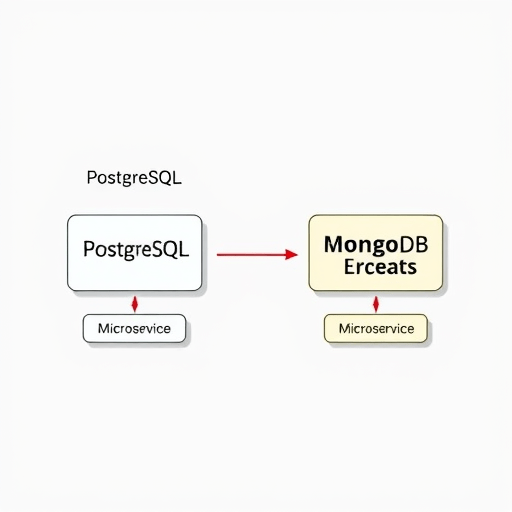
The reference architecture here uses PostgreSQL as the system of record for anything financial or relational, and MongoDB as the system of engagement for anything descriptive or hierarchical. An order placed in the app writes to PostgreSQL first, because the order is a contract. A product page render reads primarily from MongoDB, because the product is a description.
Two services sit on top of these stores:
- Order Service writes and reads only from PostgreSQL. It owns the order lifecycle, inventory holds, payment records, and customer history.
- Catalog Service writes and reads only from MongoDB. It owns product definitions, variants, media, localized descriptions, and merchandising metadata.
The two services communicate through events, not through shared tables. An order_placed event carries just enough information to update analytics or trigger fulfillment, but never attempts to mirror the entire order into MongoDB. A product_updated event flows the other direction only if downstream systems need to know, but the source of truth for product data remains MongoDB.
Why PostgreSQL Owns the Order
Transactional integrity is not negotiable in order processing. A customer who is charged must also receive a valid order row, an inventory decrement, and a tax record. PostgreSQL’s ACID guarantees, mature transaction model, and support for partial unique indexes make it the natural anchor. Constraints can enforce business rules at the database layer:
- A partial unique index on
(customer_id, status)where status = ‘open’ prevents duplicate open carts. - A check constraint ensures line item totals reconcile with unit price times quantity.
- Foreign keys between orders, payments, and shipments guarantee referential integrity.
PostgreSQL also shines for reporting. Joining orders to customers to shipments to refunds is straightforward, predictable, and indexable. The team uses read replicas for analytics so the write path stays untouched. None of this requires exotic features; it relies on decades of relational design discipline.
Why MongoDB Owns the Catalog
A product catalog is a living document. A laptop has CPU, RAM, and screen size. A sofa has dimensions, fabric options, and care instructions. A gift card has almost nothing except a redemption code. Trying to model all three in a single relational schema produces either an explosion of category-specific tables or a degenerate design where every interesting attribute lives in a JSON column that nobody can query.
MongoDB’s document model absorbs this heterogeneity naturally. Each product is one document, and each product type carries the fields that make sense for it. Indexing selective fields keeps queries fast. Schema validation, introduced years ago and now robust, lets the team enforce required fields like price and SKU without giving up flexibility.
More importantly, MongoDB allows the catalog to evolve without coordinated migrations across environments. When the merchandising team launches a new “sustainability score” attribute, engineers add it to the schema validator, ship the code, and existing documents are simply missing the field until they are updated. There is no ALTER TABLE blocking writes for hours.
Keeping Two Databases Honest
The hardest part of polyglot persistence is not choosing the databases. It is preventing them from drifting apart. There is no foreign key that spans PostgreSQL and MongoDB. There is no JOIN. The application code is the only thing that ties them together, and that code must be defensive.
Three patterns make this manageable:
1. Treat Each Store as the Sole Source of Truth for Its Domain
The order database never mirrors product descriptions. It stores only the product ID and the snapshot of price and name captured at the moment of purchase. The catalog database never mirrors order status. If a query needs both, the application joins them in code, using a stable product ID as the bridge.
2. Use Events for Cross-Domain Awareness, Not Mirroring
An outbox table in PostgreSQL captures order events that downstream services consume. A change stream in MongoDB captures product updates that downstream services consume. Neither store tries to replicate the other. Consumers that need both contexts perform their own lightweight joins in memory or in a read model optimized for the specific query.
3. Reconcile Continuously, Not Manually
A small reconciliation job runs daily and compares the set of active product IDs in MongoDB against the IDs referenced by orders in PostgreSQL. Discrepancies trigger alerts, not auto-corrections. The team learned early that silent fixes mask bugs. Loud alerts force conversations.
Lessons From Operating This Architecture
After running this split for over a year, several practical lessons stand out. First, ownership boundaries matter more than technology choices. The team that owns the catalog schema must be the one that writes the schema validator, not a centralized data team. Second, monitoring needs to be split. PostgreSQL metrics track transaction latency, lock waits, and replication lag. MongoDB metrics track document size, index usage, and change stream lag. Mixing them on one dashboard hides signal in noise.
Third, and perhaps most importantly, polyglot persistence is not free. Every additional store is another backup strategy, another upgrade window, another on-call concern. The team treats the addition of a new database as a serious architectural decision, not a casual experiment. The decision to split orders from catalogs was driven by real pain, and that made the operational cost worthwhile.
The result is an application where the order pipeline never goes down because of a schema change in the catalog, and where the catalog team can ship a new product type every week without filing a database migration ticket. Each database is allowed to be great at what it does. The application is allowed to be pragmatic about what it asks each one to do.
That is the real promise of polyglot persistence in practice: not novelty, but fit.