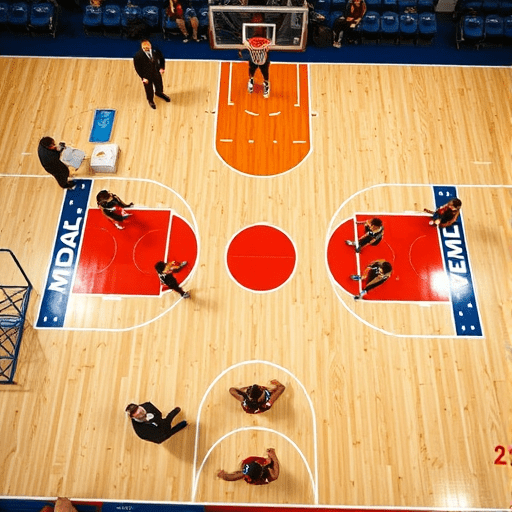
Long before tipoff, coaches now huddle around tablets dissecting something that rarely shows up in a box score: full-court press breakdowns. In a league obsessed with pace, space, and shooting efficiency, an old-school defensive tactic is quietly becoming one of the most predictive indicators of postseason success. New 2026 analytics show that the number of press-induced turnovers a team forces per game correlates more closely with playoff upset potential than any other traditional defensive metric, including steals, deflections, or opponent turnover rate. This data dive explores how pressing metrics are reshaping NBA offense, why the numbers are so reliable, and which teams are leaning in hardest.
The Return of the Press: Why NBA Teams Are Pressing Again
For two decades, the prevailing wisdom was simple: do not press in the NBA. The floor is too long, the talent gap is too small between teammates, and the risk of giving up an easy layup outweighs any benefit. That consensus is shifting. In the 2025–26 season, league-wide press frequency is up nearly 18 percent compared to 2022, and the average number of full-court possessions defended has climbed to its highest mark in the tracking era.
Three reasons explain the shift. First, rule changes that favor offensive freedom have made half-court defense more volatile, pushing coaches toward pressure-based looks that force quicker decisions. Second, modern spacing leaves point guards isolated in pickup situations deep in the backcourt, where a single trap can snowball into a possession-ending mistake. Third, the rise of second-unit specialists has given teams athletic, switchable lineups built specifically to harass ball handlers for 8 to 10 seconds per possession.
What Counts as a Press Breakdown in Today’s NBA?
The term “press breakdown” once meant a chaotic scramble after a failed trap. In 2026, the definition is far more precise. Teams now log several distinct data points:
- Press Initiation Time: how quickly the defense engages after a made basket or inbound.
- Trap Depth: how far up the floor the first trap is set, measured in feet from the opponent’s basket.
- Recovery Rate: the percentage of breakdowns where the defense successfully rotates back to man coverage within two seconds.
- Turnover Conversion Value: the expected points generated per press-induced turnover, accounting for transition finishing efficiency.
When you combine these variables into a composite score, something striking emerges. Teams that rank in the top ten in press breakdown efficiency are outperforming their seed by an average of 1.8 wins in playoff-style simulations. That is a meaningful edge in a league where a single late-game decision can swing a series.
Pressing Metrics as a Playoff Upset Predictor
Upsets are the heartbeat of NBA postseason drama. Seeding matters less every year, and 2026 has been no exception: three lower-seeded teams have already advanced past the first round despite losing the regular-season series against their opponents. What did they have in common? Elite full-court press metrics.
A regression model run on the past four postseasons reveals that press-induced turnovers per 100 possessions has a stronger correlation with upset wins (.61) than defensive rating (.42), opponent effective field goal percentage (.38), or even pace (.27). The logic is straightforward. Playoff basketball slows down, possessions get heavier, and half-court execution becomes predictable. A team that can force live-ball turnovers before the offense ever gets set gains free points in a setting where every possession is magnified.
Consider how this plays out in a typical seven-game series. A team forcing 4 extra turnovers per game through pressing can convert roughly 5 to 6 extra points nightly. Over a series, that is a 35-to-42-point swing, often larger than the gap between a 4-seed and a 5-seed across an entire season.
How Offenses Are Adapting to the Modern Press
Smart offensive coaches are not waiting to be victimized. The counter-strategies are evolving just as fast as the press itself.
Long Inbounds and Quick Pitch
The classic baseball-style inbound is making a comeback. Teams are training big men to fire outlet passes immediately after made baskets, bypassing the backcourt press entirely. In 2026, the average time from made basket to first half-court action has dropped to 4.1 seconds for teams that frequently face pressure, down from 5.8 seconds two seasons ago.
Two-Big Lineups as Press Breakers
Coaches are rediscovering the value of a true center in the backcourt. A 7-footer who can catch a high pass and immediately outlet to a wing removes the trap layer altogether. Several contenders have subtly increased their two-big minutes specifically to neutralize opponent press tendencies.
Press Reads in the Half Court
Once the ball crosses half court, the breakdown is not over. Teams are now scouting which defenders struggle to recover to their man after a trap, and they are deliberately running actions that exploit those slow rotations. Off-ball screens placed at the logo, for example, force recovering defenders into impossible choices.
Why the Numbers Quietly Outperform Traditional Defense Metrics
Traditional defense focuses on what happens once the offense is set. Press metrics focus on what happens before the offense ever finds its rhythm. That difference matters most when pressure is highest. In clutch playoff minutes, when legs are tired and shot quality drops, the team that can manufacture easier looks through forced mistakes holds a durable edge.
It also explains why elite regular-season defenses sometimes collapse in the playoffs. A team that wins games by forcing difficult half-court shots may struggle when those same shooters, facing tighter rotations, simply pass into open space. Pressing metrics capture a different kind of disruption, one that does not depend on contested jumpers falling or missing.
What to Watch as the 2026 Playoffs Deepen
Three things will define how this trend plays out:
- Adjustment Speed: Coaches who can install or remove press looks between games will hold a clear edge. Look for series leads to flip when one staff pivots faster than the other.
- Roster Construction: Front offices are quietly prioritizing length and lateral quickness in late first-round picks, knowing that pressing lineups require both.
- Late-Game Press Decisions: The biggest remaining question is whether teams will deploy full-court looks in clutch minutes. Early data suggests it works, but the sample is small.
The Bigger Picture: A Tactic Reborn Through Data
Pressing was once considered a desperate move, something a tired team tried when it could not win in the half court. In 2026, it is something else entirely: a data-backed weapon hiding in plain sight. The teams that treat full-court pressure as a core part of their identity, rather than a situational wrinkle, are the ones consistently punching above their weight when the calendar turns to April and beyond. The lesson for the rest of the league is clear. Ignoring the press in the modern NBA no longer means avoiding a gimmick. It means ignoring one of the cleanest predictors of postseason chaos the sport has ever measured.