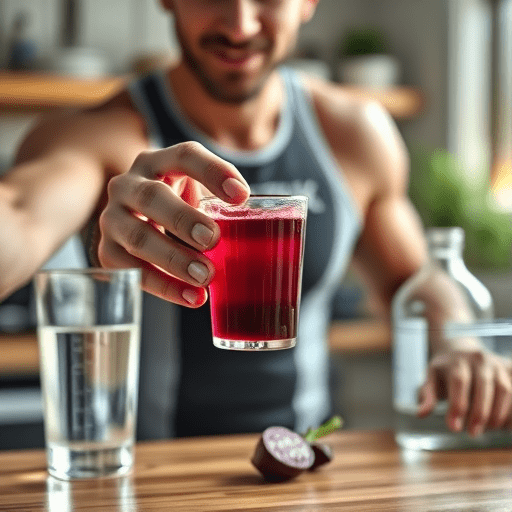
Mouthwash ruins your beetroot performance? Nitrate timing matters, and the good news is that a simple two-hour buffer around your pre-race shot can keep most of the ergogenic benefit intact. Beetroot juice has become one of the most popular performance supplements in endurance sport, but many athletes are unknowingly dulling its effect with a common morning habit: rinsing with an antibacterial mouthwash. The science is surprisingly clear: the beneficial compounds in beetroot don’t work alone. They depend on the bacteria living on your tongue and in your saliva. If you wipe out those bacteria at the wrong time, your pre-race shot may become little more than a very expensive glass of red juice.
How Dietary Nitrate Really Works
Beetroot’s performance boost comes from inorganic nitrate. When you drink a beetroot shot, that nitrate enters your bloodstream and is eventually taken up by your salivary glands. Over the next 30 to 120 minutes, nitrate is secreted back into your saliva. That’s where the magic begins — but only if your mouth contains the right microbes.
Oral bacteria such as Rothia, Veillonella, Actinomyces, and Neisseria reduce nitrate to nitrite. You then swallow that nitrite, and in the stomach’s acidic environment it is converted to nitric oxide. Nitric oxide relaxes blood vessels, improves blood flow, and lowers the oxygen cost of exercise. This is the physiological chain that makes beetroot shots valuable for runners, cyclists, and anyone chasing a demanding performance goal.
If that chain is broken anywhere, the performance effect shrinks. The break most athletes never think about is the mouthwash bottle in the bathroom.
Why Antibacterial Mouthwash Can Sabotage the Pre-Race Shot
Antibacterial mouthwashes are designed to kill bacteria. They are not selective. A rinse containing chlorhexidine, cetylpyridinium chloride, alcohol, or certain essential oils can drastically reduce the oral bacteria responsible for nitrate conversion.
Research has shown that even a short rinse with chlorhexidine can lower salivary nitrite levels by as much as 90 percent in some individuals. That means the nitrate from your beetroot shot is still absorbed, but it cannot be converted efficiently into the nitrite and nitric oxide that your muscles need. Your engine gets fuel, but the ignition system is wet.
This effect is not permanent. The oral microbiome can recover within hours or days, depending on the product and the person. But the timing of that recovery matters enormously on race day. If you use an antibacterial rinse too close to your beetroot shot, the nitrate arrives in your saliva while the bacterial community is still suppressed.
The Two-Hour Window Is the Key
The practical takeaway is straightforward: avoid antibacterial rinse for at least two hours before your pre-race shot and two hours after it. That gives your oral bacteria a fighting chance to be active exactly when nitrate is cycling through your saliva.
Why two hours? Because it works as a practical buffer for the nitrate-related timeline. If you rinse immediately before the shot, your mouth is still in a low-bacteria state when nitrate first appears in saliva. If you rinse immediately after the shot, you kill off the very microbes that were about to process the nitrate. Two hours on either side keeps you clear of the most vulnerable period.
Nitrate Timing and the Oral Microbiome: The 2026 Picture
Sports nutrition guidance in 2026 is finally treating the oral microbiome as a performance organ rather than a hygiene afterthought. The old advice was simple: take beetroot juice, wait a couple of hours, race faster. The updated picture is more personalized and more practical. It acknowledges that what you do in the bathroom can affect what happens on the road.
Emerging evidence suggests that chronic mouthwash use may blunt the vascular benefits of a high-nitrate diet. For athletes who train with beetroot or other nitrate supplements, repeated antibacterial rinse use around sessions could reduce training adaptations. This is not about ditching oral hygiene. It is about separating mouth care from the moments when you need your oral microbiome to work for you.
Individual responses also vary. Some athletes have a more abundant oral nitrate-reducing community and can tolerate a less strict rinse schedule. Others seem to lose most of the beetroot benefit after a single antibacterial swish. Since you cannot easily measure your salivary nitrite in the middle of a race morning, the safest approach is to treat every pre-race shot as microbe-sensitive.
A Practical Nitrate Timing Protocol for Race Day
Here is a simple, low-stress way to protect your beetroot performance without overcomplicating your morning.
- Set your shot time first. Most protocols suggest finishing your beetroot shot 2–3 hours before the start. That gives enough time for nitrate to be absorbed, secreted in saliva, converted, and the resulting nitric oxide to be active.
- Mark a no-rinse window. From two hours before the shot until two hours after it, avoid antibacterial mouthwash entirely. This is the core of the timing rule.
- Brush teeth earlier in the morning. If you usually brush after breakfast, do it at least 30–45 minutes before the shot. Use a normal toothpaste and rinse with water. Do not follow it with an antibacterial mouthwash.
- Skip the rinse on race morning. If you want to be extra safe, skip any antibacterial rinse entirely on race morning. Use a tongue scraper or plain water swish to feel fresh without suppressing your oral bacteria.
- Move intensive oral care to the evening. After your race or training session, you can return to your normal mouthwash routine. The oral microbiome has hours to recover before the next nitrate-rich meal or supplement.
- Be mindful of non-mouthwash antibacterial products. Some throat sprays, breath strips, and chewing gums also contain antimicrobial agents. In the hours around a pre-race shot, treat those the same way you would mouthwash.
What About Rinsing Immediately After the Shot?
Many athletes rinse their mouths after drinking a strong beetroot shot because they want to get rid of the earthy taste. That is understandable, but if you use an antibacterial rinse, you are hitting your oral bacteria at the worst possible time. Instead, wait at least 30–60 minutes before drinking water or use a small amount of plain water to swish. Better yet, let the beetroot juice coat your mouth for a few minutes before swallowing. That brief contact can help establish nitrate in the oral environment while your bacteria are still active.
Does This Mean Mouthwash Is Off-Limits for Athletes?
No. Mouthwash still has a place in dental care and for athletes who are specifically advised to use it by a dentist or periodontist. The point is not to eliminate antibacterial mouthwash from your life. It is to respect the two-hour buffer around your pre-race shot. If you train or race in the afternoon, an evening antibacterial rinse is unlikely to interfere with your next morning’s nitrate intake. If you train in the late afternoon, keep the rinse later in the evening.
For cyclists, runners, triathletes, and team-sport athletes, this timing adjustment is a low-cost way to get more value from a supplement that already has strong evidence behind it. No additional pills, no extra expenditure, no need to double your beetroot dose.
Conclusion
Mouthwash doesn’t ruin every beetroot performance, but it can clearly weaken the response when used at the wrong time. Nitrate timing matters because the oral bacteria that convert nitrate into usable nitric oxide are fragile and easily disrupted. By avoiding antibacterial rinse for two hours before and after your pre-race shot, you protect the biological bridge between beetroot and blood flow. That simple change is one of the most underrated adjustments in endurance sports nutrition, and it costs nothing but a little forethought.