When your calendar fills with client dinners, airport security lines, and back-to-back conference calls, marathon training on a business trip can feel like the first thing to sacrifice. But the reality is simpler than most runners fear: you do not need a track, a treadmill, or even a proper running route to keep the engine intact. Marathon training on a business trip: 3 hotel workouts can preserve your speed and base, provided you’re willing to treat the building itself as your training ground. The three sessions below use stair sprints, a 20-minute tempo interval, and a bodyweight circuit to deliver the same physiological stimulus as track work without any of the logistical headaches.
Whether you land in a city where the sidewalks are unfamiliar or your hotel gym has one treadmill and a broken water fountain, these workouts are designed to fit into the weird, interrupted schedule of a work trip. No long warm-up loops. No GPS required. Just effort, honest pacing, and a willingness to walk past the bar and find the stairwell.
Why the Stairwell Beats the Treadmill for Speed Preservation
Hotel treadmills are notoriously unreliable. Some cap at 10 miles per hour. Others have cushioning that feels like running through wet sand. And when you’re traveling for work, the last thing you want is to waste twenty minutes figuring out a machine’s quirks. Stair sprints, by contrast, are brutally consistent. A flight of stairs is always the same distance. Gravity is always present. And the intensity is scalable to whatever your legs can handle that morning.
Stair sprinting also recruits the posterior chain more aggressively than flat running. That’s useful for marathoners who lose glute power during long periods of sitting in meetings and economy-class seats. A short session of stair sprints can wake up the glutes, hamstrings, and calves while elevating your heart rate to near-maximal levels in a way that a flat dash cannot replicate.
For marathon training specifically, stair sprints are not a substitute for long runs. But they are an excellent substitute for track intervals when you need to maintain fast-twitch muscle fibers and neuromuscular coordination. The concentric strength you build on stairs carries over to hill starts, surge changes in a race, and the final push to the finish line.
Workout 1: The 12-Minute Stair Sprint Session
This workout is designed to be done before breakfast or after a dinner meeting. It takes less than fifteen minutes of intense effort and requires only a stairwell with at least two flights of stairs. If your hotel has more flights, even better. The goal is short, aggressive bursts with full recovery in between.
- Warm-up: Walk up and down the stairs for three minutes. Then do 10 walking lunges on the landing, 10 calf raises off the bottom step, and 10 bodyweight squats. Keep it easy.
- Main set: Sprint up one flight of stairs as fast as you safely can. Do not take the steps two at a time unless you are already used to that type of loading. Walk down slowly. Rest for 60 seconds.
- Repeat: Complete 6 to 8 total sprint repeats. For the first two, focus on quick foot turnover. For the last two, focus on knee drive and arm swing.
- Cooldown: Walk on flat hallway carpet for three minutes, then stretch the hip flexors and calves for two minutes.
If you are feeling strong, add a weighted element by carrying a backpack filled with a laptop or water bottles. That changes the stimulus slightly and adds core engagement, but keep the weight low enough that your sprint form does not collapse.
Workout 2: The 20-Minute Tempo Interval That Fits Any Schedule
A tempo run is the most efficient way to preserve your lactate threshold when you are short on time. And here is the secret: you do not need a track or a treadmill to do it properly. You can execute a 20-minute tempo interval on a treadmill, on a hotel exercise bike, or even on a loop around a parking garage if the surface is safe. The key is the effort, not the machine.
Set the treadmill to a 1% incline if you’re using one. For a true tempo, you want to be running at an effort that is “comfortably hard”—about 85% of your max heart rate, or roughly the pace you could hold for an hour in a race. This should feel manageable but impossible to maintain for much longer than 20 minutes. If you can chat comfortably during it, speed up. If you cannot say a single word beyond a grunt, slow down slightly.
Here is a practical structure for the workout:
- 0-5 minutes: Easy jog at a conversational pace. Your body will feel stiff, especially after travel. Do not rush this portion.
- 5-25 minutes: Tempo effort. Run at that comfortably hard pace. Keep your breathing rhythmic and your torso tall. Avoid watching the clock too often; instead, check in with your legs every few minutes.
- 25-32 minutes: Easy jog cooldown. Let the heart rate drift down.
If your hotel gym lacks a treadmill, use a stationary bike for the same 20-minute tempo interval. Set the resistance so your cadence stays around 90 RPM and your effort matches the same “hold this pace for one hour” feeling. Cycling is not running, but when the only alternative is skipping the workout entirely, the bike wins.
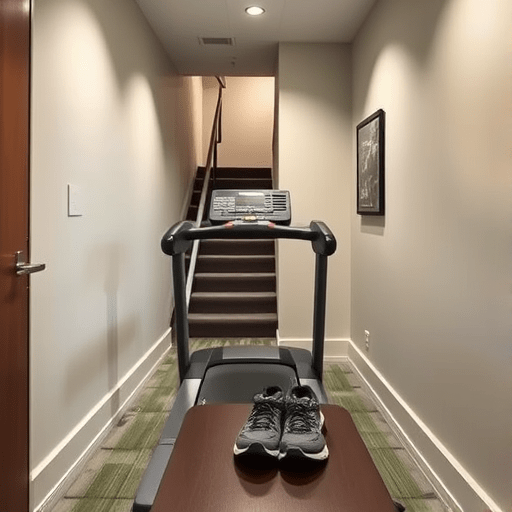
For a more running-specific option, find a long, flat corridor on a lower floor of the hotel—many conference centers have them. You can run out-and-back intervals for 20 minutes: 90 seconds fast, 30 seconds slow, repeated. That’s not a classic tempo, but it mixes speed and base without requiring any route-knowledge.
Workout 3: The Hotel-Room Strength Circuit for Marathon Base
Marathon base is not just about aerobic volume. It is about connective tissue resilience, joint stability, and the ability to absorb thousands of foot strikes. A 45-minute bodyweight circuit in your hotel room can preserve that base without a track, and it doubles as a way to offset the stiffness from long flights.
Do this circuit in a circuit format. Perform each exercise for 45 seconds, then rest for 15 seconds. Move through the whole set twice.
- Bodyweight squats: Keep your feet hip-width apart and sit back as if you are lowering into a chair. Go as deep as your mobility allows.
- Glute bridges: Lie on your back, bend your knees, and press up through your heels. Squeeze your glutes hard at the top for two seconds.
- Step-ups: Use a sturdy chair, low table, or the bottom stair of a quiet stairwell. Step up with one leg, drive the knee up, then lower slowly. Alternate legs.
- Single-leg calf raises: Hold onto a wall or desk for balance. Rise up onto the ball of your foot, pause, and lower for three counts. This one is the most important for marathoners because calf resilience is the first thing to fade during travel.
- Plank hold: Keep your hips level and your glutes squeezed. Do not let your lower back sag.
- Reverse lunges: Step backward into a lunge, then push through the front heel to return. These are gentler on the knees than forward lunges but still target the quads and glutes.
This circuit is not glamorous, but it preserves the physical capacity that makes running feel easy when you return home. If you have only 20 minutes, cut the second set and increase the work interval to 50 seconds.
How to Arrange These Workouts Across a Multi-Day Business Trip
If your trip spans more than one night, avoid stacking all three workouts are the wrong approach. Instead, think about the purpose of each session.
- Arrival day: Use the stair sprint session as a way to shake out travel stiffness. It is short enough to fit between meetings and intense enough to make you feel like a runner again.
- Middle day: Do the 20-minute tempo interval in the morning before work. This gives you a mental boost and a clear window of protected time.
- Last day: Use the strength circuit if you have an early flight or a late-night check-out. It requires no special clothes and can be done even with a hangover from too many networking dinners.
If you have more than three workout days available, repeat the stair sprint session on the final day. You can also add an easy 30-minute walk or jog during a lunch break on any of those days—this does not replace a long run, but it keeps your aerobic rhythm alive.
One internal note: do not try to replicate a long run in the hotel. The goal of these shorter sessions is to preserve the work you have already done, not to add new stress that delays recovery. The next weekend’s long run at home will benefit from the freshness these workouts leave in your legs.
Conclusion
Headed into another business trip, you can stop apologizing for missed workouts. Stair sprints provide speed, a 20-minute tempo interval protects lactate threshold, and a strength circuit reinforces base without a track. These three sessions are portable, efficient, and flexible enough to attach to any work schedule. The key is not perfection—it is showing up for the twenty minutes or the twelve minutes and letting the hotel be your gym.