The days of maintaining separate CAPA documentation for each regulatory inspection are over. In 2026, quality leaders are finding that the best way to pass a single MDSAP audit and support clean FDA, EMA, and ISO submissions is to map your CAPA process to close ISO 13485 gaps while satisfying MDSAP, FDA, and EU MDR simultaneously. Instead of building three parallel systems, you need one intelligent, traceable workflow that every auditor can follow. This article lays out a concrete method for doing exactly that — turning your CAPA process from a recurring source of inspection findings into a regulatory bridge across four major frameworks.
Why ISO 13485 Gaps Create Ripple Effects Across MDSAP, FDA, and EU MDR
ISO 13485:2016 is the backbone of many medical device quality management systems (QMS). When you map your CAPA process to close ISO 13485 gaps, you directly reduce your exposure under MDSAP, FDA 21 CFR Part 820, and EU MDR. Regulatory agencies and auditing organizations have harmonized their expectations more than many device-makers assume. The FDA’s 2022 overhaul of Quality System Regulation (QSR) moved closer to ISO 13485, and MDSAP’s 2024-2026 audit model continues to emphasize process-based assessment over procedure-by-procedure checks. EU MDR, meanwhile, requires that CAPA evidence reach beyond your own organization into post-market surveillance and clinical evaluations.
Yet typical gap analysis exercises fail because they treat each regulation as a unique checklist. That approach leads to redundant documentation, conflicting terminology, and missed cross-functional evidence. The smarter angle for 2026 is reverse engineering: define one mature CAPA process that simultaneously satisfies the core expectations of ISO 13485, MDSAP’s CAPA element, FDA QSR, and EU MDR’s vigilance and post-market requirements. In practice, that means designing your CAPA records to answer the same set of fundamental questions on every audit day.
The MDSAP Approach to CAPA: What Auditors Actually Observe
MDSAP audits are unique because they assess a device manufacturer’s QMS against multiple regulatory requirements at once. For CAPA, MDSAP auditors observe how your process behaves when the system moves from a potential issue to a documented nonconformity. They want to see that you have not simply written a CAPA procedure, but that you can demonstrate:
- Which input signals trigger a CAPA vs. discovery action or minor correction
- How risk-based prioritization is applied to issue levels and patient impact
- Where the initial quality data (complaints, audits, production data) lives in your QMS
- How root cause analysis chooses the right depth — not just the easiest fishbone
- How effectiveness checks are designed to prove the corrective action worked, not just that it was implemented
- How you link related CAPAs to one systemic issue and avoid recurring findings
The key insight from MDSAP is that the physical paperwork is less important than the traceable story your workflow tells. If your CAPA process follows ISO 13485’s clause 8.5.2 (corrective action) and 8.5.3 (preventive action), but the steps and ownership are unclear to an MDSAP auditor, you will still get a finding. Mapping your process ahead of time makes that story legible — not only for MDSAP, but for any future FDA inspection or EU notified body audit.
Step-by-Step Mapping Method for Your CAPA Process
To clear FDA and EMA submissions without generating a brand-new CAPA format for each product file, you need a structured approach. Follow these four steps to map your CAPA process to close ISO 13485 gaps and meet the distinct emphases of MDSAP, the FDA, and EU MDR.
1. Define Your Core CAPA Workflow Using ISO 13485 Process Clauses
Start your mapping at the process level. Map your CAPA process against ISO 13485 clauses 8.4, 8.5.2, and 8.5.3, paying close attention to 8.5.2’s required records: the nature of the nonconformity, investigation outcome, root cause, actions taken, and effectiveness verification. This triples as your MDSAP foundation, because MDSAP’s CAPA assessment uses the same logic. By explicitly mapping your workflow to ISO 13485 clauses, you generate a ready-made matrix for your next internal audit and for any pre-submission gap analysis.
One practical tool is to create a table that lists each ISO 13485 clause requirement in one column and the corresponding step in your CAPA software or paper form in the second column. In the third column, note which additional evidence elements MDSAP, FDA, and EU MDR expect. This table becomes your reference during inspector walkthroughs, and it is far more useful than a generic CAPA procedure that no one actually follows.
2. Align Terminology with FDA QSR Principles (21 CFR Part 820 / QSR 2024)
The FDA’s recent revisions to the Quality System Regulation were designed to avoid unnecessary redundancy with international standards. For CAPA, this means you already have a golden opportunity to align your process with 21 CFR 820.100, which requires timely, risk-based actions overseen by personnel who truly understand the process. The old wording — “corrective and preventive action” — still appears in audit vernacular, but the substantive expectations have shifted to data-driven decisions. To map your CAPA process correctly, you need to ensure that your definitions of “correction,” “corrective action,” and “preventive action” are the same across your internal teams, supplier contracts, and regulatory documentation.
During an FDA inspection, citing an ISO 13485 clause is not enough. You must show the connection between your CAPA root cause analysis and your risk management file (ISO 14971). The same CAPA that influences future product development should feed into your risk review. That single linkage prevents an FDA finding and shortens your investigational device exemption or premarket submission review.
3. Integrate EU MDR’s Post-Market and Vigilance Requirement
EU MDR adds a layer that MDSAP and FDA do not fully cover: the mandatory reporting of trends and serious incidents under Article 86 and the ongoing periodic safety update report (PSUR). When you map your CAPA process, you must identify where post-market surveillance (PMS) data enters the corrective action stream. A complaint that reveals a pattern of device malfunction should not stay in a standalone vigilance tracker. It should trigger a CAPA if the root cause is potential, actual, or suspected product or process failure.
For EU MDR submissions, especially for class III and implantable devices, auditors want to see that you have used CAPA findings to update your clinical evaluation and post-market clinical follow-up (PMCF) plan. Map the flow so a CAPA outputs to PMS data, risk management, and if applicable, the PSUR. This single path satisfies the EU MDR expectation of a “living” quality system and also gives your EU authorized representative confidence in your ability to manage serious events.
4. Turn Your CAPA Map into a Single Audit Trail
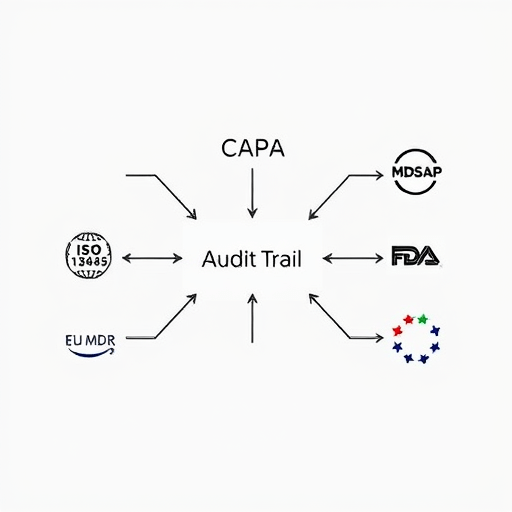
Once you complete the first three mapping steps, the final technical step is assembling a visual CAPA map or a documented procedure that any auditor can navigate in under a minute. Add process owners, input signals, gate criteria, and escalation triggers. For each CAPA, create a top-level audit trail that links to complaints, service reports, supplier nonconformances, internal audit findings, and the final effectiveness check. This map does not have to be a twenty-page binder — in fact, a one-page diagram or an electronic dashboard is usually more effective.
The consequence of this single audit trail is that you can pass a single MDSAP audit and then reuse the same CAPA evidence for a subsequent FDA inspection or an EU notified body review. Instead of pulling together separate binders and cross-referencing documents, your auditors can see exactly what action was taken, who was accountable, and how the data ultimately informed product change.
Advanced Considerations for 2026: Integrated Software and Real-Time Data
As medical device quality software becomes more sophisticated, automation can help you map your CAPA process in real time. Leading quality management systems now offer pre-built mapping to ISO 13485 and MDSAP elements, but configuration matters more than a feature list. When you implement software, customize your CAPA forms so that each required field aligns with at least three regulations. For example, an “effectiveness check” field can record both the verification method and the resulting output to your risk file. That single field becomes a goldmine during an EMA submission because it shows proactive safety management.
Artificial intelligence is also entering the CAPA space, but the best use in 2026 is triaging incoming quality signals. You can use AI to cluster identical complaints from different regions, flag data points that suggest a new root cause, and even propose initial risk scoring. Still, you must keep the human-in-the-loop for final CAPA decisions, especially when facing MDSAP’s requirement that personnel be trained on the quality policy and process control.
Common Pitfalls That Waste Your Audit Capital
Even a well-mapped CAPA process fails when small implementation gaps create confusion. The most frequent and avoidable pitfalls seen in 2026 audits are:
- Using different CAPA templates for different markets or product lines, breaking the unified audit trail
- Missing the distinction between CAPA actions and routine corrective actions, leading to under-documented preventive actions
- Failing to close out CAPAs within the timeline you promise to the auditor — having a 90-day cap that is rarely met is worse than a realistic 180-day cap
- Treating root cause analysis as a simple checklist activity; MDSAP auditors can quickly tell if you merely wrote “training issue” without deeper verification
- Not including supplier-related nonconformities in your overall CAPA review, even when the contract manufacturer is the one acting
- Your CAPA map lives in the head of one quality manager rather than being accessible to all shift leads and process owners
To avoid these pitfalls, schedule a short internal validation walkthrough after you complete your mapping. Ask a colleague to trace a recent complaint, product recall, or internal audit finding from its trigger to the final CAPA closure. If that colleague cannot explain the process using the map, your documentation and training still need work.
The New Baseline for Global Medical Device Audits
Because MDSAP is recognized across major markets, including the United States, Japan, Brazil, and Canada, audit results influence more than just one certificate. When you map your CAPA process to close ISO 13485 gaps, you create a foundational quality system that naturally carries over to FDA QSR principles and EU MDR vigilance obligations. The opportunity for 2026 is to stop seeing CAPA as a reactionary effort and instead treat it as your QMS’s connective tissue. A unified CAPA process does not require inventing new requirements or doubling work for your quality team. It requires clarity, structured evidence, and a map that every regulator can follow.
Take a few hours to map your existing CAPA workflow against ISO 13485 clauses and the MDSAP audit element. Identify where the evidence breaks down, then build the single audit trail. By the time your next MDSAP audit arrives, you will be ready to present one process that clears multiple hurdles without a last-minute scramble.