Postgres has quietly become the most flexible database in production today, blending the rigidity of relational modeling with the document-style freedom developers once reserved for MongoDB. The hybrid JSONB schema pattern in Postgres production has emerged as a pragmatic answer to evolving data shapes, especially as teams ship faster and schemas shift weekly. Yet somewhere between a clean prototype and a million-row table, the same flexibility that felt liberating begins to slow queries, inflate storage, and confuse query planners. Understanding where JSONB stops being a convenience and starts becoming a bottleneck is essential for any team scaling Postgres beyond its comfort zone.
The Allure of Schema on Read
Document databases earned their reputation by letting developers store arbitrary fields without upfront design conversations. In Postgres, JSONB replicates that promise while preserving ACID guarantees. A startup launching a configurable product catalog can ship feature flags, custom attributes, and metadata in a single column, then evolve the shape without running migrations every sprint. Early on, this feels like the best of both worlds.
However, the convenience comes with hidden costs that surface only under load. Indexing strategies behave differently, query plans change as data distributions shift, and aggregation performance rarely matches what a normalized table would deliver. The tipping point rarely arrives with a dramatic failure; it creeps in as p95 latencies climb and storage footprints balloon.
Three Warning Signs JSONB Is Hurting Your Postgres Production Workload
Most teams do not notice the problem until dashboards turn yellow. The earliest signs are subtle. Recognizing them early saves months of refactoring later.
1. Index Bloat on Expression Indexes
When teams rely heavily on GIN indexes over JSONB columns, those indexes grow rapidly because they tokenize every key-value combination. A column storing user preferences, for instance, can produce an index many times larger than the underlying table. As the index bloats, write amplification increases and vacuum cycles struggle to keep up. The performance tax is paid on every INSERT and UPDATE.
2. Query Planner Confusion
JSONB predicates often lack the statistics the planner needs to estimate row counts accurately. A query filtering on a deeply nested key may return millions of rows when the planner expected dozens, triggering sequential scans at the worst possible moments. When EXPLAIN ANALYZE repeatedly shows misestimated row counts involving JSONB fields, the schema is sending a signal.
3. Aggregation and Reporting Pressure
Analytics queries that group, count, or sum values inside JSONB structures tend to perform poorly compared to equivalent operations on typed columns. A reporting team asking for monthly revenue by region will eventually need a materialized view or an ETL job to keep response times reasonable. That is the moment the JSONB flexibility becomes operational drag.
Designing a Hybrid Schema That Actually Scales
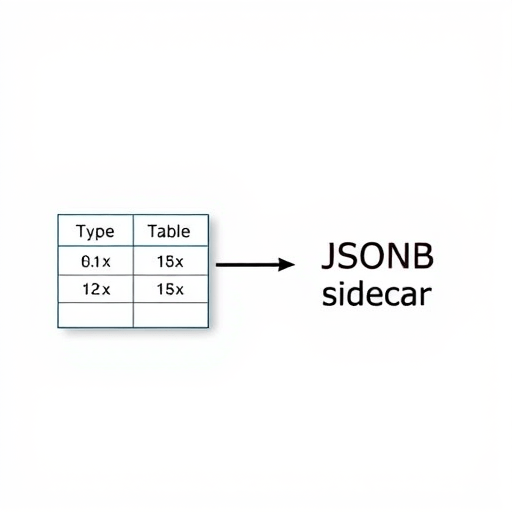
The goal is not to abandon JSONB; it is to use it where it earns its keep. A hybrid schema pattern reserves rigid columns for fields that drive queries, joins, and constraints, then delegates evolving attributes to a JSONB sidecar. This approach keeps critical paths fast while preserving adaptability.
Identify Query-Critical Fields
Start by listing every field that appears in a WHERE clause, JOIN condition, or GROUP BY statement. Those belong in the relational structure. Fields that are read together but rarely filtered, such as UI settings, feature flags, or nested metadata, are strong candidates for JSONB. The rule of thumb is simple: if the planner needs statistics about it, type it.
Promote Hot JSONB Fields to Columns
Over time, certain JSONB keys attract frequent queries. When a field is read in more than twenty percent of production queries, promote it to its own typed column with an appropriate index. This gradual migration is often invisible to application code if the data layer handles the dual-read pattern gracefully.
Use Partial Indexes Strategically
Instead of indexing the entire JSONB column, build partial indexes that target only the document shapes that matter. For a SaaS product where only enterprise tenants have advanced attributes, a partial GIN index scoped to a specific tenant tier dramatically shrinks index size and write cost.
When MongoDB-Style Freedom Becomes a Production Liability
There are specific scenarios where JSONB in Postgres production should be reconsidered altogether. High-cardinality analytics, write-heavy event streams, and multi-tenant systems with wildly divergent schemas all push Postgres past its document-database comfort zone. MongoDB, DynamoDB, or even a purpose-built wide-column store may serve those workloads better.
The decision rarely comes down to ideology. It comes down to measured performance. If a single Postgres instance struggles to maintain sub-50ms latency for queries that hit JSONB paths, and no amount of indexing, partitioning, or schema refinement closes the gap, the workload is asking for a different engine. Hybrid does not mean universal. It means using each tool where it excels.
Operational Practices for Long-Term JSONB Health
Sustainable JSONB usage is not a one-time design decision; it is an ongoing discipline. Several practices keep hybrid schemas healthy as data volumes grow.
- Monitor index size relative to table size. A ratio exceeding three to one is a strong signal that JSONB indexing is becoming a liability.
- Track query plan changes over time. Use auto_explain or pg_stat_statements to detect when JSONB-heavy queries drift from index scans to sequential scans.
- Vacuum and analyze aggressively. JSONB columns benefit from regular ANALYZE updates because their internal statistics decay faster than typed columns.
- Limit nesting depth. Deeply nested structures amplify parsing costs. Flatten where possible, or extract sub-objects into separate JSONB columns with targeted indexes.
- Document expected JSON shapes per column. Even without formal schema enforcement, a living document of expected keys prevents drift and aids onboarding.
Case Study: A Configurable Pricing Engine
Consider a B2B SaaS company whose pricing engine accepts arbitrary rules per tenant. Initially, storing rules as JSONB made sense: each tenant defined unique discount structures, tier multipliers, and contract clauses. Within a year, however, billing queries that filtered on rule types became slow. The team promoted the most queried rule attributes, such as rule_type and effective_date, into typed columns. Queries that previously scanned millions of JSONB documents now hit btree indexes in milliseconds. The remaining flexible rules stayed inside JSONB, untouched and free to grow.
This kind of progressive promotion is the hallmark of mature JSONB usage. The schema is neither frozen nor chaotic; it adapts as access patterns become clear.
The Future of Flexible Data in Postgres
Postgres continues to invest in features that blur the line between relational and document storage. Improvements in JSONB compression, parallel processing, and planner statistics are gradually closing the performance gap with native document stores. As machine learning and AI-driven applications demand increasingly fluid data shapes, the hybrid model will likely become the default rather than the exception. Teams that master the balance today will be best positioned to leverage those improvements tomorrow.
Conclusion
JSONB is one of the most powerful features in Postgres, but like any powerful tool, it demands respect. The hybrid schema pattern offers a middle path between rigid tables and unbounded documents, capturing the agility of NoSQL while preserving the reliability of SQL. The key is knowing when to type a column, when to nest a field, and when to walk away from JSONB altogether. Production systems that survive the next decade will not be the ones that chose one paradigm over another, but the ones that learned to combine them intelligently.