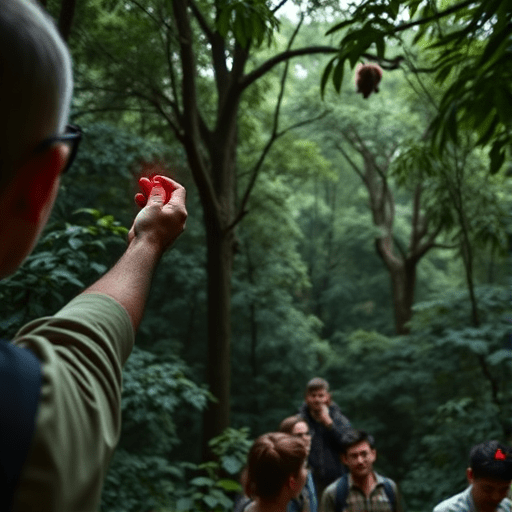
The beam of a red flashlight sweeps slowly across the forest edge, catching a pair of orange eyes. A slow loris freezes mid-step; a group of six visitors stands motionless, watching for less than a minute before the animal resumes its hunt. This is what an ethical night safari looks like — not a chaotic crowd chasing eye-shine with white headlamps, but a carefully managed encounter designed around the animal first. As nocturnal tourism expands in 2026, learning to see nocturnal wildlife responsibly has become a core part of conservation, and the two most powerful tools are red light and disciplined guide-to-group ratios.
Nighttime reveals an entirely different cast: tarsiers, night monkeys, chameleons, civets, owls, and countless insects. Yet an animal that never feels safe is not wildlife; it is a performance. Field research increasingly shows that the way we look at animals matters as much as the animals we find. Ethical night safaris are being reshaped by two quiet innovations — red illumination and smaller groups — and both are essential to keeping the night wild.
Why Night Safaris Are Booming (And Why That Is a Risk)
Affordable red LED torches, compact thermal monoculars, and infrared trail cameras have made the dark accessible. Night walks and night drives are now listed alongside daytime safaris from Costa Rica to Sri Lanka, and travellers are more willing than ever to book an after-dark outing. But the pressure cuts both ways. Where once a single naturalist roamed, now there are repeated circuits of groups with powerful beams. Each visit sends a pulse of disturbance into the forest. Nocturnal animals have adapted to darkness over millions of years, not to being watched. Elevated stress hormones, missed breeding opportunities, and abandoned habitats are the measurable cost of careless night tourism.
The Science Behind Red Light: A Window Animals Cannot See
Most nocturnal mammals have eyes packed with rod cells for gathering dim light, but very few cone cells for colour and bright-light vision. A white headlamp beam can wash out their vision for minutes, temporarily blinding them in a world full of predators. Red light, however, operates at a longer wavelength that many nocturnal species cannot perceive clearly. To them, a dim red glow resembles deep shade, so natural behaviour continues.
This is why ethical night safaris standardize red light — not for cinematic effect, but because it is the difference between watching and interrupting. Responsible guides use narrow-beam red torches, keep intensity as low as possible, and never hold the light on an animal’s face for more than a few seconds. Some animals, including many insects and amphibians, still perceive red light, so the most careful operators adjust their lamps to each species and back away when an animal shows signs of stress. Red light is not a licence to stare; it is a privilege that must be earned slowly.
Guide-to-Group Ratios: The Hidden Rule That Keeps Animals Wild
The second pillar of ethical night safaris is the guide-to-group ratio. Good operators maintain one guide for every six to eight participants, with a strict overall ceiling of about six or seven guests, and often use a two-guide model — one spotter, one interpreter. Why does this matter so deeply?
Noise and numbers are part of the story. A group of twelve creates more footsteps, more whispers, more rustling than a group of six. But the deeper issue is social stress. Primates and ungulates can count. They assess the number of approaching shapes as a threat. When a large group gathers, the animal’s flight threshold rises sooner, and the encounter ends the moment it bolts. Large groups also create a wider human edge on the trail, pressuring animals on all sides, not just ahead. A low guard-to-group ratio keeps watchers tight, quiet, and careful — and leaves the animal a clear escape route. If you are booking a night safari, the guide-to-group ratio is a more reliable indicator of ethics than any brochure promise.
Practical Etiquette: What Visitors Can Do
Every traveller can help make ethical night safaris work. Turn off white light entirely — including phone screens, which reset night vision for the whole group and startle animals. Leave camera flashes at home; today’s best nocturnal photography relies on high-ISO sensors and dim red torchlight. Keep voices to a whisper, avoid sudden movement, and never step forward when a guide points to an animal. Let the spotlight come to you.
Also remember that red light is a finite resource. Re-shining the same animal repeatedly can turn curiosity into a nuisance, especially in breeding season. Watch quietly, take a mental image, and move on. Never use sound calls or food to lure an animal closer — that is the opposite of responsible wildlife viewing. The easiest test is whether you would apply the same rules at home: no flash, no noise, no crowding.
How to Choose an Ethical Night Safari Operator
Because the night tourism industry is young, regulations are patchy. Some parks issue a limited number of night permits; others allow anyone with a torch to wander. Ask direct questions before booking: What is the maximum group size? How many guides accompany each group? Are white lights permitted? Are routes rotated to give animals rest? Red flags include guarantees of sightings, particularly of shy species like pangolins and slow lorises, which usually means baiting or territory harassment. Offers to attract animals with sound or food are definite warning signs.
The best ethical night safari operators are often tied to local research programmes, contributing sightings to wildlife databases and avoiding certain trails during breeding periods. A growing trend is citizen science: guests record observations on apps, photograph eye-shine for identification, and report invasive species. This turns a tour into a contribution. You are not just seeing nocturnal wildlife responsibly — you are helping the organisation that protects it.
The Future of the Night
Red light and guide-to-group ratios are not restrictions; they are keys. They allow humans to enter a world that was not made for us without destroying it. The night is one of the last truly wild habitats — darker, quieter, and more fragile than the daytime world. Every ethical night safari is a reminder that observation is a form of relationship, and responsibility is what separates a sighting from a memory worth keeping. When we choose ethical night safaris, we choose to share the dark without taking it. That is the future of wildlife tourism, and it begins with a single red beam and a small group moving softly through the trees.