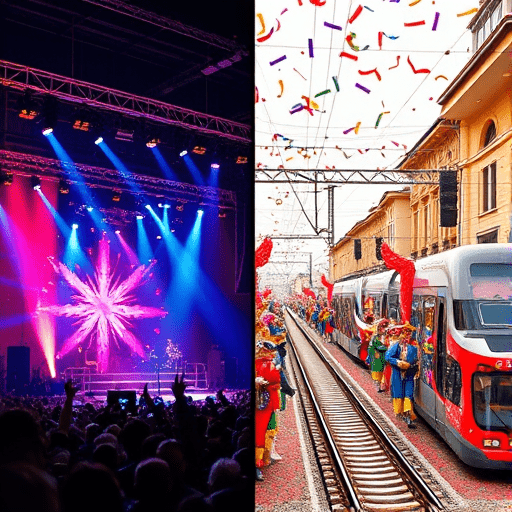
Combining concerts and carnivals in one city-hopping itinerary usually fails for one reason: the band you want to see is in one city, the carnival is in another, and your limited PTO gets split into two short trips. A better approach is event stacking — planning a single leave period as a loop of three cities, each with one anchor event, connected by trains or buses that take less than half a day. Done right, it turns three separate vacations into one, and it multiplies what you can do with a finite number of days off.
Why a Leave Period Is the Perfect Unit for Event Stacking
Most trip planning starts with a destination. Event stacking starts with a calendar. Your leave period is a fixed block of days; events are movable pieces that you fit inside it. When you reverse the usual order and plan around the days you actually have, you immediately stop asking “where should I go?” and start asking “which three events can I chain together between day one and day ten?”
Concerts and carnivals are uniquely suited to this because they follow predictable patterns. Tour routing is usually announced all at once, so you can see which cities your favorite band will hit on consecutive nights. Carnivals and street festivals are annual, and their dates rarely shift by more than a week. That gives you a planning window of six to nine months — enough time to lock in the leave period before anyone else grabs those days.
The 500-Mile Rule: Choose Cities That Chain Well
The most common reason multi-event trips fail is distance. If your three cities are spread across a continent, you waste a day of travel between each one and you’re no longer saving PTO — you’re just making a longer, more stressful trip. Keep every city within roughly 500 miles (800 km) of your starting point. That’s the range where a high-speed train, a short bus ride, or a quick regional flight costs you less than half a day.
Why 500 miles specifically? Because it guarantees that a concert ending at 11:00 p.m. doesn’t ruin the next morning. You can take a late dinner, sleep, and still catch a morning connection that arrives before noon. When legs stretch past that radius, you need to arrive a day early, and the entire chain breaks.
Three Corridors That Work Well for Event Stacking
- Central Europe: Vienna → Bratislava → Budapest, under three hours per train leg with dense summer festival dates.
- UK South: London → Bristol → Cardiff, under two hours by train, with carnivals and festivals in late August.
- US Northeast: New York → Philadelphia → Washington, D.C., connected by Amtrak with venues near stations.
How to Line Up Three Events That Don’t Overlap
Once your corridor is set, the real planning begins: matching events to dates. Start with the two fixed points — the carnival, which is usually tied to a specific weekend, and the concert, which is tied to a tour schedule. Then fill the middle with a wildcard: a free street fair, an open-air market, a local holiday, or a smaller show you discover after booking. This wildcard is what makes the trip feel effortless.
The Three-Event Rule
- Event 1 — The Anchor: The non-negotiable experience, whether that’s a band on a farewell tour or a carnival you’ve wanted to attend for years.
- Event 2 — The Co-Headliner: A major festival or concert located within one travel leg of the anchor.
- Event 3 — The Wildcard: A smaller, often free event that fills a half-day or serves as a rest-day activity. No pre-booking required.
Because the wildcard requires no ticket and no reservation, it’s also your safety valve. If you’re exhausted after the first two events, you can skip it without losing anything.
A Real-World Loop: Late August in the UK and the Low Countries
Here’s a concrete example of event stacking in action. In late August, London’s Notting Hill Carnival is a day-long Caribbean street party with costumed parades, sound systems, and street food. The same window includes Reading and Leeds at the August bank holiday weekend, and Belgium’s Pukkelpop in mid-August.
A seven-day leave period could look like this:
- Day 1–2: Fly into London and catch a headline show at the O2 Arena or a smaller gig in Camden.
- Day 3–4: Take the Eurostar to Brussels, then a short train to Hasselt for Pukkelpop (or stay in Brussels for a club show).
- Day 5–7: Return to London for the Notting Hill Carnival on the bank holiday weekend.
That’s two major ticketed events plus a free carnival in seven days, using one itinerary and one leave period. The alternative — doing them separately — would consume at least two weekends of PTO plus travel recovery days.
Packing for a Concert and a Carnival in One Trip
A city-hopping trip that includes both a concert and a carnival means packing for two very different dress codes, but the solution isn’t a bigger suitcase. It’s a smarter one.
- Base layers: Neutral, quick-dry clothing that works for daytime sightseeing and evening concerts.
- One statement piece: A bright jacket, patterned shirt, or ridiculous hat. Carnival crowds reward color, and it helps you find your group in a sea of strangers.
- Ear protection: Musicians’ earplugs are essential at concerts and just as useful at carnival sound systems and parades.
- Washable shoes: Carnival streets collect spilled drinks, mud, and confetti. Comfortable shoes you can wipe down will save your trip.
Managing the Biggest Risk: A Canceled Headliner or a Rain-Out Parade
Any multi-event plan has an obvious weak point: one cancellation can break the chain. The answer is to build buffer days into the schedule and to favor refundable bookings. A buffer day between each event means that if a train is delayed or a show runs late, you’re not choosing between missing the next event and losing a night’s lodging. Refundable train and hotel rates cost a little more, but they function as insurance for your entire leave period.
Also, make your anchor event the one that requires the least travel. If the concert falls through, the carnival still anchors the trip. If the carnival is rained out, the wildcard becomes your backup. The structure keeps the trip alive even when one of its three legs fails.
When to Start Planning for 2026
If you’re planning a summer 2026 leave period, the window to start locking things down is now. The FIFA World Cup in North America will draw touring artists, street carnivals, and public celebrations into the same corridors as the tournament, creating unusually dense clusters of events in June and July. In Europe, major festivals and carnivals for 2026 are already announcing dates, and the early-bird ticket windows close sooner than you’d expect.
Set alerts for the venues in your chosen corridor, not just for the bands you like. That way, when a tour is routed through one of your three cities, you’ll know immediately. Then book in this order: leave period, transport, lodging, and finally tickets. Apply the same formula to your next leave period after you’ve done it once, and the planning gets faster every time.
Event stacking won’t remove every risk of a multi-city trip, but it eliminates the most wasteful part of travel planning: the extra leave periods. When you think in corridors instead of points, three events become one journey, and a single week of PTO becomes the most memorable week of your year. One anchor, one co-headliner, one wildcard, all within 500 miles and a buffer day apart — that’s the formula that makes limited PTO feel unlimited again.