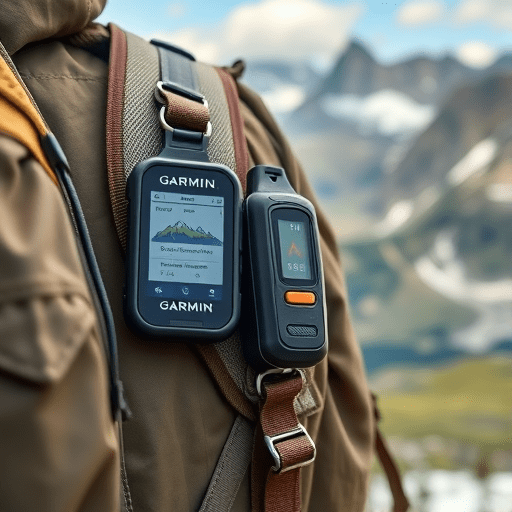
The choice between a personal locator beacon vs Garmin inReach has never been about which device signals louder. Both can launch a rescue. The real split is what happens before and after you press the SOS button, and that split has grown murkier in 2026 as smartphone satellite SOS expands. For remote trail use, dedicated devices still rule, but the reasons for choosing one over the other have shifted. Let’s weigh the trade-offs in cost, coverage, battery life, and emergency workflow.
The PLB Core: One-Way Reliability With Zero Recurring Fees
A personal locator beacon uses a 406 MHz distress signal over Cospas-Sarsat, the international search-and-rescue satellite network. When activated, it transmits a burst with your GPS position to satellites in polar, geostationary, and medium-Earth orbits. In 2026, Cospas-Sarsat’s ground segment upgrade has cut typical detection times below five minutes. You get no confirmation and no conversation. You press, it transmits, and rescue follows.
Cost is the decisive advantage. A PLB costs $300–$450 up front, registration is free, and there are no subscription fees for the life of the device. A modern PLB holds its battery for seven to ten years. That is the entire financial picture: pay once, forget it, and let it sleep until you need it.
The sealed battery cuts both ways. It cannot be recharged, so a false alarm or extended self-test drains it permanently, and you must send the unit back to the manufacturer for a battery replacement. For most hikers, that trade-off is acceptable. An emergency beacon that always has full power when you grab it is worth more than one you can recharge but might have forgotten to.
Garmin inReach: Two-Way Communication With an Ongoing Price
Garmin inReach devices use the Iridium satellite constellation, a network of 66 cross-linked low-Earth-orbit satellites that supports two-way text messaging. In an emergency, you press SOS and then exchange messages with the Garmin IERCC response center: what happened, how many people are injured, whether the scene is stable. You can even call off a rescue if you decide to self-evacuate, which is not an option with a PLB.
This flexibility requires a subscription. In 2026, Garmin’s cheapest prepaid plan is about $19.99 per month on an annual commitment, around $37.99 on a rolling monthly plan, plus a one-time activation fee. A year of active use lands near $280. Own an inReach for three seasons and you have spent more than $1,000 beyond the hardware. That recurring cost is the number-one deciding factor in the PLB vs inReach comparison.
SOS Costs at a Glance
When you add it up over a five-year period, a PLB is still the clear winner on price. A $400 PLB plus a free registration works out to about $80 per year. An inReach with the $19.99 prepaid plan plus activation and hardware totals roughly $1,500 over the same five years. That is nearly four times the cost, and only you can decide whether two-way messaging justifies that difference.
The inReach runs on a rechargeable battery. Garmin rates the Messenger for up to two weeks with 10-minute tracking, but real-world use with message checking and map scrolling drops that to three to six days. You will charge it from a power bank or at a resupply stop. That is convenient on a long expedition, but it introduces a daily power chore a PLB never demands.
Coverage and Battery Life in the Real World
Coverage is where the two diverge in ways that matter in difficult terrain. A PLB’s 406 MHz signal is high-power and reaches satellites even under heavy forest canopy or from the bottom of a steep canyon. Iridium’s lower-power two-way link needs better sky access. In a pine thicket or slot canyon, the PLB is more likely to get through.
Iridium’s real advantage is confirmation. When you send a message from an inReach, you know within a minute or two that it went through. A PLB gives you no such acknowledgment; you have to trust that the burst was received. That lack of feedback makes some users uneasy, even though Cospas-Sarsat has been conducting rescues for more than four decades.
The 2026 Wildcard: Smartphone Satellite SOS Changes the Calculus
A fresh wrinkle in 2026 is the maturity of smartphone satellite SOS. Apple’s Emergency SOS and Android’s satellite messaging now put an emergency radio in the pockets of many hikers, and Starlink direct-to-cell has begun delivering standard SMS to unmodified phones in several countries. A phone can already request help from a remote canyon floor, so why carry a dedicated device?
Because a phone is a poor emergency device. Its battery lasts hours under active use, not days. It fails in cold, in water, and after a bad drop. Its satellite capabilities depend on your exact phone model, your carrier, and your plan, and some midrange devices only share your location with emergency contacts rather than sending full two-way texts. For a deliberate, trail-proven rescue tool, a PLB or inReach still wins.
The smart strategy in 2026 is to combine approaches: carry a zero-subscription PLB as the emergency failsafe, and use a smartphone’s satellite SOS or a friend’s inReach on group trips for casual check-ins. That avoids recurring fees without giving up the ability to text home when you are behind schedule.
Making the Call: Which One Goes on Your Pack?
Boiling the decision down to your route and your willingness to pay:
- Choose a PLB if you want the lowest total cost over many years, never send messages on trail, hike in a group where someone else carries a communicator, or want a device that cannot accidentally run out of battery.
- Choose a Garmin inReach if you hike solo, want family to track your progress, need spot weather forecasts, or want the option to inform rescuers that you are stable and moving under your own power.
- Choose a hybrid setup if you want the always-ready safety and zero subscription of a PLB plus satellite texting through a newer smartphone for everything else.
The personal locator beacon vs Garmin inReach decision still comes down to cost and communication. A PLB keeps your wallet lighter and transmits a signal built to get through; an inReach keeps you in the conversation and in control. In 2026, both are better choices than relying on a phone that could be dead by nightfall. Pick the one that fits your budget, your route, and your need to know—not just your need to be found.