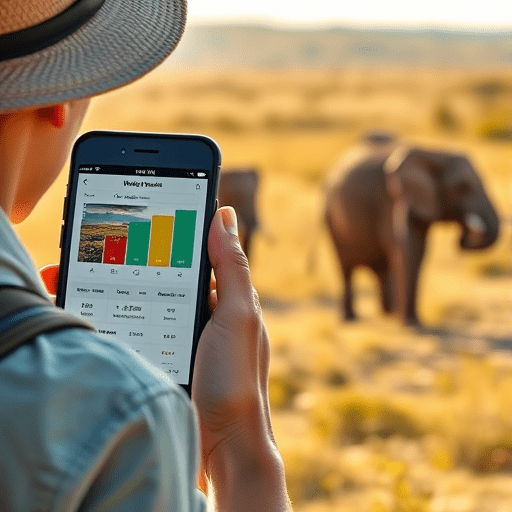
The gap between a tour operator’s marketing promises and the reality on the ground has always been hard to measure. A lodge can call itself “wildlife-friendly” while still offering cub-petting experiences; a safari company can claim “conservation-first” while driving vehicles too close to a pride of lions. That trust gap is exactly why AI monitoring tools are making ethical wildlife tours safer: they are shifting the power of verification away from self-published brochures and into the hands of travelers, researchers, and independent auditors. This year, a new generation of apps has emerged that uses artificial intelligence to audit animal welfare claims before you even open your wallet — and they are changing the way thoughtful travelers choose their trips.
Why “Certified” and “Responsible” Are No Longer Trustworthy
Traditional eco-certifications have not disappeared, but their limitations have become more visible. Many certification schemes rely on annual self-assessments, paperwork audits, and occasional in-person inspections that can be announced months in advance. A facility that passes an audit in January can quietly slip back into harmful practices by June. Other operators simply invent their own badges. The result is a marketplace saturated with unverifiable terms like “ethical,” “sustainable,” and “wildlife-conscious,” all used with little consequence.
In response, the leading AI audit apps take a fundamentally different approach. Instead of relying on what an operator claims, they analyze vast streams of data — tourist photos, live camera feeds, audio recordings, GPS movement traces, and even public review text — and use machine learning models to flag patterns that indicate stress, injury, unnatural behavior, or outright abuse. For the modern traveler, this means a social-media screenshot of a beautiful sunset can be cross-checked against actual welfare indicators. The result is a shift from “trust us” to “verify this.”
Inside the AI Audit Stack: Four Forces Powering the New Apps
Not all AI monitoring tools work the same way, but most of the top apps in this space combine the following techniques to produce a welfare score or risk rating.
Computer Vision: Reading Animal Body Language
Computer-vision models can now recognize subtle indicators of distress in animals: tense posture, repetitive pacing, excessive grooming, or a tucked tail. Newer models go further, analyzing the distance between a tour vehicle and the animal in question. A photograph that looks perfectly fine to a human eye can be flagged by an app for showing a vehicle encroaching on an elephant’s personal space. Many 2026-era apps let users upload a photo from the tour operator’s Instagram feed, and in seconds, the AI returns an estimated welfare risk based on visual cues from the animals and the environment around them.
Acoustic Monitoring: Catching What the Camera Can’t
Sound is a powerful indicator of welfare that human travelers often miss. Elephants may rumble in distress when separated from family members; wild dolphins change their whistle patterns when boats linger too long; parrots in cramped enclosures produce high-frequency alarm calls. Bioacoustic AI models are now trained to recognize these vocal signatures. Some apps pull short audio clips from tour operators’ own videos and analyze background noise to detect stress calls or startling sounds, such as chains rattling or a handler shouting. This acoustic layer is especially useful for marine tours, where animal welfare abuses are rarely captured on camera.
Natural Language Processing: Auditing the Marketing Copy
It sounds almost too simple, but the very words a tour operator chooses can reveal their values. Natural language processing (NLP) models scan an operator’s website, reviews, and social media captions for language patterns associated with exploitation. Phrases like “hands-on encounter,” “photo with,” or “tame and friendly” are flagged as high-risk, while words like “observation,” “distance,” and “protected viewing” are treated as positive signals. NLP tools also sift through hundreds of past traveler reviews, looking for hidden clues such as “the guide made us stand too close” or “the animals looked tired.” This text analysis gives a reliable baseline that is far harder to fake than a badge.
Satellite and Telemetry Data: Verifying It on the Ground
The most transparent apps now combine on-the-ground data with geospatial analysis. Satellite imagery can confirm whether a facility is actually connected to a large protected area or is a fenced display yard masquerading as a sanctuary. Movement data collected from GPS-collared animals, where available, is cross-referenced with tour routes. If an operator claims to provide “wild viewing” but their vehicles track the same collared individual for an entire day, the gap between the promise and the practice becomes obvious. This layered verification is what separates the new wave of AI audit tools from older, static certification systems.
Comparing the New Wave of AI Audit Apps
Most travelers will encounter these tools through one of three app archetypes, each with its own strengths and limitations. Knowing the difference helps you choose the right one for your booking decision.
- Pre-Trip Vetting Apps: These are the most popular and the easiest to use. You paste the tour operator’s name or URL, and the app scans all available digital evidence — reviews, photos, video clips, location data — to generate a welfare compliance score between 0 and 100. The best pre-trip vetting apps cover more than 12,000 operators globally and update their scores monthly. Their limitation is that they can only rely on data that exists online; a brand-new operator with a thin digital footprint may be scored as “undetermined.”
- On-Site Verification Apps: This category turns your own phone into a data-collection tool. While on the tour, you record a short video or take a few photos, and the AI reads the scene live: how close the vehicle is, whether the animal shows signs of stress, and whether the guide’s behavior matches best-practice guidelines. On-site apps are particularly valuable for real-time reporting because they can flag and document problems the moment they occur, creating a timestamped record that is hard for an operator to contest.
- Post-Trip Review Analyzers: These tools use the collective power of past travelers. After a tour, you upload your photos and video clips, and the AI scans your material for welfare indicators. The results are anonymized and aggregated into a publicly visible risk profile for each operator. Over time, the continuous flow of tourist media makes greenwashing increasingly difficult. The more travelers use the app, the harder it is for a bad actor to hide behind a handful of positive reviews.
None of these archetypes are mutually exclusive. The strongest apps available this year combine all three functions in a single subscription, allowing you to vet an operator before you book, collect evidence during the tour, and contribute to a public audit trail when you return home.
How You Can Use These Tools Before Booking
Adopting AI monitoring as part of your travel ritual takes only a few minutes, and it makes a tangible difference for the places you choose to support. A practical, four-step workflow works well for most travelers.
- First, search for the operator’s name in a pre-trip vetting app and read the welfare score plus any flagged incidents. Remember that a low score is often tied to specific, dated events — pay attention to whether the operator has responded with corrective action.
- Second, upload a few of the operator’s own marketing photos or video clips to the app’s analysis tool. This step takes seconds and picks up red flags that a passive score check might miss.
- Third, use your own judgment alongside the AI output. If the score is high but the operator’s website is full of “hands-on” language, the discrepancy alone is reason to look deeper.
- Fourth, once you have narrowed your list, contact the operator with specific questions raised by the app. A genuinely ethical business will welcome your questions; a defensive response is itself a warning sign.
The Limits: What AI Can’t Tell You
For all their sophistication, AI monitoring tools are not a magic wand. They depend on the volume and quality of data they receive, which means popular, heavily photographed sites benefit from better coverage than remote locations. A welfare score is also a snapshot in time, not a permanent guarantee; an operator that passed last month may have changed staff or procedures since then. Furthermore, AI models can struggle with cultural context — certain behaviors that look unusual to a model trained on data from one region may be normal for a different species or environment. And there remains the question of animals who cannot be filmed: nocturnal species, deep-diving marine life, or animals housed in dark indoor enclosures where no tourist camera can penetrate. For those cases, the tools can only rely on indirect signals, such as historical reports or nutritional claims.
The smartest users treat AI audit apps as a powerful filtering mechanism rather than a final verdict. They use the tools to eliminate the worst offenders quickly, then apply their own research and common sense to choose among the remaining options.
The Bottom Line
The power of AI monitoring tools is not that they replace human judgment — it is that they make ethical wildlife tours safer by making animal welfare claims auditable, transparent, and increasingly difficult to fake. As these apps continue to train on larger datasets, their accuracy will only improve, and the cultural norm will shift from passive acceptance to active verification. For the conscientious traveler, that shift is the single most valuable development to come out of the wildlife tourism industry in years. Choosing a tour is still a personal decision, but it no longer has to be a blind one.