You stop outside a restaurant. A staff member waves. You scan the menu on the stand. In the time it takes to check your phone, you flip one page, glance at the photos, and feel the pressure. Most travelers make that call based on hunger and curiosity — but that is exactly how tourist menu traps work. If you learn to spot and avoid tourist menu traps in 3 seconds, you can walk past the overpriced spots and find the table where locals actually eat.
This isn’t about reading every dish or doing a price analysis. It’s a purely visual trick about menu length and photo placement, and once you see it, it’s hard to unsee. In 2026, with AI-generated food photography and QR-code menus becoming more common, the visual signals matter even more.
Why the Menu Is a Restaurant’s Handshake
Travelers love to obsess over online reviews and star ratings. But in real time, the menu is a faster signal. A restaurant has already decided who it wants to attract through its menu design. Tourist trap menus are not accidental. They are built to generate maximum orders with minimum thought.
These menus fight for your attention with crowded layouts, multi-page complexity, and glossy pictures. In high-tourism areas, the menu is a marketing billboard, not a guide to food. The real quality signal is often what the menu doesn’t do.
The 3-Second Visual Menu Test
Before you get pulled into the friendly waiter’s welcome, run this two-part visual test. It takes three seconds. No language skills required. No menu translation app. No reading reviews.
What to do with your eyes
- Step one: check the physical length of the menu. Is it one page, two pages, or a spiral-bound book?
- Step two: check for photos. Do the dishes have picture inserts, or is the food described only with words?
You already have enough information to make a smart exit. The best case is short and word-based. The warning case is long and photo-heavy.
The Menu Length Rule: Deep Is a Red Flag
If a menu has more than fifteen or twenty items, the kitchen is not making each one fresh. It is reheating prep sauces, frying frozen batch items, or assembling plates from cans. Tourist menu traps love length because it signals abundance. It tells a traveler “you have choices!” In reality, it means “we cook all of this in a central kitchen and heat it up.”
A restaurant with a short menu, on the other hand, is telling you what it can execute well. When you see a one-page menu with five appetizers, eight mains, and two desserts, that is a kitchen with focus. It is the easiest visual shortcut to an honest meal.
How many pages is too many?
There are exceptions. A dim sum place or an establishment with a huge wine list may have many pages, and that can still be excellent. But for the standard tourist-zone restaurant, apply this: if a menu looks like a magazine and has separate sections for pasta, pizza, steak, sushi, tacos, and pad thai, you are not in a restaurant. You are in a food court with tablecloths.
The Photo Menu Trap: Why Pictures Are the Second Red Flag
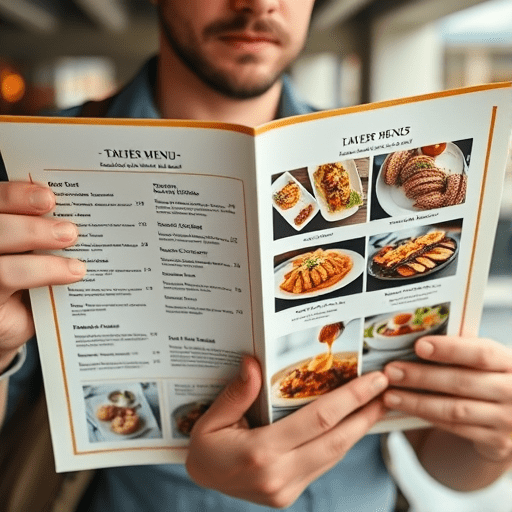
Photos on menus feel helpful. They show you the golden crust of a fish filet, the cheese pull on a burger, the glistening sauce of a stir-fry. But think about your own kitchen. When you cook a good meal, do you need a photo to know what it is? The restaurants that take pride in their food don’t waste menu space on photography because the dish already sells itself once it arrives.
Tourist traps use photos because they are selling the image of food, not the food itself. High-gloss photography is one of the most reliable warning signs that the menu is designed for someone who has no way to judge authenticity — a traveler. The photo ensures you order the expensive “specialty” before you ask what it actually tastes like.
The difference between a photo on a street stall and a photo on a bilingual menu
Street food is a different story. A photo on a plastic board at a hawker stall can be useful because it shows portion size and local preparation. But in a sit-down restaurant targeting visitors, photos are rarely there for clarity. They are there to anchor your expectations to something visually appealing, so you accept the 28-euro reheated pasta plate with a smile.
The trick is to be suspicious if the menu includes photos and is long and is laminated. The triple combo is a near-perfect predictor of a tourist menu trap.
Three Other Visual Cues to Confirm the Suspicion
While you are already looking at the menu, let your eyes drift to a few other places. They should take less than a second each.
- Menus in three languages with pictures? It means the restaurant’s default customer is not a local. A menu translated into English, Chinese, and Arabic while the neighborhood speaks Italian is a sign of international tourist pricing.
- A waiter standing outside the door? It is common in some cultures, but if they are physically blocking your path, the menu is probably a trap.
- The menu’s plastic cover: Heavily laminated, stained, and ribbon-bound menus point to high churn and a business model built on one-time visitors.
Where to Put Your Three Seconds to Work Instead
The visual trick is only useful if you have a replacement strategy. When you skip the long and photo-heavy menu, what should you do?
- Look for a chalkboard outside. Stand with handwritten daily specials. A chalkboard updates on a regular basis, which means the menu is changing with the market and the season.
- Read the actual menu text. If you see phrases like “according to grandmother’s recipe” or “sourced from the local market,” it can still be marketing, but it’s a better sign than a 40-page glossy list.
- Follow the lunch menu. In Europe, many restaurants offer a fixed-price lunch menu on a small board. The short menu is a signal that the restaurant is serving the same food to locals who work nearby.
- Use a translation app on the second sentence of a menu. If the menu has no English, ask for it anyway. A restaurant that keeps a deep menu in the local language is often not a trap — it just has older owners.
The Exceptions That Don’t Kill the Trick
No shortcut is perfect. Some of the best restaurants in the world have long menus, and some have photographs because the owner knows visitors need help navigating an unfamiliar cuisine. The 3-second visual test is not a strict detector; it’s a risk filter.
If the menu is long but the venue is packed with locals at 2:00 p.m., ignore the length. If the menu is short but has a suspiciously shiny photo section in the middle, ignore the photo and check the reviews. The point is to treat the visual signals as a warning, not as a final verdict.
Also, don’t apply the menu length rule to Asian restaurant formats that are naturally different. A hot pot restaurant with a catalog of ingredients is normal. The test works best for the kind of generic, multi-cuisine, “everything for everyone” restaurants that dominate central squares and street corners near famous landmarks.
Make It a Habit: Three Seconds Before You Sit
The real skill isn’t memorizing rules. It is making the scan automatic. When you approach any restaurant on your next trip, pause before you talk to the greeter. Count the menu pages. Search for photos. Check the language of the first line. Once you practice it on a few city trips, the pattern becomes obvious.
You’ll notice how many places are built for tourists and how many are simply for people who happen to be hungry. The best meal of a trip often happens when you turn away from the menu trap and walk down the side street where the menu is short, the paper is cheap, and the room is full of locals.
The Bottom Line
A tourist menu trap is not just about money — it’s about the experience. You did not travel all the way to a new city to eat a reheated version of something from a hotel buffet. A 3-second menu check can be the difference between a forgettable meal and a trip highlight. The next time a server hands you a menu on the street, don’t open it hoping. Look at the cover, feel the paper, count the pages, and notice whether the food is described or displayed. Your instincts will do the rest.