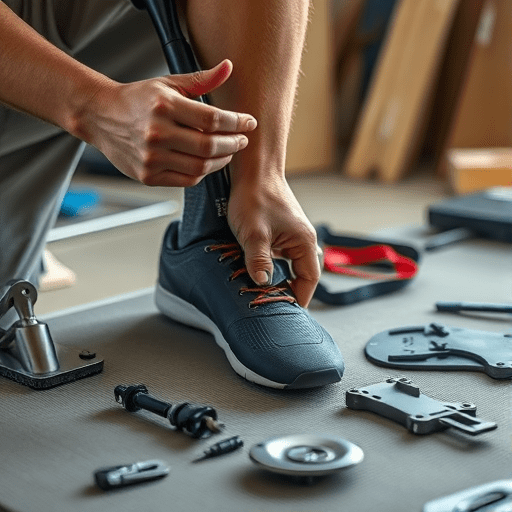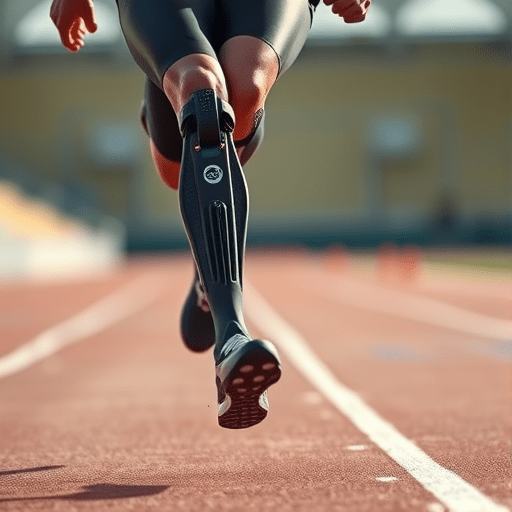
The image of a Paralympic sprinter exploding off the starting blocks no longer fits the old narrative of human grit compensating for missing limbs. In 2026, it is increasingly the prosthetic itself doing the compensating. A quiet revolution in additive manufacturing, materials science, and biomechanical modeling has moved prosthetics from the realm of medical devices into the realm of elite sporting equipment, and athletes are rewriting records as a direct result. The finish line, once a metaphor for limitation, has become a starting point for engineered performance.
From Medical Device to Carbon-Lattice Competition Gear
Traditional prosthetics were designed to restore function, not to optimize it. They prioritized comfort, durability, and approximate replication of natural movement. The shift began when engineers stopped asking, “How do we make this limb work like the original?” and started asking, “What does an athlete actually need from a limb during a specific event?”
The answer turned out to be something no human body can provide: tunable stiffness, mass distribution, and energy return calibrated to the millisecond. Modern sprinting blades now use internal lattice structures generated by generative design software, then produced in carbon-fiber-reinforced polymers through automated fiber placement and 3D printing hybrids. The result is a blade that is rigid where force is applied, compliant where the foot would normally dorsiflex, and lighter than its predecessor by margins that translate into measurable hundredths of a second.
One notable 2026 development is the use of multi-material printing, where a rigid carbon core is co-printed with a viscoelastic outer layer. The outer layer absorbs lateral stress during curve running, while the core delivers forward propulsion. Coaches report that athletes adapt to these hybrid blades within days rather than weeks, a change attributed to the way additive manufacturing allows geometry to be tailored to an individual gait analysis rather than a population average.
Generative Design and the Athlete-Specific Socket
If the blade is the visible revolution, the socket is the invisible one. The socket is the interface between residual limb and prosthetic, and historically it has been the weakest link, both literally and figuratively. Ill-fitting sockets cause skin breakdown, restrict blood flow, and force athletes to compensate with suboptimal movement patterns. In high-stakes competition, a millimeter of misalignment can cost a medal.
In 2026, the leading approach involves scanning the residual limb with structured-light 3D scanners, capturing not just geometry but surface pressure maps during sprinting. That data feeds into a generative design algorithm that proposes a socket topology optimized for force distribution, ventilation, and suspension. Engineers then print the socket in a continuous run using a flexible thermoplastic polyurethane blended with carbon fiber, achieving a fit that adapts dynamically to muscle movement during the stride.
What makes this meaningful beyond performance is comfort. Athletes who previously required daily socket adjustments or who trained at reduced intensity due to pain are now able to push harder and recover faster. The line between training volume and injury risk has shifted.
AI Tuning in Real Time
Artificial intelligence has become the unsung collaborator in prosthetic design. Machine learning models trained on thousands of stride cycles can predict how a candidate design will perform before a single gram of material is laid down. In elite training centers, this feedback loop happens overnight, allowing a coach and engineer to test dozens of design iterations digitally before committing to a physical print. The 2026 Paralympic season has seen several world records set using blades whose final geometry was selected by an algorithm rather than by intuition.
Materials That Outperform Biology, On Purpose
There is a philosophical debate in adaptive sport about whether engineered prosthetics confer an unfair edge. The current consensus among governing bodies, including the IPC, is that they do not, provided that all athletes in a class have access to comparable technology. The more interesting question is whether this principle scales. As printing costs drop and design tools become more accessible, the technology ceiling rises for everyone.
Materials science is leading that rise. Several Paralympic programs are experimenting with 3D-printed titanium pylons for long jumpers, where stiffness-to-weight ratios exceed those of the femur. For swimmers, hydrophobic lattice grips printed in elastomeric polymers reduce drag on the entry phase. For cyclists, frame-mounted prosthetic adapters are now printed with integrated strain sensors that transmit real-time power data to the rider’s head unit.
None of these technologies are designed to replace the body. They are designed to do what the body cannot do in a specific competitive context. That distinction is subtle but important, and it is reshaping how the public understands Paralympic performance.
The Open-Source Movement and Grassroots Innovation
The 2026 Paralympic conversation is not only happening in elite labs. The open-source prosthetics movement, which has been gaining momentum for years, has matured into a credible contributor to the field. Community-driven projects now share socket scan files, blade geometries, and printing parameters under permissive licenses, allowing prosthetists in lower-resource settings to produce competitive-grade equipment.
This matters because Paralympic talent does not respect national wealth. Several athletes who competed at the 2024 Games came from countries where commercial prosthetics were simply unaffordable. With a desktop scanner, an open-source design file, and a mid-range industrial machine, a clinic can now produce equipment that would have required a six-figure budget a decade ago. The performance gap between well-funded programs and emerging ones is narrowing, and that is changing the medal tables.
What This Means for Coaching and Training
Coaches are having to learn new vocabulary. Terms like “energy return curve,” “lattice cell density,” and “torsional compliance” are showing up in training staff meetings. The athlete-prosthetic pair is now treated as a single system to be optimized, with engineers present in the training environment rather than consulted after the fact. Some programs have even embedded 3D printers in their high-performance centers, allowing for between-session modifications and rapid prototyping of equipment adjustments.
Sustainability and the End-of-Life Question
A less glamorous but increasingly urgent conversation is about what happens to elite prosthetics after their competitive life. Carbon-fiber blades are difficult to recycle, and older prosthetics frequently end up in landfills. The 2026 generation of equipment is being designed with end-of-life in mind. Manufacturers are experimenting with thermoplastic carbon composites that can be shredded and reprinted, and several programs have launched take-back schemes that refurbish used blades for emerging athletes.
This is not merely a marketing concern. As performance standards rise, the equipment churn rate increases, and the environmental footprint of high-performance adaptive sport grows with it. Engineers who began their careers focused solely on performance metrics are now balancing design briefs against lifecycle assessments.
The Next Two Years
Looking ahead, the boundary between prosthetic and athlete will continue to blur. Research programs are exploring 4D-printed components that change stiffness in response to temperature, allowing a single blade to perform across sprinting, jumping, and endurance events. Neural interface research, while still in early stages, hints at a future where prosthetics respond directly to motor cortex signals rather than mechanical cues.
For now, the 2026 Paralympics are showcasing what is possible when materials science, additive manufacturing, and athletic ambition converge. Records are not merely being broken; the question of what constitutes a record is being redefined. The finish line is still the goal, but the technology that carries athletes across it is being redesigned with every layer of printed carbon.
In the end, the story of 3D-printed prosthetics is not a story of replacement. It is a story of expansion, of what the human-plus-machine system can achieve when engineering is allowed to take athletes beyond the limits their bodies alone would impose. The Paralympic movement has always been about possibility. In 2026, that possibility is being printed, layer by layer, into hardware that finally matches the ambition of the people who use it.