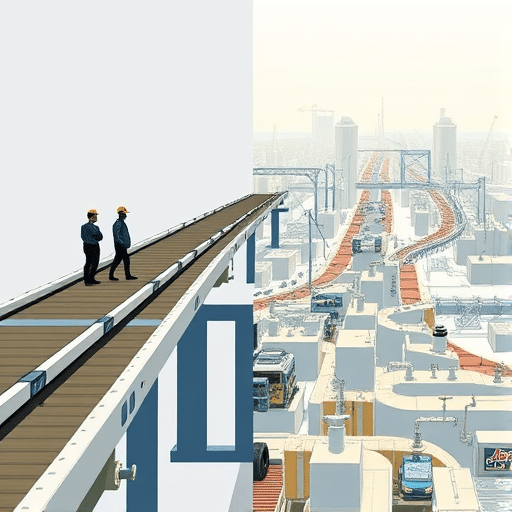
The codex screen is where narrative ambition goes to die. Players skim, scroll, and skip, carrying only a vague impression that some civilization collapsed—never truly feeling its weight. Silent storytelling through level design offers a better path. By embedding spatial clues within the architecture of a space, developers reveal generations of conflict, ambition, and loss through materials, placement, and light.
Spatial clues to reveal history are not decorative flourishes. They form a silent language the player learns to read without ever being told they are reading. A doorway narrower than the rest of the hall, cut by a culture that feared giants—that is history visible with the bare eye.
Why Codex Dumps Fail the Players They Want to Reach
Text logs demand a player stop moving and start reading. A codex entry interrupts the exploration loop and forces the player to decouple movement from comprehension. Spatial storytelling communicates while the player is already traversing, climbing, walking. A ruined chapel tells the story of a fire in seconds, whereas a diary page takes a minute of work.
Worse, codex entries are optional. The player who skips them never knows what they are missing. But space is compulsory. You cannot cross a courtyard without noticing that the floor is scorched at the height of a child’s waist, or that the wall mural halts mid-battle. The player absorbs the history whether they intended to or not.
Reading Space Like an Archaeologist: Layers in a Single Room
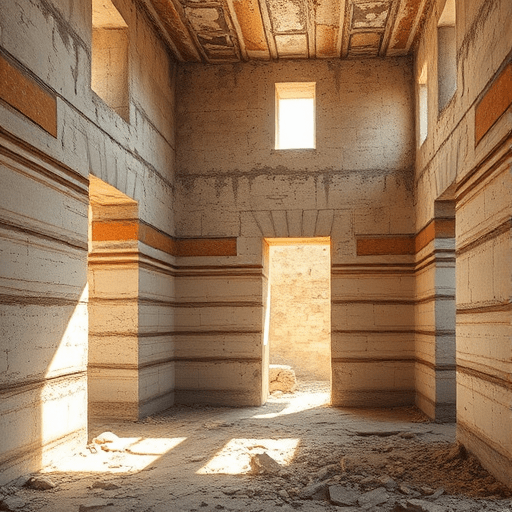
The most effective silent storytelling does not show one frozen moment—it stacks multiple eras into the same load-bearing wall. A good level is a palimpsest: newer plaster over older brick, repaired cracks indicating a long-ago collapse, fresh paint hiding a structural failure the occupants no longer care to address.
Take a simple room. The floor carries two different tiles: polished marble and rough stone patched over a hole where something heavy broke through. Beside it, the inspector’s hatch is welded shut. The player understands, without a single note, that there was an incident, that someone sealed it up, and that the current residents are afraid. That is spatial history—the opposite of a codex dump.
Developers can achieve these strata with three contrasts:
- Material: the oldest part of a structure uses resources found nowhere else.
- Age: the newest additions sit on top with visible mismatches.
- Use: the walkway everyone trods is worn smooth, while the corners remain untouched.
Layers like these are the spatial equivalent of a timeline.
Absence as Evidence: Designing Negative Space
Some of history’s most powerful signs are things that are not there. A statue with a chiseled-off base tells you a regime fell and its symbols were purged. A food hall with benches stacked along the wall indicates a rushed departure, not a gradual one. A trophy room with empty brass hooks shows a cultural shift away from militarism—or a theft so sudden that no one cleaned up.
The key is to place the absence deliberately. A hollow doorway with its hinges still intact tells an attentive player the door was taken, not destroyed. A gun rack that holds only dust tells of an army that left willingly. These details work because the player’s mind fills in the missing object, then wonders why the developer bothered to leave the hint. That cycle—look, think, infer—beats any paragraph of flavor text.
Orientation by Light: Making History Unmissable
If the player never looks at the clue, it is just an elaborate prop. Light and geometry solve the problem. A shaft of daylight falling through a broken ceiling onto a faded floor mural draws the eye without a single arrow. Placing a clue at the end of a corridor, or beside the first corner after entering a room, aligns with natural scanning behavior.
Consider the 90-degree rule: players notice details off to the side more dramatically than what is straight ahead. Set a collapsed colonnade at the edge of a transition hallway, not dead-center. The player catches it as they turn—a private burst of recognition. Avoid the glowing skull on a plinth. Give the clue natural illumination, and the player feels like a detective rather than a tourist.
Let the Player Dig: Turning Observation into Interaction
Observation is passive, but interaction is the heart of gameplay. Silent storytelling through level design works best when the player physically joins the excavation. Breakable walls reveal older brickwork; moss hides a name carved decades ago; sliding panels expose a coal scuttle from an era before electricity. Each micro-interaction turns lore recovery into an active reward for curiosity.
Discovery is strongest when the spatial clue is the payoff of a tiny effort—not a puzzle, but an exploratory gesture. The mechanic can be as simple as stepping into a circle of dead grass, hearing a dry crunch, and looking down at the lattice of a cracked foundation. That object is the trace of a house that lost its roof. The player’s virtual digging replicates the archaeologist’s trowel, and that embodied narrative surpasses any codex entry.
Pitfalls to Avoid: When Spatial Clues Become Object Theater
The silent approach can fail. The biggest pitfall is overcomplicating the environment. If every wall is a historical document, the player stops caring and space becomes clutter.
A second pitfall is the too-loud clue. A single object on a spotlighted plinth reads as a quest hint, and the environment becomes a slot machine. Scatter clues with confidence and let the player sift; history should be findable, not forced.
A third pitfall is the urge to make everything readable. It is better to have a tile pattern that looks like a broken city layout than to slap a tiny legend on it. When all the history is on the surface, there is nothing left for the player’s imagination to build.
Finally, the spaces need temporal depth. A world that has existed for centuries should not feel built last week. Show thinning renovations, graffiti pasted over other graffiti, and a player who is walking through a living document, not a museum diorama.
The Player as Co-Author of the City’s Memory
When lore lives in the architecture, the player becomes the scribe. They walk through a place and emerge with a mental model of its history—their own, yet unmistakable. The joy is not in being told, but in asking the question and drawing the conclusion. Silent storytelling through level design invites players to reconstruct the past with their own hands and feet.
Conclusion: Trade the Chapter for the Corridor
Codex dumps are the chapter nobody wants to read. Spatial clues to reveal history are the museum wing, the trench, and the weather-worn face of a forgotten city all at once. Treat the floor plan as a historical document: layers, absences, interaction, and light convey everything a codex ever could, with far more staying power. Players will forget the paragraph they skipped, but they will remember the scorch mark on the nursery wall.