In 2026, the cloud’s default computing unit is no longer a long-lived virtual machine but a short-lived spot instance that can disappear on a moment’s notice. That shift has created a quiet crisis in configuration management: traditional Ansible workflows assume you can reach a stable host at the end of a provisioning pipeline. The solution smart infrastructure teams are adopting is to run Ansible on spot instances via Pulumi-managed lifecycle hooks, treating cloud lifecycle events as the triggers that drive configuration. This approach turns disposable servers into dependable, self-configuring workers—without sacrificing the declarative power of Ansible or the infrastructure-as-code guarantees of Pulumi.
Why Ephemeral Servers Need a New Orchestration Playbook
Ephemerality changes the failure model. A spot instance can be reclaimed with a two-minute warning, an Auto Scaling group can terminate an unhealthy node mid-playbook, and a batch job can finish so quickly that the host is gone before you ever open an SSH session. Old-school orchestration that assumes persistent inventory, long-lived SSH connections, and central control nodes starts to look fragile.
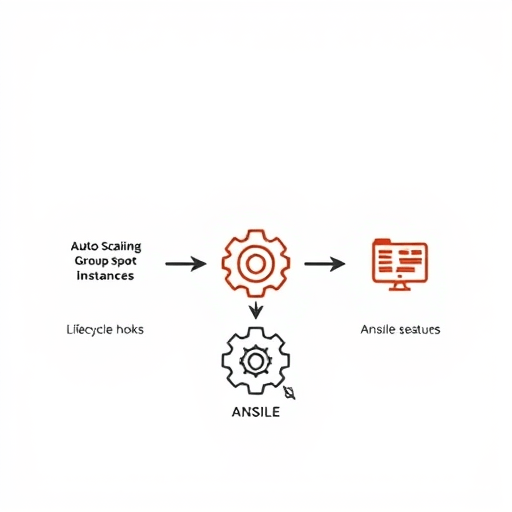
The answer, increasingly, is event-driven orchestration. Instead of deciding when to run Ansible based on a static schedule or an external CI job, the instance lifecycle itself becomes the scheduler. A launch event means “provision and configure.” A termination event means “clean up, extract state, and say goodbye.” Pulumi is uniquely positioned to build this bridge because it is not just a provisioning tool; it can also deploy the functions, queues, and notification pipelines that respond to lifecycle events. Pulumi-managed lifecycle hooks become the connective tissue between the cloud’s native lifecycle signals and Ansible’s configuration automation.
How Pulumi-Managed Lifecycle Hooks Trigger Ansible at the Right Moment
Pulumi programs can define an entire ephemeral workload in one stack: a launch template, the Auto Scaling group, the spot instance allocation strategy, the lifecycle hooks, and the worker functions that respond when those hooks fire. The lifecycle hooks themselves are typically configured at the Auto Scaling group level. They put the instance into a wait state and emit a notification to a target—an EventBridge rule, an SNS topic, or an SQS queue. A small handler, also created by Pulumi, consumes that notification and invokes Ansible against the specific instance that generated the event.
The key is that Pulumi manages the entire pipeline as a single cohesive resource graph. If you add a new Ansible role, you don’t have to manually update a separate Lambda or CI job. You simply define the handler once, and Pulumi wires it to the lifecycle hook with the right IAM permissions, retry policies, and dead-letter queues. The result is that the “orchestrator” is part of the infrastructure itself, rather than a bolted-on external system.
Launch Hooks: Configuring the Instance Before It Joins the Fleet
When an Auto Scaling group launches a spot instance, the launch lifecycle hook pauses the instance before it reaches the `InService` state. That pause is the perfect window to run Ansible. The handler triggered by the launch event can run a playbook that installs packages, writes configuration files, joins the instance to a cluster, or runs smoke tests. Only after the playbook reaches its `post_tasks` does the handler signal the lifecycle hook to continue, allowing the instance to start serving traffic. If Ansible fails, the hook can abort the launch, automatically replenishing the capacity with a fresh instance and preventing broken nodes from ever receiving load.
Termination Hooks: Extracting Logs and State Before the Instance Disappears
Termination lifecycle hooks serve the reverse purpose. When a spot instance is interrupted or an Auto Scaling group scales in, the termination hook gives your Ansible playbook one last chance to act. Typically this is a slim shutdown playbook: drain connections from the load balancer, flush logs to S3, upload any important state to object storage, and clean up temporary secrets. Because the instance is already in a wait state, Ansible can run safely without racing against the hypervisor. The termination hook turns a potentially chaotic shutdown into a graceful final act.
Designing an Interruption-Safe Ansible Run on Spot Instances
Spot interruptions are not a bug; they are a guarantee to plan around. The most direct risk is that Ansible is mid-playbook when the two-minute warning arrives. There are a few strategies to make your playbooks resilient in that window.
First, keep the critical work at the beginning of the playbook. If you can install and configure the essentials in the first minute, the remainder of the run is just polish. Second, structure playbooks so they are idempotent and resumable: if a task fails or the instance is interrupted, the next instance that replaces it can run the same playbook without conflict. Third, use Ansible’s own features like `serial` and `fork` to avoid overloading the instance, and consider `–timeout` to keep SSH from hanging on a dying host.
The lifecycle hook also defines how much time you have. Launch hooks typically allow up to an hour, but for spot instances you should assume seconds matter. Keep the playbook lean, use `gather_facts` sparingly, and consider using a lightweight connection like AWS SSM or a Pulumi-provisioned WireGuard mesh instead of public SSH. The less network overhead your orchestration requires, the more likely it is to finish inside the interruption window.
Handling Configuration, State, and Secrets on Disposable Infrastructure
Ephemeral servers force you to rethink where configuration lives. If an instance can vanish at any moment, you cannot rely on drift-correcting cron jobs or manual SSH sessions. The playbook becomes the single source of truth for the instance’s desired state. Anything that needs to survive the instance must be pushed to durable storage before the termination handler runs.
Secrets are the trickiest part. Storing a private key or API token in a spot instance’s local disk is a security liability, because you cannot guarantee the disk is wiped when the instance is repurposed. Instead, pull secrets at runtime from a managed store such as HashiCorp Vault, AWS Secrets Manager, or Pulumi ESC. Ansible can fetch secrets using a lookup plugin or a custom action module, and the Pulumi-managed handler can inject a short-lived IAM role into the instance that grants access to exactly the secrets it needs. When the instance terminates, the role disappears and the secrets never touch persistent storage.
For stateful components like Ansible fact caching, avoid a local cache file. Use a shared backend like Redis, a database, or a secrets manager that can be updated by the launch playbook and read by the termination playbook. That shared state ensures a replacement spot instance can bootstrap itself based on what the previous instance learned before it disappeared.
Observability and Recovery for Fleets That Disappear
When your fleet is constantly churning, traditional host-based monitoring produces noise: hosts go offline, metrics gaps appear, and dashboards fill with red. The better approach is to monitor the fleet as a whole, and the lifecycle hooks themselves become valuable telemetry. Every launch, termination, and replacement event that Pulumi manages can be emitted to a log stream or an analytics pipeline. These events give you an audit trail of exactly when Ansible ran, how long it took, and whether it succeeded or failed.
To get that level of visibility, have the Ansible playbook send structured JSON events to CloudWatch, DataDog, or your preferred observability platform at the end of each notable task. Use Ansible callbacks to capture task-level metrics and upload them with the termination handler. The key is to make logging part of the lifecycle contract: any instance that terminates must first export its logs, otherwise an auto-replacement process—also orchestrated by Pulumi—can flag the incident for deeper inspection.
Operational Best Practices for Ephemeral Orchestration
Teams that successfully run Ansible on spot instances with Pulumi tend to converge on a consistent set of practices. These are the fundamentals worth replicating:
- Treat Ansible as a bootstrapping layer, not a living connection. Once the playbook completes, the instance should be stateless and self-contained. No periodic ad-hoc commands on ephemeral hosts.
- Make every lifecycle hook idempotent. The same launch event may fire more than once, and the same termination handler may retry. Ansible playbooks must be safe to rerun against a host that is already fully or partially configured.
- Isolate the handler from the infrastructure. The Pulumi-managed function that triggers Ansible should live outside the Auto Scaling group, so a spot interruption in the compute layer never takes down the orchestrator itself.
- Use the smallest possible success window. If a playbook never finishes before the spot claim, your architecture does not actually survive. Continuously measure the time from launch event to `InService` and shorten it ruthlessly.
- Version your playbooks with your infrastructure. Because Pulumi and Ansible are declared together in the same repository, you can tag the exact playbook revision that corresponds to each stack version. That eliminates the classic “but it worked on the other instance” problem.
From Disposable Hardware to Dependable Compute
The mental shift matters as much as the technology. Spot instances are not “cheap and dangerous”; they are fault-tolerant compute units that need a fault-tolerant control plane. Pulumi provides that control plane by managing lifecycle hooks natively, while Ansible supplies the configuration intelligence that turns raw compute into a purpose-built worker. When the two are wired through lifecycle events, servers come and go while the workload remains stable. The orchestration no longer chases stability; it embraces ephemerality and designs for it. The result is a fleet that can regenerate itself from one codebase, one stack, and one reliable playbook—even when the underlying hardware changes by the minute.