Missed doses, skipped appointments, abandoned care plans—non-adherence has long been the silent tax on healthcare outcomes. But a new generation of predictive patient apps is changing the game. Instead of reacting after a patient drops off, these apps now use AI risk scoring to identify the subtle behavioral, clinical, and contextual patterns that precede non-adherence—often weeks before the patient even feels at risk. This future-outlook guide explains how adaptive engagement platforms are moving beyond simple reminders to anticipate, personalize, and prevent non-adherence before it starts.
Why Static Adherence Interventions Are Obsolete
Traditional adherence tools rely on fixed rules: push a notification after a missed dose, send a generic text before a refill, or schedule a follow-up call when a patient falls behind. These approaches are reactive and coarse. They treat every patient as an average, ignoring the fact that non-adherence is rarely one event—it’s a trajectory influenced by motivation, socioeconomic pressures, medication side effects, mental health, and even weather or commuting patterns.
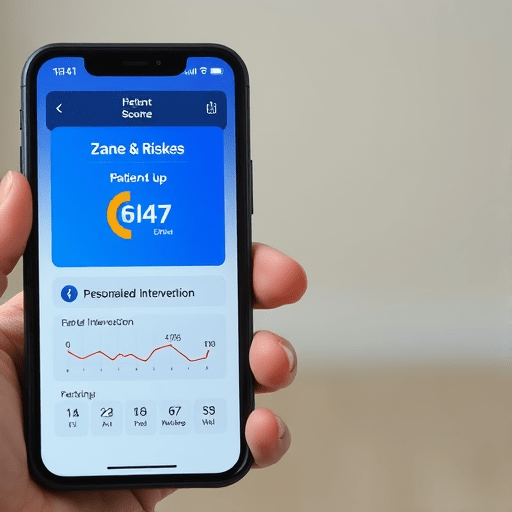
By the time a static system registers a missed dose, the patient has already begun a decline. In contrast, predictive patient apps model adherence as a dynamic probability. They continuously compute risk scores from digital breadcrumbs—how often the patient opens the app, logs symptoms, updates biometric readings, or interacts with chatbots. When the score crosses a personalized threshold, the app engages the patient with a tailored intervention, not a generic nudge.
The New Anatomy of AI Risk Scoring in Patient Engagement
AI risk scoring in modern engagement apps is not a single algorithm. It’s a layered system that fuses multiple data streams into a livesine. The core insight is that non-adherence has recognizable precursors, and those precursors are increasingly visible in the patient’s digital behavior.
Data Sources That Feed Real-Time Risk Models
Predictive patient apps draw from several categories of data to train and refine their risk models. Clinical data like diagnoses, recent lab values, and prescription refill history provides the baseline. Behavioral data adds nuance: login frequency, navigation patterns, completion of in-app surveys, and response times to notifications. Device-generated data from wearables and connected sensors contributes physiological context, such as heart rate variability, sleep quality, and physical activity changes. Unique to the latest generation of tools, passive context signals—like language sentiment in patient chat messages and even time-of-day activity patterns—help models detect emerging distress before a missed dose occurs.
From Risk Score to Personalized Intervention
Once the risk score is computed, the real work begins: deciding what to do with it. A high risk score does not automatically trigger an alert. Instead, the app’s engagement engine matches the patient’s profile to the most effective intervention style. For a patient with cognitive overload, the app might simplify the medication schedule and show visual progress. For a patient experiencing side effects, the intervention could be a quick educational snippet about side-effect management or a direct link to schedule a telehealth visit. The key is that the intervention is generated for that patient at that moment, using the risk score as a starting point, not an endpoint.
Designing Engagement Apps That Act on Risk, Not Just Display It
The promise of AI risk scoring only materializes if the app can act on it with precision. A risk score buried in a clinician dashboard does nothing for the patient. In 2026, the most successful predictive patient apps are those that embed risk-aware logic directly into the user experience, turning every screen into a potential point of intervention.
Triggering the Right Channel at the Right Moment
Context matters more than frequency. A patient who always checks the app in the morning should not receive a high-priority alert at 9 p.m. Instead, the app learns each patient’s optimal engagement windows. For some, an in-app notification with a gamified streak is enough. For others, a text message with a direct phone link works best. The shift is toward channel orchestration—choosing between push, SMS, email, voice assistant, or a human call from a care coach based on both the risk level and the patient’s historical responsiveness. This minimizes disruption while maximizing influence.
Avoiding Alert Fatigue in Patients and Clinicians
Over-triggering is the fastest way to burn out both patients and care teams. AI risk scoring addresses this by assigning confidence levels to each prediction. Only when the model is highly confident and the predicted consequence is meaningful—like a missed chemotherapy dose versus a missed vitamin supplement—does the app escalate to a human clinician. For lower-risk cases, the app may simply adjust the next set of prompts or delay a non-urgent inquiry. The goal is to reduce the noise, not add to it, so that each alert carries genuine weight.
The Human Side: Trust, Transparency, and Clinical Oversight
For predictive patient apps to gain adoption among patients and providers, the AI risk scoring process must be transparent. Patients want to know why the app is asking more questions or changing their schedule. Clinicians need to understand the factors driving a high-risk score before they act on it. This means every risk assessment should generate an explainable summary—such as “Mrs. Chen’s adherence risk increased due to irregular sleep patterns and a longer than usual gap between app check-ins.” It also means the system must have clear fallback paths for patients who prefer not to share certain data types, ensuring that consent and privacy remain central.
Clinical oversight remains non-negotiable. The app’s risk scores are decision support, not decisions. Care teams must have the ability to override, annotate, and give feedback to the model. This human-in-the-loop approach keeps the system accountable and continuously improves its predictions. In practice, leading health systems pair these apps with pharmacist-led outreach for high-risk patients, using the AI signal to prioritize limited human resources on the people who need them most.
What This Means for Health Systems, Payers, and App Developers
The shift to proactive risk scoring changes the economics of patient engagement. Health systems no longer have to guess which patients to call or how often. Payers can identify at-risk populations earlier and tie reimbursement to measurable prevention milestones, not just fill rates. App developers must move beyond feature checklists and invest in iterative model validation, behavioral science integration, and interoperability with electronic health records. The winners in this space will be those who treat the risk score as a living, evolving conversation with the patient—not a one-time classification.
In this environment, the best predictive patient apps feel less like software and more like an attentive care partner. They notice when a patient’s routine shifts. They ask the right questions at the right time. And they quietly intervene before a small lapse becomes a permanent gap.
Conclusion
AI risk scoring in predictive patient apps represents a fundamental move from hindsight to foresight. By combining clinical, behavioral, and contextual data with adaptive intervention design, these tools can stop non-adherence before it starts—improving outcomes and reducing the emotional and financial burden on patients and systems alike. As the technology matures, the most durable competitive advantage will be earned not by the accuracy of the algorithm alone, but by the empathy and intelligence of the engagement experience that surrounds it.