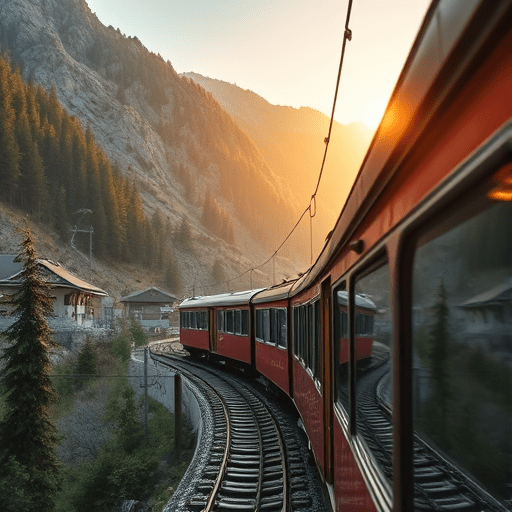
The Bernina Express and the Glacier Express tend to dominate every conversation about scenic Alpine rail travel. Their panoramic carriages, towering viaducts, and snow-dusted peaks are legendary — and crowded. Yet scattered across Switzerland, Austria, Italy, and France are lesser-known mountain railway lines that deliver just as much drama without the packed coaches and reserved-seat rush. For slow travel enthusiasts, these quieter corridors are where the Alps actually breathe.
If you have already ridden the famous routes and want something more intimate, more local, and more surprising, the following seven hidden Alpine rail routes offer a different kind of journey. Expect timber villages, forgotten tunnels, lakes the color of glacier melt, and conductors who still greet passengers by name.
1. The Aigle–Sépey–Diablerets Line (Switzerland)
Hidden in the Vaud Alps just south of Lake Geneva, the ASD railway climbs from the wine town of Aigle through orchards, pastures, and the tiny spa resort of Le Sépey before terminating at the foot of the Diablerets massif. The train is a humble single-car unit that feels almost private, rattling past wooden hay barns and herds of Simmental cattle.
The route traces the slopes above the Grande Eau valley, and on clear evenings the glow from the Dents du Midi stays with you all the way to the end of the line. Hikers often disembark for trails to the Col du Pillon, while winter travelers transfer to the glacier cable car. Few tourists know this line exists, which is exactly why it works.
2. The Centovalli Railway (Switzerland–Italy)
Where the Bernina draws crowds between Chur and Tirano, the Centovalli quietly does something equally remarkable between Locarno and Domodossola. Translating to “one hundred valleys,” the line crosses the border between Switzerland and Italy more than thirty times, switching tracks in border towns so often that passengers stop noticing the flags.
Vineyards spill onto the tracks near Intragna, stone bridges leap from gorge to gorge, and the small towns — Verdasio, Palagnedra, Re — feel almost medieval. The journey takes around two hours but feels longer, in the best sense. Italian cappuccinos at Domodossola station are the perfect punctuation mark.
Why it works for slow travel
- Frequent stops with no reservation required
- Dramatic gorge scenery without the tourist volume
- Cross-border charm in a single ride
3. The Mariazellerbahn (Austria)
Forests, monasteries, and rolling foothills rather than ice peaks define this narrow-gauge line in Lower Austria. The Mariazellerbahn links the railway hub of St. Pölten with the pilgrimage town of Mariazell, where a baroque basilica has welcomed travelers for centuries. The steam-hauled Maríazellerbahn Himmelstreppe, or “Heavenly Stairway,” climbs through the Ötscher landscape with gradients so steep they require special rack-and-pinion sections.
Because the route is mostly inland and far from the postcard mountain corridors, it remains a local secret. Expect forest tunnels, mushroom pickers, and loyal pilgrims who treat the journey as part of the devotion. In autumn, the beech canopy turns copper and the open-window carriages smell of woodsmoke from nearby farms.
4. The Ligne de Cerdagne (France)
Better known to French rail enthusiasts as the Train Jaune, the Yellow Train threads across the eastern Pyrenees between Villefranche-de-Conflent and Latour-de-Carol. Although not strictly Alpine in name, the range is technically part of the greater Alpine system and the scenery matches anything in Switzerland.
Bright yellow and electric from the outset, the train crosses the dramatic Séjourné viaduct, dips into the Têt valley, and pauses at remote villages where Catalan remains the first language. At Bolquère-Eyne it reaches France’s highest railway station, perched at 1,593 meters. The pace is unhurried, the carriages rattle charmingly, and almost every passenger is a regular.
Travel tip
Sit on the left heading toward Latour-de-Carol for the best vantage of the Têt gorges and the fortress above Villefranche.
5. The Rigi Railway (Switzerland)
Rigi is famous, but its railway is rarely the headline act. While tourists crowd the Pilatus cogwheel near Lucerne, the Rigi Bahn glides from Vitznau or Arth-Goldau to the summit with a quiet confidence. Built in 1871, it was Europe’s very first mountain rack railway, and the wooden carriages still feel like a living museum.
The summit rewards travelers with views spanning Lake Lucerne, the Bernese Oberland, and on the clearest days, the Black Forest in Germany. Because most visitors come up by cable car from Weggis, the rail ascent feels refreshingly uncrowded. Hike down through wildflower meadows and catch a later train, or simply sit on the terrace and watch the clouds trade places with the peaks.
6. The Ferrovia della Valmorea (Italy)
Just across the Italian border from Switzerland, the Valmorea railway was once a vital cross-border link between Castellanza and Mendrisio. Most of the line closed to passenger service in 1952, but a heritage operation has restored a scenic stretch from Castellanza to Malnate, with ambitions to extend toward the frontier.
The train trundles past villas, vineyards, and wooded ridges, the gentle hum of its vintage diesel units mixing with birdsong. Tourists almost never find this line on their own. Pair it with a visit to Lake Varese and the unassuming beauty of the Prealpine landscape feels like stepping into a different era of rail travel.
7. The Montenvers Railway and the Mer de Glace (France)
Finally, a route that hides in plain sight near Chamonix but is regularly missed by visitors too dazzled by the Aiguille du Midi cable car. The Train du Montenvers has been climbing from the town center to the Mer de Glace glacier since 1909, and despite its proximity to one of the Alps’ busiest resorts, the red trains still feel like a quiet adventure.
The line was extensively rebuilt in recent years using modern trains that climb a stunning 20 percent gradient, but the arrival remains the same: a sweeping view of the glacier, now lower and more fragile than a century ago, framed by the Dru and the Grandes Jorasses. Walk down the newly carved ice grotto and you will understand why Alpine rail travel has always been about more than reaching a summit.
Practical Tips for Riding the Lesser-Known Alpine Lines
Hidden routes reward travelers who plan loosely rather than rigidly. A few habits make the experience smoother:
- Buy regional passes like the Swiss Travel Pass or the ÖBB Vorteilscard to avoid ticket-by-ticket friction.
- Avoid July and August school holidays if silence is the goal. Shoulder seasons in May, June, and September often deliver better weather and empty seats.
- Carry cash for small stations where ticket offices only open seasonally.
- Pack layers, even in summer. Mountain valleys can swing fifteen degrees in a single afternoon.
Beyond the famous Alpine rail routes lies a quieter network of trains that move at the pace of the valleys themselves. From the rack-and-pinion climb of the Mariazellerbahn to the Catalan-flavored Yellow Train of the Pyrenees, each of these hidden lines reveals a different face of the mountains. The Bernina Express will always have its place on the bucket list, but the Alps feel far more personal from a wooden seat in a half-empty carriage, watching the conductor wave at a farmer who has caught the train every Tuesday for forty years.