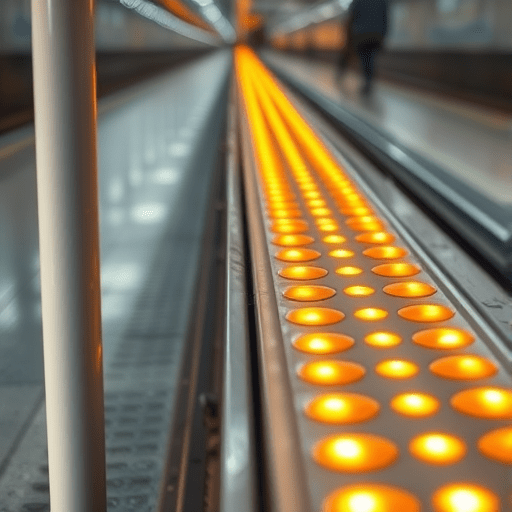
At a busy regional rail terminal in the Pacific Northwest, a traveler using a white cane steps off the bus and hears nothing but the low hum of ventilation. Within seconds, a row of textured tiles beneath her shoes begins to vibrate gently, then brighten with a soft amber glow. A quiet voice from a nearby speaker says, “Train to downtown, platform 3, departs in four minutes.” She follows the raised dome pattern past the ticket kiosk, across the concourse, and into the elevator. The doors close. She is on her way. This is not a prototype on a trade-show floor. It is a working installation of haptic sidewalk tiles guiding visually impaired riders through transit hubs, stitched together with an inclusive IoT stack that city planners, accessibility advocates, and engineers spent three years getting right.
Why Tactile Wayfinding Alone Was Not Enough
For decades, transit authorities have relied on truncated dome tiles and detectable warning surfaces to mark platform edges and crossings. They save lives, but they do not route. A person who cannot rely on sight still has to ask for directions, listen for announcements, or memorize the layout of a station that may change every time a renovation closes off a hallway. The new installation treats that gap as an infrastructure problem rather than a training problem.
The core idea is deceptively simple: extend the language of tactile pavement from a safety signal into a real-time navigation channel. The tiles become endpoints of a network, each one capable of vibrating, illuminating, and reporting its state to a central platform that knows where trains, buses, and elevators are at any given moment.
Three Layers Working Together
- Edge hardware: Polymer tiles with embedded piezoelectric actuators, RGB LED rings, and a low-power microcontroller. Each tile communicates over a mesh network using a protocol similar to Thread.
- Transit data layer: A middleware service that ingests GTFS feeds, elevator status, and gate counts, then maps them to a tile coordinate system.
- Accessibility layer: A user-facing app and tactile beacon trigger that lets riders opt in to spoken wayfinding, simplified floor plans, and vibration patterns they have already learned.
Inside the Case Study: A Regional Rail Terminal
The pilot covers a single terminal building, two side platforms, an underground bus loop, and the adjacent city sidewalk up to the crosswalk. Roughly 1,400 tactile tiles were upgraded, and 240 new smart units were installed at decision points such as stair tops, elevator lobbies, and platform entries. The project was funded jointly by the transit authority, a federal accessibility grant, and a regional smart cities initiative.
During a six-month observation period, 78 riders who identified as blind or low-vision used the system at least once. Interviews and ride-alongs revealed a pattern that surprised even the engineers.
What Riders Actually Used the System For
- Finding the correct platform during service changes. Construction reroutes had previously stranded riders at the wrong end of the station. Vibration cues now update as detours are announced.
- Locating the elevator when escalators were under repair. A long-standing frustration, since the elevator bank sits behind a corner that is invisible until you are on top of it.
- Crossing the bus loop safely. Tiles embedded in the curb ramp pulse in sync with the pedestrian signal, giving a non-visual cue that matches the audible beacon.
- Verifying that a train has actually arrived. Platform tiles shift pattern when doors open, eliminating the need to ask fellow passengers.
The Design Choices That Made the Inclusive IoT Infrastructure Work
Several decisions early in the project shaped how well the system performs today. None of them are glamorous, and most came out of focus groups rather than engineering meetings.
Vibration Patterns Are a Language, Not a Notification
Engineers initially treated each pulse as a single bit: vibrate or do not. Riders pushed back. A single pulse carries no meaning without context, and adding voice prompts for every tile made the station noisy. The team settled on a small grammar of patterns:
- Two short pulses: turn left at the next decision point.
- One long pulse: continue straight.
- Three short pulses: stop, decision ahead, await further cue.
- Continuous low buzz: warning, edge or hazard nearby.
Riders learned the grammar in under a week, and several reported that they now prefer the tactile prompts to audio, especially in crowded concourses.
Light Is Optional, Never the Primary Signal
The LEDs were a late addition, pushed by the architecture team. They are useful for sighted companions and for people with low vision who can perceive bright contrast, but the system is designed so that removing the LEDs entirely would not break wayfinding. Tiles still vibrate, still report state, and still trigger audio cues through the user’s own device.
Privacy by Default
The tiles do not carry cameras, and the mesh does not track individual phones. Riders opt in through a Bluetooth handshake that exchanges a temporary token, valid for the duration of their visit. The middleware can count how many opted-in users are near a given tile, which helps the transit authority understand demand without ever identifying a person.
What Broader Transit Hubs Can Learn
The terminal is small compared with major airports or central stations, but the lessons scale. Three principles emerged that any agency planning similar work can borrow.
Start with the Tactile Vocabulary, Not the Technology
It is tempting to begin with a vendor demo and work backward. The project team deliberately began with focus groups of blind and low-vision riders, mapped the actual journeys from arrival to platform, and only then selected hardware that could express those journeys. The result is a system that feels intuitive rather than impressive.
Treat IoT as Plumbing, Not a Product
The middleware is built on open standards and runs on existing transit servers. When the underlying GTFS feed changed format, the team updated the translation layer in an afternoon. If a vendor disappears, the tiles can be repurposed with new firmware. This kind of boring resilience matters more in public infrastructure than headline features.
Plan for Construction from Day One
About 15 percent of the smart tiles were damaged or displaced during a routine floor refinishing in month four. The project included a maintenance contract and a simple QR code on each tile that links to its installation record, so crews know what they are about to disturb. Without that, the system would have slowly degraded into a partial deployment.
Where the Technology Is Heading Next
The team is already testing two extensions. The first is a sidewalk pilot beyond the terminal, embedding tiles into a block of curb that leads to a popular medical clinic. The second is integration with rideshare drop-off zones, so a vehicle can signal the terminal that a rider with an accessibility profile has arrived and pre-light a path from the pickup curb.
There is also an honest conversation about cost. Each smart tile runs several times the price of a standard truncated dome. For widespread deployment, agencies will need either dedicated accessibility funding, as happened here, or a manufacturing curve that drives prices down. Early indications suggest both are plausible within the next planning cycle.
Conclusion
Haptic sidewalk tiles linked through an inclusive IoT stack have moved beyond safety markings into active wayfinding. The transit hub case study shows what becomes possible when accessibility is treated as core infrastructure rather than a retrofit: riders who once depended on memory and strangers now move through a busy terminal with the same confidence any commuter expects. The technology is not exotic. The discipline of designing with blind and low-vision riders at the table, then building the network around their needs, is what made it work.