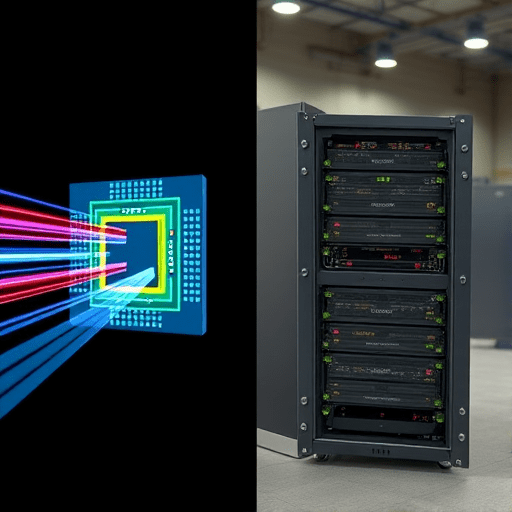
For research teams that train large models or run high-throughput scientific simulations, the next procurement cycle is already forcing a hard look at infrastructure options. The most consequential decision may no longer be between GPU vendors, but between photonic computing and AI accelerators. This 2028 cost-benefit guide moves beyond peak FLOPs and instead benchmarks total cost of ownership (TCO) for real research workloads, from optical neural networks to dense linear algebra. The goal is not to declare a universal winner, but to give labs and research institutions a repeatable framework for deciding where their money actually moves the needle.
Understanding the Core Trade-offs: Photonic Computing vs AI Accelerators
Photonic computing and AI accelerators are both designed to speed up matrix-heavy operations, but they achieve that speed through fundamentally different physics. AI accelerators, such as GPUs and TPUs, shuttle electrical signals through digital transistors, which consume power in proportion to data movement. Photonic systems, by contrast, use light pulses to perform computations during transmission. This allows them to execute certain linear algebra operations, like multiply-accumulate, directly in the optical domain, dramatically reducing energy per operation and latency.
How photonic computing works in practice
Most current photonic processors use arrays of Mach-Zehnder interferometers or micro-ring resonators to encode data in optical amplitudes or phases. When light passes through these arrays, the interference pattern produces the result of a matrix-vector product almost instantly. For research workloads that are compute-bound but not memory-bound—such as simulating wave propagation, solving sparse linear systems, or running certain neural network inference tasks—this optical approach can sidestep the von Neumann bottleneck entirely.
What AI accelerators still do best
AI accelerators remain the workhorse for training and general-purpose deep learning because of their mature software ecosystems, support for mixed precision, and ability to handle irregular memory access patterns. Photonic hardware, as of 2026, still struggles with nonlinearities—optical nonlinearities are weak and require hybrid electronic conversion. This makes end-to-end training on photonic chips impractical for most models. Accelerators also benefit from massive vendor support and standardized frameworks, which lowers integration cost, a factor that often dominates TCO once you account for engineering time.
Benchmarking Total Cost of Ownership for Research Workloads
A meaningful TCO comparison must include hardware acquisition, installation, power and cooling, maintenance, downtime, and the human cost of software porting. Research institutions frequently undercount the last two. A photonic accelerator might have a lower unit price than a high-end GPU, but if existing code cannot run without months of optical-circuit redesign, the true cost quickly exceeds that of a simpler, more expensive electronic part.
Capital expenditure and operational costs
Current photonic prototypes are often sold as PCIe cards or rack-mounted units, with prices ranging from tens of thousands to a few hundred thousand dollars depending on channel count and precision. AI accelerators for research, such as an H100 or a custom TPU pod, start at similar numbers but scale nonlinearly with memory capacity. However, photonic systems are not yet mass-produced, so procurement lead times and vendor lock-in risks can be higher. For a 2028 outlook, assume that photonic prices will drop as silicon photonics manufacturing matures, but not to commodity levels unless a major hyperscaler adopts them at scale.
Energy and cooling: the hidden TCO driver
In dense research clusters, power delivery is often the binding constraint. Photonic computing offers a notable advantage here because optical operations generate far less heat than electronic switching. Benchmarks from earlier academic pilots show energy efficiency gains of several orders of magnitude for specific linear algebra kernels. Yet those gains do not automatically translate to whole-application savings. Photonic systems still require electrical conversion for data I/O, memory, and nonlinear activation functions. When that overhead is included, a photonic inference accelerator might still cut energy by 30–70% for some workloads, while providing little benefit for data-intensive transformer training.
Workload-specific performance metrics
To benchmark fairly, researchers should define metrics that directly reflect their own workloads. Raw TOPS (tera operations per second) is misleading. Instead, consider:
- Time-to-solution for a fixed physics simulation or optimization problem
- Energy-to-solution per completed experiment, including memory and I/O
- Programming complexity: staff-hours needed to adapt existing code
- Utilization rate in a shared cluster, because underutilized AI accelerators waste capital
For example, a research group solving electromagnetic scattering problems might find that a photonic simulator finishes a parameter sweep in hours, while a GPU cluster takes days. Another group fine-tuning large language models will likely see no advantage from optics because the workload is dominated by nonlinear operations and memory bandwidth that electrons handle far better today.
A 2028 Cost-Benefit Framework for Research Teams
Rather than predicting a winner, frame the decision around three horizons: immediate procurement, 12-month experiments, and long-term infrastructure strategy. The following heuristic can guide that decision.
When to choose photonic primitives
Photonic computing makes financial sense when your research workloads have one or more of these characteristics:
- High-dimensional linear algebra with low precision requirements (e.g., iterative solvers, preconditioners)
- Real-time inference or control loops where low optical latency is critical
- Continuous data streams from sensors or detectors that can be processed optically without conversion
- Sustained pattern-matching or correlation analysis, such as in particle physics or radio astronomy
In these cases, photonic accelerators can deliver a lower cost per experiment, especially for energy-constrained facilities that cannot expand their power budget.
When to stick with AI accelerators
AI accelerators remain the better TCO choice for:
- Training large neural networks from scratch, due to the need for backward propagation and nonlinearity
- Workloads with frequent branching or dynamic tensor shapes
- Environments that rely on mature libraries like PyTorch or JAX and cannot afford custom driver work
- Hardware sharing across many different research groups with varying needs
General-purpose accelerators also have a broader second-hand market and longer software support cycles, both of which improve their lifetime TCO for smaller labs.
Hybrid architectures as the practical pivot
Most research institutions in 2028 will not choose between photonics and accelerators; they will deploy a hybrid pipeline. For example, a photonically accelerated front-end can preprocess data and compute embeddings, while an AI accelerator handles the final training and analysis. This division of labor aligns with the strengths of each technology and avoids the high cost of porting a monolithic codebase. The TCO model should therefore account for integration overhead, but also for the potential to oversubscribe the electronic accelerator with preprocessed, lower-dimensional data.
Building a defensible benchmark requires in-house experimentation. Start with a small pilot, measure energy and wall-clock time for your top three workloads, and include staff effort in the cost model. A shift toward photonic computing is not a matter of simply swapping accelerator cards. It changes how algorithms are expressed, how data is moved, and how science is scheduled.
Conclusion
The photonic computing vs AI accelerators debate is less about which technology is superior and more about which one aligns with the physics of your research workload. For some scientific computing, photonic systems already offer a lower TCO in energy, space, and time. For others, AI accelerators remain the safer, cheaper path because of their ecosystem and flexibility. A rigorous 2028 cost-benefit analysis will not rely on vendor benchmarks but on honest measurements of power, latency, and engineering effort. Research teams that start building that evaluation now will be ready to make procurement decisions with confidence when photonic systems mature further into the commercial mainstream.