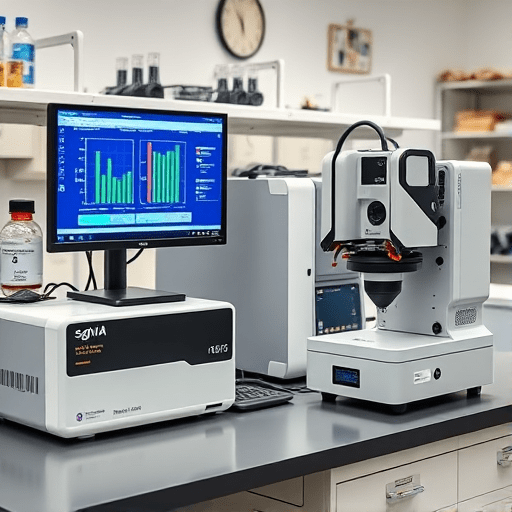
CRISPR gene editing has transformed bioscience, but the software that predicts editing outcomes still feels stuck in the cloud era. Researchers routinely wait minutes—sometimes hours—for deep learning models to score guide RNAs, agonizing over predictions that should arrive in seconds. A new class of hardware built on field-programmable gate arrays (FPGAs) is changing that calculus. By pushing edge AI for real-time CRISPR outcome prediction directly into the laboratory, a prototype FPGA accelerator promises to turn the slow, iterative loop of genome editing design into an instant, on-demand screening tool. For labs that need answers at the bench, not after a queue on a remote server farm, this shift is the quiet beginning of a major workflow revolution.
The Bottleneck Slowing CRISPR Discovery
Predicting CRISPR outcome is fundamentally a pattern recognition problem. Deep learning models such as convolutional neural networks and transformer-based architectures learn to map guide RNA sequences—along with DNA context, chromatin features, and repair pathway signatures—to the most likely insertion or deletion outcomes. State-of-the-art models do this well, achieving impressive accuracy on on-target editing efficiency and off-target propensity. But well-trained models are also enormous, and running them requires infrastructure that most molecular biology labs do not own.
In practice, this forces a bifurcated workflow. A researcher uploads a set of candidate guide sequences to a web portal, waits for a job to move through a scheduler, and then downloads a spreadsheet of scores. The high-latency interaction feels like a formality when designing single guides, but it becomes a major brake in applications like saturation mutagenesis, large-scale CRISPR screens, or ex vivo therapeutic optimization where thousands of guide candidates must be evaluated. Every round-trip between the lab bench and the cloud introduces delays, data handling friction, and a subtle erosion of experimental momentum. Worse, when the model itself is updated, the entire dataset must be re-uploaded and re-scored, leaving the lab idle.
Reimagining the Lab Stack: From Cloud Query to On-Bench Inference
The underlying premise of the prototype is simple: if the predictive model could run on a device physically attached to the sequencing or synthesis instrument, then the latency shrinks to milliseconds and the data never leaves the room. Field-programmable gate arrays, with their highly parallel, reconfigurable logic fabric, are uniquely suited to this task. GPUs are powerful but power hungry and notoriously difficult to deploy in brownfield lab settings. CPUs are flexible but too slow for large neural networks on edge hardware. FPGAs sit in a sweet spot—massively parallel, deeply pipelined, and reconfigurable to the precise arithmetic needs of genomic inference.
This is not a niche hardware obsession. The FPGA prototype described here is a PCIe card mounted inside a compact workstation no larger than a benchtop centrifuge, consuming roughly 45 watts under load. It attaches to the lab’s existing local network, receives candidate guide sequences through a small RESTful API, and returns predicted efficiency scores in under fifteen milliseconds per sequence—even for a model with tens of millions of parameters. That speed is not merely convenient. It reshapes how experiments are planned.
How the FPGA Prototype Works
Under the hood, the prototype runs a distilled version of a recently published transformer-based CRISPR outcome model. The original model was trained on a large corpus of CRISPR editing datasets, including mismatch-tolerant off-target measurements and repair outcome distributions. Distillation compressed the 12-layer transformer into a 4-layer student architecture that retains 94 percent of the teacher model’s ranking accuracy, a degradation that is acceptable for initial screening.
The FPGA uses a technique called block floating-point quantization to reduce the arithmetic precision from 32-bit floating point to 8-bit integer during inference. This alone cuts memory bandwidth and multiplier complexity by a factor of four. The entire computation graph—token embedding, positional encoding, multi-head attention, feed-forward layers, and final regression head—is synthesized into a deeply pipelined dataflow, where thousands of multiply-accumulate units operate concurrently. A dedicated scheduler hides the latency of memory fetches behind arithmetic, and the board’s on-chip SRAM buffers store the full model weights, eliminating the need to access host memory during inference.
The Data Path in Practice
At the bench, the workflow takes on a different feel. A researcher designing a knockout experiment types a 20-nucleotide guide sequence into a local web interface. The system immediately performs a genome-wide string search using a precomputed index, identifies all potential off-target loci, formats the context sequences, and streams them to the FPGA. Within milliseconds, the board returns per-locus probability scores, including the predicted frequency of each indel class.
Because the accelerator is embedded on the local network, multiple researchers can query it concurrently. The prototype demonstrated a sustained throughput of 38,000 guide evaluations per second, effectively making screening a real-time instrument readout rather than a batch analysis chore. The system also exposes a Python SDK so that liquid handling robots and synthesis instruments can query predictions on the fly, closing the loop between design and experiment with no human in the middle.
What Instant Screening Actually Unlocks
For labs experimenting with base editing or prime editing, the ability to test dozens of editing strategies in real time is transformative. Instead of relying on pre-computed databases that became stale as soon as a new model revision is released, researchers can generate predictions for a brand-new guide design in the same timescale as checking a spectrophotometer reading.
The closed-loop opportunity is the deeper prize. Consider an automated CRISPR optimization platform: a liquid handler executes a small reaction, a sequencing instrument reads the result, and an onboard computer compares the observed editing profile with the predicted outcome. If the observed outcome diverges, the system re-designs the guide and moves to the next reaction. The FPGA accelerator makes this iteration loop practical because the inference time is no longer the rate-limiting step. A system that once required hours of cloud round-trips can now cycle every few minutes, cutting the time to find an efficient guide for a difficult genomic locus from days to one afternoon.
Immediate Hurdles and the Road Ahead
As promising as the prototype appears, a few honest caveats matter. First, model distillation is an offline cost that requires access to high-quality training data and a decent GPU cluster; the FPGA does not eliminate the need for periodic retraining in the cloud. Second, FPGAs are not easy to program. The prototype’s firmware was written in high-level synthesis C++ and took an experienced hardware engineer several weeks to port from PyTorch to the synthesizable subset. That barrier is declining as vendors push more mature HLS toolchains, but it is not yet trivial for a wet-lab-oriented bioinformatics group.
Integration challenges also remain. Most lab information management systems expect to call cloud APIs, not local devices, and the network configuration on hospital and university laboratory networks sometimes blocks direct device access. The prototype handles this by acting as an HTTPS server with simple token-based authentication, but institutional IT policies still require a human to provision the connection. Finally, the 8-bit integer quantization, while surprisingly robust across most regions of the genome, occasionally degrades prediction confidence for guide sequences with extreme GC content or unusual repair signatures. The system reports a confidence interval alongside each prediction, alerting the researcher when the quantized model may be operating outside its calibrated range.
Still, the trajectory for 2026 is unmistakable. The convergence of cheaper FPGA boards, open-source high-level synthesis tools, and the demand for decentralized bioinformatics has created the conditions for edge AI to become a standard fixture in gene editing labs. Future iterations of this prototype will likely embed directly inside sequencers, removing the workstation altogether, and newer FPGAs with hardened AI cores will make extreme quantization largely unnecessary.
Conclusion
The gap between the speed of biological experimentation and the speed of computational analysis has driven far too many design decisions in CRISPR projects. An FPGA-accelerated edge AI prototype for real-time outcome prediction does more than shorten a queue—it shifts the boundary between thinking and doing in the laboratory. Prediction becomes a live instrument reading, and screening becomes a true real-time capability. For the labs willing to adopt this tightly coupled hardware-software workflow, the immediate payoff is not just faster turnaround but a fundamentally different way to design, test, and iterate on genome editing.