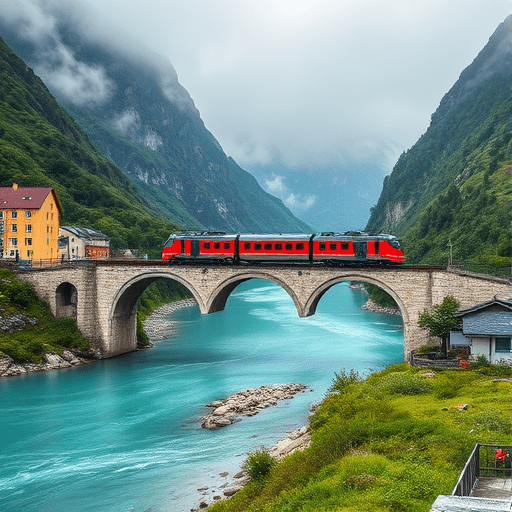
Standing on a platform in Chur or Zermatt, you might feel more like a commuter at rush hour than a traveler in the Alps. The Glacier Express, for all its iconic allure, has become a victim of its own success—packed carriage after carriage, with reservation windows booked out weeks in advance. For those seeking Europe’s quietest scenic trains, there’s a better way. Across the continent, lesser-known rail lines serve up equally jaw-dropping panoramas with a fraction of the crowd. These are the trips that reward patience and a flexible itinerary, offering unscripted views of fjords, vineyards, volcanoes, and Arctic tundra without the selfie-stick tangle.
Why Skipping the Glacier Express Is a Smart Move
Over-tourism has turned Switzerland’s famous 8-hour ride into a logistical exercise in queueing and shoulder-to-shoulder viewing. Add the steep fare and forced seat reservations, and you begin to wonder: what are you really paying for? More travelers are now seeking train journeys that feel like exploration, not transport. The quietest scenic trains in Europe offer solitude, lower costs, and a deep connection to landscapes that have not been packaged into a souvenir brochure. In 2026, with sustainability and slow travel high on everyone’s mind, the smartest rail adventures are those that avoid the herd. These five routes deliver that, and then some.
The Rauma Railway: Norway’s Secret Valley Masterpiece
Roughly 90 kilometers long, the Rauma line runs between Dombås and Åndalsnes, threading through the dramatic U-shaped Rauma Valley. This is not the fjord-or-die Norway you see on postcards—it’s wilder, more intimate. The train crosses the iconic Kylling Bridge, a stone arch that is pure engineering eye-candy, while cliffs like Trollveggen’s vertical face hover nearby. Only a handful of daily services run, many of them local trains with regular seats—no panoramic domes, no crowds. You can hang out of an open window (safely) and breathe in pine and river mist. In summer, the light lingers until late evening; in winter, snowmelt turns every cascade silver. For photographers, the Rauma Railway is a quiet goldmine.
The Inlandsbanan: Sweden’s Endless Interior
If you want space that feels infinite, Sweden’s Inlandsbanan delivers. Stretching over 1,300 kilometers from Kristinehamn in the south to Gällivare in the Arctic north, this line connects deep forests, glassy lakes, and rolling tundra. It was never designed for mass tourism—it was built to open up inland Sweden’s raw frontier. Today, you can ride it in sections or with a hop-on-hop-off pass. The train often stops at request, letting you wander into a birch grove or swim in a hidden lake before the next train appears. The silence is physical, broken only by bird calls or the distant hum of a diesel locomotive. In summer, the midnight sun paints the horizon in peach and coral; in autumn, the moorland turns rust red. The Inlandsbanan isn’t a luxury train—it’s a slow, honest journey through a landscape that still feels unconquered.
The Far North Line: Scotland’s Coastal Edge
Most tourists ride the West Highland Line to Glenfinnan, but the truly wise ones head north from Inverness to Thurso or Wick on the Far North Line. This route hugs the rugged Sutherland coast, passing long sea lochs, empty beaches, and ruined crofts. It’s a train line that has never been on a bucket-list poster, which is exactly its charm. The carriages are simple and usually half-empty. From your window, you can spot seals lazing on sandbanks and, if luck smiles, peregrine falcons scouring the cliffs. The line terminates on the northeastern tip of mainland Britain—a place where wind and waves do most of the talking. With the North Sea on one side and the flow country’s peat bog plains on the other, it feels like riding the edge of the world. For Europe’s quietest scenic trains, the Far North Line is hard to beat for coastal drama.
The Douro Line: Portugal’s Vineyard Corridor
Skip the crowded river cruises and take the train that snakes along the Douro River from Porto to Pocinho. The Douro line has been operating since the 19th century, carrying port wine barrels and local commuters. Today, it’s a slow, rickety journey through terraced vineyards that tumble down to the river’s edge. The view changes every few minutes: weathered granite villages, almond trees in blossom, and quintas pouring wine centuries-old. The train itself is basic—hard seats, openable windows, no frills. That’s a feature, not a bug. You can lean out and smell the warm earth and ripening grapes. The line is rarely crowded except on harvest weekends, and even then, it’s mostly wine-makers, not tourists. This is the kind of scenic rail ride that feels authentic, unscripted, and quietly magnificent.
The Circumetnea Railway: Sicily’s Volcano Ring
Few train rides on Earth pass an active volcano. Sicily’s Ferrovia Circumetnea does exactly that, circling the base of Mount Etna in a narrow-gauge loop from Catania to Riposto (and back). The tracks cut through black lava fields, pine forests, and small villages that seem frozen in time. In some stretches, the train inches so close to the volcano’s slopes that you can touch the jagged, cooled lava. The ride is slow and quirky—sometimes the conductor jumps out to move a stray sheep. There’s no panoramic window, no audio guide. Instead, you get raw views of the Mediterranean below and Etna’s smoking summit above. Locals use the line for daily errands, so it feels like a living part of the landscape rather than a tourist attraction. If the volcano behaves (and even when it doesn’t, issuing distant ash puffs), this is one of Europe’s most unusual, and quietest, scenic train experiences.
These five lines prove that the quietest scenic trains carry more than passengers—they carry a sense of discovery. Without the crowds, the landscapes speak louder. Whether you’re watching a Norwegian waterfall from a window seat or smelling eucalyptus on Etna’s slopes, the ride becomes a meditation. Next time you plan a European rail adventure, let the Glacier Express pass you by. The silence is the real luxury.