Planning your first scenic train journey across Europe can feel overwhelming, especially when every route promises breathtaking views, charming villages, and unforgettable experiences. The good news is that Europe’s rail network offers something genuinely special for every kind of traveler, whether you want glacier-fed lakes at sunrise, rolling Tuscan vineyards in golden afternoon light, or the wild Atlantic coast rolling past your window. This guide compares the most beloved scenic European train routes side by side, helping you match the right journey to your budget, your preferred pace, and the landscapes you have been dreaming about since you first started browsing travel photos.
What Makes a European Train Route Truly Scenic
Not every train ride qualifies as a “scenic” experience. The routes that earn that label combine three elements: dramatic natural features visible from the window, thoughtfully designed panoramic or curved carriages that maximize the view, and enough journey time to let the landscape shift gradually rather than blur past at highway speed. The best routes thread through mountain valleys, follow river gorges, hug coastlines, or cross wide-open plateaus where the horizon seems to stretch forever.
First-time travelers often underestimate how much the type of carriage matters. Modern Swiss and Austrian trains frequently include dedicated panorama cars with oversized windows stretching into the roof, while older regional lines in Italy or Portugal rely on standard windows that frame the world like a moving painting. Knowing this difference can transform an ordinary ride into the highlight of your trip.
Route Comparison at a Glance
Before diving into each journey, here is how the most popular scenic routes stack up against one another across the factors that matter most to first-time travelers.
Glacier Express (Switzerland)
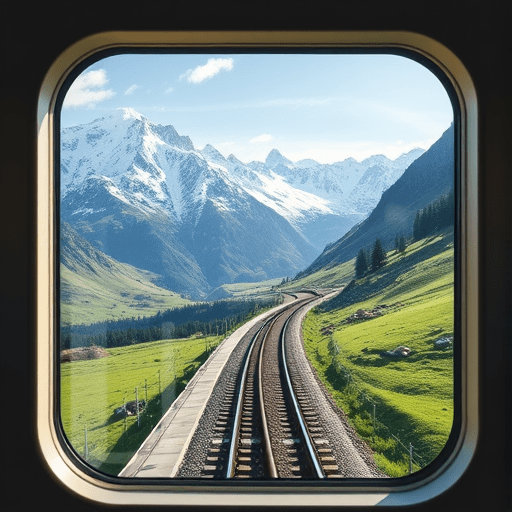
The Glacier Express has earned the nickname “the slowest express train in the world,” which is precisely the point. Traveling between Zermatt and St. Moritz, the full journey takes roughly eight hours and crosses 291 bridges and 91 tunnels while threading through the Swiss Alps. Highlights include the Matterhorn views near the start, the Oberalp Pass at just over 2,000 meters, and the dramatic Landwasser Viaduct, one of the most photographed railway structures in Europe.
- Best for: Travelers who want pure Alpine drama and do not mind paying for the privilege.
- Typical cost: Around 150 to 200 euros for a standard seat in 2026, rising to 400 euros or more for first class or Excellence Class.
- Pace: Slow and contemplative, with commentary apps and dining service included.
- Window time: Nearly eight continuous hours of scenery.
Bernina Express (Switzerland to Italy)
The Bernina Express is the Glacier Express’s shorter, sharper sibling. Running from Chur or St. Moritz into Tirano in northern Italy, the route climbs the Bernina Pass, swings across the famous Landwasser Viaduct from a different angle, and descends through the Val Poschiavo before crossing into the palm-lined Italian side of the valley. Because the altitude change is steeper and the journey shorter, the landscape shifts faster than on the Glacier Express.
- Best for: Travelers connecting Switzerland and Italy who want a half-day highlight rather than a full-day commitment.
- Typical cost: Roughly 60 to 120 euros with a compulsory seat reservation.
- Pace: Quick but still scenic, completing in about four hours.
- Bonus: No mandatory catering means you can bring your own picnic from a Swiss bakery.
Flåm Railway (Norway)
The Flåm Railway is less a cross-country journey and more a vertical experience. In just 20 kilometers, the train descends from Myrdal station on the Bergen Line down to the village of Flåm on Aurlandsfjord, dropping nearly 870 meters through tunnels carved by hand and along waterfalls that crash past the windows. Many travelers combine it with the Bergen Railway and a fjord cruise to create a two-day circuit.
- Best for: First-time visitors to Norway who want dramatic fjord scenery without committing to a long drive.
- Typical cost: Around 50 to 70 euros one way in 2026, often bundled with fjord cruise discounts.
- Pace: Intense and short, ideal as part of a longer Scandinavian itinerary.
- Landscape: Sheer cliffs, waterfalls, and deep blue fjords.
West Highland Line (Scotland)
Running from Glasgow to Mallaig, the West Highland Line passes Loch Lomond, crosses the wild Rannoch Moor, and finishes near the silver sands of the Atlantic coast. The Jacobite steam service, which uses the same tracks between Fort William and Mallaig, has become famous as a real-world stand-in for the Hogwarts Express.
- Best for: Travelers who love moody landscapes, literary references, and a more affordable alternative to Alpine routes.
- Typical cost: From around 40 to 80 euros depending on whether you choose the modern ScotRail service or the heritage Jacobite steam train.
- Pace: Relaxed, with stops that make it easy to break the journey.
- Landscape: Lochs, moors, glens, and sea cliffs.
Matching Routes to Your Travel Style
Choosing between these journeys is less about which is objectively best and more about which fits the shape of your trip. Each route rewards a different kind of traveler, and understanding your own priorities can save you from booking a legendary ride that leaves you underwhelmed.
If Your Budget Is the Main Constraint
The West Highland Line and the Bernina Express deliver the strongest value per euro. Both offer dramatic scenery, comfortable carriages, and the flexibility to break the journey into smaller segments if you want to stretch your trip over multiple days. Hostel and guesthouse networks along both routes also tend to be more affordable than Alpine resort pricing.
If You Want Maximum Scenery Per Hour
The Glacier Express remains the gold standard for scenery density. Almost every minute of the eight-hour journey offers a postcard view, and the panoramic windows are specifically designed for slow sightseeing. For travelers with limited vacation days, this efficiency makes it an attractive choice even at the higher price point.
If You Prefer Shorter, Sharper Experiences
The Flåm Railway is unmatched for concentrated impact. Pair it with the Bergen Railway main line and a fjord cruise, and you have a complete Norwegian scenic experience in roughly 48 hours. This is ideal for travelers adding Norway onto a longer European itinerary.
Practical Tips for First-Time European Rail Travelers
Whichever route you choose, a few universal tips apply. Book seat reservations as early as possible, especially for the Glacier Express and Bernina Express, where popular dates sell out weeks ahead. Pack a light day bag with snacks, a refillable water bottle, and a layers-friendly jacket, because temperatures vary between coastal stations and mountain passes even in summer. Bring a camera with a wide-angle lens if you have one, because the panoramic windows are wider than your phone screen will capture.
Finally, build in buffer time at either end of your scenic journey. The most common disappointment among first-time travelers is rushing the experience, treating the train as mere transport rather than the destination itself. Slow down, stay on board through every tunnel, and let the landscape arrive at its own pace.
Conclusion
Europe’s scenic rail routes each tell a different story about the continent, from the polished precision of Swiss Alpine engineering to the windswept romance of Scottish moors and the thunderous drama of Norwegian waterfalls. For first-time travelers, the best journey is rarely the most famous one but the one that matches your budget, your available time, and the kind of landscape that makes you press your face against the glass. Compare these routes honestly against your own travel style, and the right choice tends to reveal itself long before you reach the station.