Deploying Hugging Face models on GKE with CPU-only autoscaling has moved from a fringe experiment to a cost-saving best practice for teams running latency-tolerant workloads. As model quantization improves and smaller task-specific transformers outperform their bloated predecessors, the GPU is no longer the only sensible compute substrate for inference. By pairing Kubernetes-native event-driven autoscaling with preemptible spot capacity, you can serve thousands of requests per minute for a fraction of the cost of an always-on GPU fleet.
Why CPU-Only Inference Is Gaining Ground for Hugging Face Models
The economics of GPU inference are brutal. A single A100 node can cost hundreds of dollars per month even when idle, and most applications have bursty traffic patterns that make steady GPU allocation wasteful. CPU-only inference, by contrast, uses the same hardware you already run for your web services and data pipelines, and it scales horizontally with well-understood Kubernetes primitives.
This is not a return to the dark ages. DistilBERT, MiniLM, and modern quantization techniques like bitsandbytes 8-bit loading allow a well-tuned CPU server to handle 1,000 to 5,000 inference requests per second for embedding tasks. For applications such as semantic search, content classification, and summarization of short documents, CPU inference consistently delivers acceptable p95 latency below 500 milliseconds when the compute is scaled correctly.
The Core Architecture: GKE Node Pools for Different Workloads
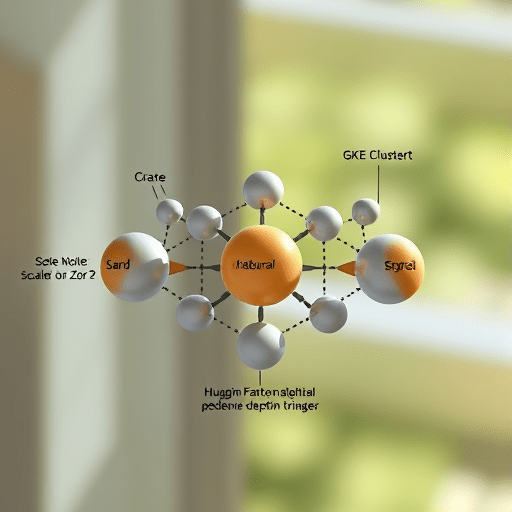
The key to a resilient CPU-only deployment is separating your capacity into two distinct node pools. The first pool uses standard, guaranteed compute for your Kubernetes control plane components, metrics infrastructure, and those workloads that absolutely cannot tolerate interruption. The second, much larger pool is backed by spot instances and hosts your model serving pods, where KEDA and the Kubernetes disruption budget handle the inevitable churn.
- Standard pool: small, run as a regional managed instance group, hosting CoreDNS, KEDA operator, Prometheus, and your ingress controller.
- Spot pool: larger, using custom machine types with high CPU-to-memory ratios, tainted so that only model-serving workloads land there.
- Cluster-autoscaler: configured with expandable node pools and priority expansion so spot capacity is always preferred over on-demand.
This split ensures that a spot reclamation event never degrades your control plane or observability stack. Your model pods may die, but your cluster stays healthy and can rapidly reschedule them onto fresh spot nodes.
Setting Up KEDA Event-Driven Autoscaling for Model Serving
Kubernetes-native autoscaling based on CPU utilization alone is too slow and too coarse for serverless-style inference. KEDA (Kubernetes Event-Driven Autoscaling) watches external metrics—queue depth, HTTP request rate, or even messages in a Pub/Sub topic—and scales the number of replicas proactively.
For a Hugging Face model server exposing an HTTP endpoint, a KEDA ScaledObject binds to the Prometheus endpoint and scales on requests per second. The trigger threshold should match your target throughput, and the activation threshold lets you keep replicas dormant until traffic actually crosses a meaningful baseline.
The crucial setting is minReplicas: 0. This enables true scale-to-zero, which has been the missing piece in self-managed CPU inference. When no requests arrive, the model pods terminate, releasing the spot nodes they occupied. When a burst arrives, KEDA scales out from zero in under a minute. This is the difference between paying for idle capacity 24/7 and paying only for active inference.
For stateful pipelines that consume from a queue, use KEDA’s Kafka or Pub/Sub scaler instead. The same pattern applies: pending message lag scales the pod count, and a cooldownPeriod of 30 to 60 seconds prevents thrashing during transient dips in traffic.
Making Spot Pods Your Primary Capacity with Graceful Shutdown
Teams often treat spot nodes as a secondary capacity source, but the real cost savings come when spot becomes the default and on-demand is the exception. To make this work, you must design for graceful shutdown.
- PreStop hooks: your model server should run a termination handler that stops accepting new requests, drains the in-flight batch, and flushes results before the pod receives SIGTERM.
- PodDisruptionBudgets: set
maxUnavailable: 50%so the cluster autoscaler cannot evict more than half of your model replicas at once during node maintenance. - Topology spread: spread replicas across multiple spot zones to avoid losing all capacity in a single reclamation event.
- Graceful termination time: allow 60–90 seconds in
terminationGracePeriodSeconds; the PreStop hook needs time to finish in-flight work.
Spot capacity in GKE repurposes nodes with a warning, not a kill. Google’s compute engine sends a preemption notice ahead of time for spot VMs, which gives your pod enough time to drain correctly. If your inference server has a warm-up period for loading model weights—which many have—you can warm a fresh pod before an old one is fully removed by combining a rolling update strategy with a minimal replica count.
Cost and Performance Benchmarks: What to Expect
Realistic estimates depend on your model and traffic profile, but early 2026 reports from production deployments indicate consistent 60–80% savings when moving from GPU-backed serving to CPU-only KEDA scaling on spot pods. One common example: a semantic-search pipeline serving BERT-style embeddings saw its inference bill drop from roughly $300 per month on a single T4 GPU to under $80 on spot CPU nodes, while maintaining p99 latency under 800 ms with a burst of parallel requests.
When selecting an instance type, look for high sustained clock speeds rather than core count alone. Intel Ice Lake and Sapphire Rapids generations include advanced vector extensions that significantly accelerate transformer workloads. A machine with 16 dedicated vCPUs and 8 GB of memory often outperforms a shared 32-vCPU machine with slower base frequency.
Operational Pitfalls and How to Avoid Them
The biggest mistake teams make is to treat CPU inference as a pure drop-in replacement. You must right-size your model and your latency target together. A 3-billion-parameter generative model is not a good CPU candidate unless you accept multi-second latencies; use CPU-only autoscaling for the long tail of smaller models while keeping GPU nodes only for generation-heavy routes.
Another common issue is cold-start latency. Scale-to-zero means the first request after an idle period pays the model-loading cost. Solve this by setting minReplicas to a small number during business hours, or by using KEDA’s scaleUpStabilizationPeriod to keep replicas alive slightly longer than strictly necessary. Alternatively, pre-deploy a single warm pod for fast users and let KEDA scale additional replicas for load.
Conclusion
CPU-only autoscaling on GKE, driven by KEDA and backed by spot pods, is more than a cost hack—it is a deliberate architecture for serving Hugging Face models with the same elasticity you expect from serverless APIs. By matching event-driven scaling with graceful preemption handling, you can cut inference costs dramatically while keeping latency stable for the workloads that matter. The tooling has matured, the benchmarks are solid, and the only remaining variable is how aggressively you can tune the trade-off between warm pods and wallet-friendly scale-to-zero.