In an industry where live-service games increasingly rely on battle pass timers, rotating shops, and seasonal scarcity to drive engagement, Deep Rock Galactic’s no-FOMO monetization stands out as a quiet revolution. Ghost Ship Games has proven that you can run a successful multiplayer live-service title for years without ever weaponizing the fear of missing out. Rather than chasing short-term spikes in playtime, the studio has built a model that respects player time, fosters genuine goodwill, and still generates reliable revenue. For studios currently trapped in the anxiety-driven live-service arms race, Deep Rock Galactic offers a refreshing and increasingly viable alternative.
The State of Live-Service Fatigue: Why FOMO Backfires
By this point in the live-service era, the cracks in the FOMO foundation are impossible to ignore. Players have grown weary of calendar-shaped obligations, daily checklists, and the quiet panic that accompanies a battle pass entering its final two weeks. The industry has seen high-profile flops and declining player counts when studios assume that people will tolerate artificially inflated urgency. The problem isn’t that players dislike content drops or new rewards—it’s that they resent being manipulated into showing up out of obligation rather than genuine enthusiasm.
FOMO can produce short-term engagement bumps, but it also breeds resentment. Many players respond by quitting altogether, or by adopting a cynical “I’ll play when there’s something actually fun” mindset. The exhausting churn of season-over-season anxiety has led to what some analysts now call “live-service fatigue.” Against that backdrop, a game that explicitly tells you, “You can earn this later, no stress,” becomes a breath of fresh air.
How Deep Rock Galactic’s No-FOMO Model Actually Works
Deep Rock Galactic’s approach is deceptively simple: everything that is purchasable is cosmetic, and nothing ever disappears. The game’s in-game store, cargo crates, and season performance passes all feed into one core principle—player time is not a hostage. The result is a monetization structure that feels less like a casino and more like a cooperative gift exchange.
Cosmetic-Only Store, No Pay-to-Win
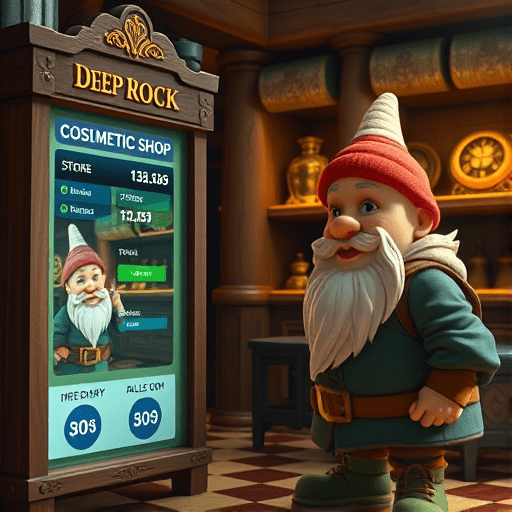
Every item in Deep Rock Galactic’s store is purely cosmetic. You can buy weapon skins, armor paints, victory poses, and a non-stop parade of silly hats for your dwarf. None of these items grant a single percentage point of combat advantage. That might sound like an obvious choice, but it’s one that many live-service games still fail to honor cleanly. By keeping all purchases cosmetic, Ghost Ship Games removes the “pay to bypass the grind” tension and ensures that paying players are never disrupting the balance of cooperative missions.
But the no-FOMO angle matters even within the cosmetic-only lane. When a new cosmetic set travels through the store, it doesn’t vanish after a week. Players can browse at their leisure, decide if they actually want something, and purchase it with either premium currency or, in many cases, earn it through regular gameplay. That flexibility is rare in an industry that thrives on “limited edition” labels and glowing countdown timers.
Battle Passes That Never Expire
The most celebrated part of Deep Rock Galactic’s monetization is its seasonal performance pass. Unlike traditional battle passes, there is no ticking clock waiting to erase all your progress. The pass has a theme, a set of cosmetic rewards, and a leveling track—but once a new season arrives, the previous pass simply remains available for players to finish at their own pace. You can swap between old passes and new ones, dipping back into a previous season’s rewards whenever the mood strikes.
This simple mechanic addresses one of the biggest pain points in live-service design. The fear of losing progress on a battle pass is often stronger than the excitement of its rewards. By guaranteeing that the pass will still be there next month or next year, Ghost Ship Games turns the battle pass from a stressful obligation into a pleasant backlog of optional goals. Players appreciate that their time is not being burned, and the developer still sees the engagement that comes from having a full list of unfinished cosmetic tiers to work through.
The Psychology of Goodwill: Player Retention Beyond Loot Drops
No-FOMO monetization is not just a nicety; it is a psychological strategy. When a game respects your time, you reward it with loyalty. Deep Rock Galactic’s community is famously passionate, and that passion is directly linked to the studio’s treatment of players. Ghost Ship Games does not hold content hostage, does not leak exclusive items into a limited-time store, and does not punish players for taking a month off. Instead, those players return on their own terms, bringing friends and sharing the experience.
This approach builds an emotional bank account. Each time a player sees that their uncompleted battle pass is still waiting for them, trust grows. Each time a season ends without panic-buying pressure, the game earns a little more respect. That emotional currency is not easily measured in a quarterly report, but it translates into organic word-of-mouth, positive reviews, and a player base that genuinely wants to support the developer’s next update or paid cosmetic bundle. You cannot buy that kind of goodwill with a road map; you have to earn it through design choices.
Sustaining Revenue Without Artificial Scarcity
Many studios cling to FOMO because they believe it is the only way to sustain revenue between major content drops. Deep Rock Galactic is living proof that a live-service game can thrive financially without pressuring players through scarcity. The revenue model relies on a different conversion trigger: desire born from appreciation, not urgency born from fear.
Content Drops as an Incentive, Not a Countdown
When a new Deep Rock Galactic season arrives, the incentive to play is the new mission types, new weapons, and the sheer fun of jumping back into cooperative mining. The cosmetic rewards are a cherry on top, not the entire reason to exist. Because the game’s content is not gated behind a pass that expires, the seasonal drop becomes a reason to come back—not a gun to your head that forces you to grind before bedtime.
The revenue cycle stays healthy because players who love the game want to support it. Some purchase the cosmetic packs simply because they look nice. Others buy the recent DLCs or supporter packs as a thank-you gesture. By removing the fear of missing out, the developer actually strengthens the desire to participate in the game’s world.
The Role of Community Goodwill in Long-Term Revenue
Deep Rock Galactic has received a reputation as one of the most player-friendly live-service games on the market. That reputation is a revenue asset. In an era where gamers are increasingly selective about which live-service games deserve their money, a studio with a no-FOMO track record stands out. Players are more likely to spend money on a game they trust, and they are more likely to stick around for years when they know their previous investments—both time and money—will not be erased.
This creates a virtuous cycle. Goodwill leads to spending; spending allows the studio to keep producing updates; updates without FOMO reinforce the goodwill. The result is a sustainable revenue stream that does not rely on churn or panic-buying. It speaks to a broader economic truth: people support businesses that don’t exploit them, especially when the product is genuinely good.
What Live-Service Devs Can Learn (and Adapt) from Deep Rock Galactic
The lessons from Deep Rock Galactic are not limited to indie games or coop dwarves in space. Any live-service game can adapt this philosophy, though adapting is not copying. A community-driven MMO might not be able to make all cosmetics completely free, but it could offer legacy battle passes that players can still progress through after the season ends. A PvP shooter might keep its seasonal exclusive weapon, but then add it to a standard unlock track the following year so that latecomers never feel permanently left behind.
What matters is the underlying intent: separate the enthusiasm for playing from the anxiety of losing rewards. The moment you set a timer on a reward that players have already earned, you are teaching them that their time is only valuable within your schedule. Reverse that lesson. Let players know, “Whenever you play, we’ll always have something for you to work toward, but the moment you go, we won’t punish you.” That message is more powerful than any winter event countdown.
Deep Rock Galactic’s no-FOMO monetization is not a niche experiment anymore—it’s a template for how live-service games can survive and even flourish by trusting their players. Removing time-limited items does not remove revenue; it removes the anxiety that drives players away. In an industry where the next big live-service launch is always promising “more,” Ghost Ship Games shows that the most radical promise might be simply: “We’ll wait for you.” The dwarves are happy, the community is strong, and the revenue still flows. That is the lesson every live-service developer should be taking note of.