Every byte of health data has a clock ticking, and the cost of ignoring that clock has never been higher. Data retention policies for digital health — specifically, what to delete and when — have evolved from a back-office compliance chore into a strategic discipline that affects privacy, AI readiness, and the bottom line. With storage costs compounding and regulators tightening expectations around data minimization, the practical question is no longer “how long can we keep everything?” but “what do we actually need, and when should it go?”
This article offers a practical checklist for teams building or refining retention schedules, with a focus on the pressures that are unique to this moment: sprawling wearable data streams, de-identification limits, and AI models trained on longitudinal health records.
Why 2026 Changes the Retention Calculus
The traditional retention schedule was driven by legal minimums: keep claims data for statutory periods, keep clinical records for a certain number of years, keep audit logs indefinitely. That approach is breaking down under three converging pressures.
Storage Costs Are No Longer Trivial
Health systems now manage petabytes of unstructured data — imaging files, continuous glucose monitor traces, patient-generated health data, and raw sensor output from wearables. Cloud storage may look cheap per gigabyte, but replication, backup, and disaster recovery multiply the real cost by a factor of three to five. Retention policies that treat all data as equal are quietly consuming budgets that should go to patient care.
Regulators Are Watching Data Minimization
Both HIPAA and the EU’s GDPR have always required reasonable data minimization, but enforcement is sharpening. Regulators increasingly ask: why do you retain data beyond the purpose for which it was collected? In 2026, a defensible deletion schedule is as important as a defensible retention schedule.
AI Training Creates New Temptations
Longitudinal data is enormously valuable for training predictive models. But using data outside its original purpose — or retaining it “just in case” — creates legal and ethical exposure. Smart organizations now separate clinical retention from AI research retention, with distinct governance rules for each.
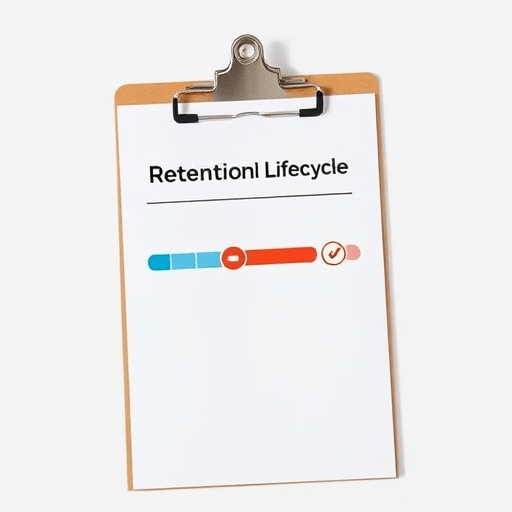
The Retention Lifecycle: From Collection to Certified Erasure
Retention is not a single decision made once; it is a lifecycle that begins before data exists. The most robust policies cover every stage.
Collection: Define the Purpose First
Before collecting data, document why you need it. If the purpose is clinical care, the retention clock starts at the date of service. If the purpose is research, define the specific research question and the endpoint of the study. Purposeless data is the first candidate for deletion.
Classification: Tag Data at Ingestion
By the time data is stored, it should carry metadata that drives its retention: type, source, subject consent, applicable jurisdiction, and auto-purge date. Without this classification, deletion becomes a manual, error-prone process that most organizations never actually perform.
Storage: Tier by Value and Risk
Not all data deserves the same storage tier. Active care records belong in fast, accessible storage. Closed cases can migrate to cheaper archival tiers while waiting out their retention period. Raw sensor data that has been summarized for clinical use can often be deleted immediately.
Deletion: Verify and Certify
Deleting is not emptying a recycle bin. Effective deletion requires cryptographic erasure or physical destruction, plus a certificate of deletion for audit purposes. For cloud storage, this means confirming that vendor replicas and backups were also purged. Regulators expect proof.
What to Delete and When: A Practical Checklist
The following checklist is a starting point. Always align it with your organization’s legal counsel and the specific requirements of your jurisdiction.
- Clinical records (adults): Retain for the minimum statutory period, typically 5–10 years from the last date of service, then review for any pending litigation or audit before deletion.
- Clinical records (pediatric): Retain until the patient reaches the age of majority plus the statutory period, which often means 20+ years. Flag these records in your classification system.
- Wearable and patient-generated device data: Delete raw streaming data after it has been ingested, validated, and summarized into the clinical record. Retain only the clinically meaningful summaries, for the same period as the record.
- Research datasets: Delete when the study endpoint is reached or the data has been fully de-identified, whichever comes first. Document the de-identification method and the date of destruction.
- Audit logs: Retain for 6 years for HIPAA compliance, but consider shorter periods for routine operational logs that contain metadata only.
- De-identified data: If a dataset has been properly de-identified and is being retained for public health or research, document the statistical re-identification risk assessment and apply periodic re-assessment at least every 2–3 years.
- Account and user data: Delete inactive patient portals and associated user data after a defined period of inactivity (e.g., 2–3 years) unless state law requires longer.
- Marketing and operational data: Purge at least every 12 months. This data is rarely covered by health information retention laws and poses unnecessary risk.
Special Cases: Wearables, Pediatric Data, and Research Biobanks
Wearable Data: Keep the Summary, Not the Stream
Continuous health monitoring creates thousands of data points per patient per day. Retaining all of it is rarely justified. If a device data stream is not integrated into the legal medical record, treat it as transient data with a retention period of 30–90 days. Summarized trends, such as average heart rate or sleep patterns, can be retained if they are clinically relevant and documented.
Pediatric Data: Plan for the Longer Clock
Children’s health data requires a longer retention arc and, in many cases, a parent’s consent for research use. When a minor reaches the age of majority, consent requirements can change. Build a workflow that reviews pediatric records at age 18 to re-consent, de-identify, or delete them based on the original purpose.
Research Biobanks and Genomic Data
Genomic data is the hardest to delete because it is intrinsically identifiable and often cannot be meaningfully anonymized. If your organization maintains a biobank, the retention policy must be defined in the consent form, and participants must be able to withdraw their samples and data at any time. Consider a “paused access” state for withdrawal requests, rather than immediate destruction, to allow ongoing studies to complete analysis.
Architecture That Enforces Policy
The best policy is worthless if it depends on manual enforcement. Leading organizations now bake retention rules into their data architecture.
- Automated deletion flags: Configure object lifecycle management in your data lake or cloud storage so that files expire automatically based on tags.
- Legal hold mechanisms: Ensure that litigation holds can be applied to a subset of data without disabling automated deletion for everything else.
- Deletion APIs: Build or purchase tools that can find and delete a specific individual’s data across all systems, including backups, within a defined service-level agreement.
- Data mapping as a living document: Your data inventory should include retention fields, and it should be updated whenever a new system or data source is added.
Conclusion
Data retention policies for digital health are ultimately a question of stewardship. Deleting data is not a loss; it is a deliberate act of responsibility that reduces risk, controls costs, and builds trust with patients. By classifying data at ingestion, setting honest retention periods, and automating deletion, organizations can meet compliance obligations without clinging to data that has outlived its purpose.