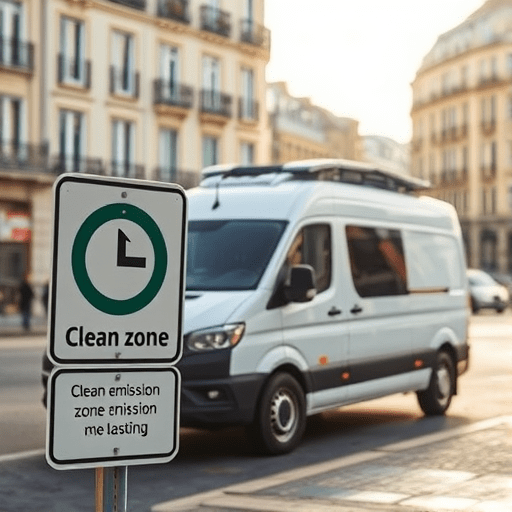
If you are planning a campervan trip across Europe this year, the single biggest logistical headache is no longer where to park overnight—it is understanding the patchwork of campervan low emission zones in Europe. They have multiplied, tightened, and become more digitally enforced than ever. What worked in 2023 will get you a fine in 2026. This guide looks at the cities that now require active permits, how the rules differ for diesel vans and motorhomes, and where you can still park without paying a cent.
Why 2026 Is a Turning Point for LEZ Enforcement
The low emission zone (LEZ) map of Europe is not static. Several major countries have been quietly dismantling grandfather clauses that once allowed older diesel campervans to enter city centres. The shift is not just about emissions categories; it is about enforcement. Automatic number plate recognition (ANPR) cameras now cover far more than the inner ring roads, and several cities have moved from voluntary registration to a strict “no permit, no entry” model.
For campervans, the challenge is twofold. First, many motorhomes are classified as heavy goods vehicles or passenger car-derived vans depending on their weight and registration document. That classification dictates which permit sticker or digital pass you need. Second, a campervan is not a car—its length, height, and cooking/gas equipment often place it in a separate category for parking. So even if your engine is clean enough to enter the zone, you may still be excluded from the parking rules that apply to cars.
The 2026 Permit Landscape: What Changed in Major Destinations
The old advice of “just buy a Crit’Air sticker for Paris and drive on” is no longer sufficient. Below is a breakdown of the notable updates that matter for campervan drivers.
France: The Permanent LEZ Network
France has ended its temporary Covid-era exemptions. In 2026, the Zones à Faibles Émissions (ZFE) are permanent in all metropolitan areas with more than 150,000 inhabitants. Crit’Air stickers remain mandatory, but several cities—including Lyon and Grenoble—have tightened their access criteria for diesel campervans registered before 2011. Even with a valid Crit’Air sticker, these older vehicles are now banned during weekday daytime hours. The practical workaround for campervanners is to use the designated aires de service on the outskirts, where the LEZ boundary usually stops.
The other major French change is the shift towards digital registration. While you still need a physical Crit’Air certificate, the ANPR cameras read your plate and cross-reference it with a national database. If your motorhome is registered to a foreign address, you need to ensure your vehicle’s emissions class is correctly encoded in your application—getting it wrong results in an automatic fine even if the sticker is visible on the windscreen.
Germany: The New Diesel Bans in 2026
Germany’s green zones (Umweltzonen) have existed for years, but 2026 has seen the expansion of Euro 6 diesel requirements in several cities that previously allowed Euro 5. Berlin, Stuttgart, and Munich are the strictest. For campervans, the key issue is the weight threshold. Most German cities issue emissions badges (Feinstaubplakette), but a campervan over 3.5 tonnes often needs a separate exemption that must be applied for in writing at least two weeks before travel. There is no same-day digital permit for heavy motorhomes in many German city LEZs, despite what some travel forums may claim.
Free parking in German LEZs is also rare. The best strategy is to use Park+Ride sites outside the LEZ boundary and cycle or take the U-Bahn into the city. Many of these P+R facilities are free, and they are typically spacious enough for long vehicles.
Belgium and the Netherlands: Cross-Border Digital Enforcement
Brussels, Antwerp, and Ghent have all harmonised their LEZ databases. In 2026, a campervan with a Dutch registration entering Brussels will be automatically checked against a central system. What makes this region unique is the “one-day tripper” permit.
Antwerp and Ghent allow campervans to buy a temporary one-day entry pass online, but only once per month. Brussels has no such daily option—you need a full three-month pass, which costs about €35. For campervanners, the sensible approach is to avoid driving through Brussels entirely. The city’s ring road is partly excluded from the LEZ, but the signage is confusing and a wrong turn onto a city street yields a €150 fine.
The Netherlands, meanwhile, has focused its enforcement on Amsterdam and Utrecht. Amsterdam’s LEZ now includes all vehicles, including campers, and the city has removed the overnight parking exemption that previously existed for campervans. Free parking is almost nonexistent within the canal ring. However, the Zeeburgereiland area outside the LEZ has designated campervan bays that are free for 24 hours—a rare find in a city known for aggressive parking prices.
Where Can You Park Free in a Campervan Without LEZ Headaches?
The most creative solution to the 2026 LEZ problem is to avoid the city centre entirely. Here are three reliable European patterns for free campervan parking that align with LEZ boundaries.
The Outskirts Service Area (Aires and Stellplätze)
France’s aires de camping-car are not just for overnight stops; many are positioned just outside the ZFE boundary. In 2026, municipalities have invested in upgrading these areas with water refill points and waste disposal specifically to catch LEZ-avoiding traffic. The key is to use apps like Park4Night or Campercontact, filtering search results for “free” and “outside LEZ.” A useful trick is to search for an aire at the nearest tram terminus—the final stop on the tram line will always be beyond the city centre’s restricted zone, and most of these aires are free on weekdays outside summer.
Industrial Estates and Supermarket Overnight Parking
It is not glamorous, but it is free and legal in most of Europe. Large destination supermarkets such as Leclerc in France, Carrefour in Belgium, and Kaufland in Germany often permit overnight campervan parking—provided you are discreet and leave by 9am. Many of these stores are located in commercial zones outside the LEZ boundary. The benefit is twofold: you get a free overnight spot, and you can walk or take a bus to the city without paying the LEZ permit.
Check local signage carefully because in 2026 more stores have started using private parking enforcement that issues fines for non-shoppers. Rule of thumb: if the supermarket is open until 8pm or later, and has a dedicated campervan bay marked out, it is probably safe. If there are no marked bays, move on.
Park + Ride as a Campervan Overnight Option
Park + Ride (P+R) lots are an underrated resource for campervans. Most cities allow overnight parking in P+R for a small fee, but many are free after 6pm and all day on Sundays. The catch is height restrictions. In 2026, several French P+R lots have introduced 2.0m barriers to prevent campervans from occupying spaces meant for commuters. However, the larger P+R Relais on the edges of cities like Nantes, Lille, and Toulouse have no such barriers and offer level, hardstanding parking. These sites are always outside the LEZ, so you can park your Euro 4 diesel campervan legally overnight, catch the free shuttle into town, and then return to your rig without ever entering the zone.
How to Avoid Fines: Practical Steps for 2026
The number one reason campervanners receive LEZ fines is not that they are trying to break the rules—it is that they assume a sticker is enough. Fines in 2026 are differentiated and steep: €68 in France, €100 in Germany, €150 in Belgium, and up to €290 in the Netherlands. Here is a practical checklist to keep you fine-free.
- Check your vehicle’s exact classification. A campervan converted from a van may be classified as a “light commercial” in the UK, but as a “motorhome” in France. That changes whether you need a Crit’Air sticker category 2 or 4, for example.
- Always pre-register your plate online. Even if the city does not require a physical sticker (some new LEZs in Italy are purely digital), your plate must be in the database before you cross the boundary. Registration is often free; the fine for failing to register is not.
- Do not rely on the vendor’s claim for “Euro 6.” The Euro classification on your V5C document is not always what a foreign authority recognises. For instance, a 2015 diesel campervan may be Euro 5 in your home country but considered Euro 6 by the Dutch enforcement system. Conversely, some French cities will treat your 2016 Euro 6 van as “Crit’Air 3” because the conversion to campervan altered the original type approval.
- Use a dedicated campervan sat-nav with LEZ overlays. In 2026, apps like TomTom and Snooper have integrated live LEZ data so that the route planner actively avoids restricted zones. Google Maps still does not show LEZ boundaries consistently, so do not trust it alone.
- Keep digital proof of your permit. Even if you have a paper sticker, take a screenshot or photo of your permit confirmation on your phone. Many LEZ enforcement systems have a human appeal process, and a digital copy is often accepted as proof of intention if your physical sticker is not yet mounted.
The Emerging Wildcard: Portugal and Spain’s Local Schemes
While many campervanners focus on France and Germany, the quieter places have also changed in 2026. Portugal now has a Low Emission Zone in Lisbon that wraps around the 24 de Julho promenade, a popular free campervan parking spot. The zone is enforced by cameras specifically aimed at foreign-plated vehicles, so it is easy to miss the sign. In Spain, Madrid’s Zona de Bajas Emisiones now requires all non-resident vans and campers to have a digital entry pass—but only if they are staying in a registered accommodation inside the zone. Campers staying in the free car parks on the Casa de Campo side of the city do not need a pass, because they are not entering the restricted core.
This is the new reality of campervan travel in 2026: the cheapest overnight parking spots are found precisely because they are outside the LEZ boundary, and the most expensive fines come from trying to sneak into a city to save a few euros on a parking garage.
Conclusion
Europe’s low emission zones are no longer a matter of paying a small fee at the border. They are active, technical restrictions embedded in each city’s transport strategy. For 2026 campervan travel, the smartest strategy is to plan your overnight stops before you decide which cities to visit: find free parking on the outskirts, use the city’s public transport from there, and only enter the LEZ if your vehicle’s classification is unambiguously allowed. That single shift—from “where can I park in the city?” to “where can I park safely outside the city?”—will save you money, headaches, and a pile of forbidden entrance warnings.