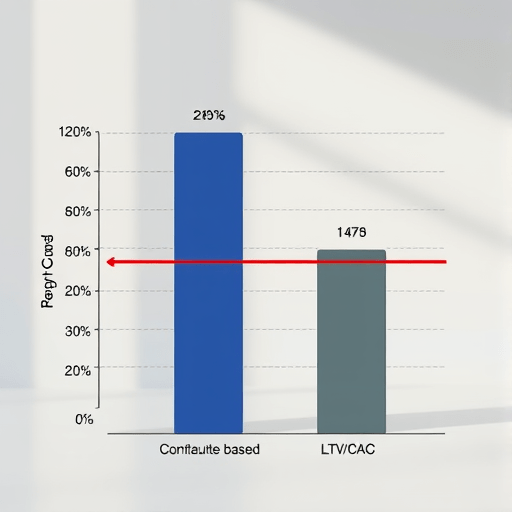
It sounds counterintuitive: a high LTV:CAC ratio is supposed to be the gold standard of SaaS health. But when that ratio is calculated on revenue instead of contribution margin, a “great” LTV:CAC can quietly destroy your company. The hard truth is that high LTV:CAC can bankrupt you if your gross margin is too thin to support the lifetime value you are bragging about. This is why smart finance teams now calculate LTV:CAC on contribution margin, not revenue — and why every founder should follow the same discipline before raising, spending, or scaling.
For years, investors and operators used LTV:CAC as a quick health check. Above 3:1 was considered good; above 5:1 was considered excellent. But that logic assumed revenue dollars eventually become profit dollars. In reality, a customer who generates a lot of revenue can still be unprofitable if variable costs eat the margin. When capital was cheap and growth was rewarded above all else, this flaw was easy to ignore. In 2026, with expensive capital and a brutal focus on profitability, it is no longer optional.
The Revenue Trap: Why a “Healthy” Ratio Hides Weakness
Imagine a B2B SaaS product with a $100 monthly subscription. The average customer stays for 24 months, so the revenue-based LTV is $2,400. If the fully loaded customer acquisition cost is $400, the revenue-based LTV:CAC is a flattering 6:1. Most founders would celebrate that number and invest aggressively in more sales and marketing.
But what if the contribution margin is only 30%? That means after paying for hosting, support, payment processing, onboarding, and other variable costs, only $30 of each $100 monthly payment remains to cover fixed costs and profit. The contribution-margin LTV is $720. Divide that by the $400 CAC, and the real LTV:CAC is 1.8:1. That is not healthy. Every dollar of customer acquisition is destroying value after accounting for the actual economics of serving that customer.
This is not a hypothetical edge case. Many SaaS companies have gross margins of 70–80%, but contribution margins can be much lower when you include variable selling expenses, implementation, customer success, infrastructure overage, and churn-related costs. The closer you get to a full contribution-margin view, the more honest your LTV:CAC becomes.
Gross Margin Sets the Ceiling — Contribution Margin Sets the Reality
Gross margin is a starting point, not a destination. It tells you how much revenue remains after subtracting the direct costs of delivering the product. For most software companies, that includes cloud hosting, database costs, third-party APIs, and technical support. A healthy gross margin is a necessary condition for a good business, but it is not sufficient to validate LTV:CAC.
Contribution margin goes one step further. It subtracts every variable cost that exists because a specific customer exists. This includes:
- Customer onboarding and implementation labor
- Sales commissions tied to the deal
- Payment processing fees
- Account management or customer success time allocated to the account
- Infrastructure costs that scale per usage or per seat
- Support tickets and technical service costs beyond the baseline
Fixed costs like research and development, general administration, and rent should not be included in contribution margin. The goal is to isolate the marginal economics of one additional customer. If a customer cannot contribute enough to cover these variable costs, then every new customer adds pressure to the company’s cash flow, no matter how large the LTV looks on paper.
How to Calculate LTV:CAC on Contribution Margin
Switching from revenue-based LTV:CAC to contribution-margin LTV:CAC is straightforward, but it requires access to good data. The process starts with calculating the contribution-margin LTV of a typical customer.
Step 1: Calculate average revenue per account per month
Start with the recurring revenue from an average customer. Include expansions and upsells, but exclude one-time fees that are not tied to the ongoing relationship.
Step 2: Determine the variable cost per account per month
Map every cost that changes with the addition or retention of that customer. For a cloud product, this may include infrastructure consumption, support requests, and customer success workload. Be ruthless here. If you are unsure whether a cost is variable, assume it is variable until you prove otherwise.
Step 3: Subtract variable costs from revenue
Revenue per month minus variable cost per month equals contribution margin per account per month. Express this as a percentage of revenue. This is your contribution margin.
Step 4: Multiply by average customer lifespan
If your average customer lifespan is 24 months, multiply monthly contribution margin by 24. If you use net revenue retention or a churn-adjusted formula, apply the same logic to contribution dollars. The result is contribution-margin LTV.
Step 5: Divide by CAC
Finally, divide contribution-margin LTV by the fully loaded cost of acquiring a customer. Include marketing spending, sales salaries, commissions, tools, and any other cost that exists solely to acquire new customers.
The formula becomes: Contribution-Margin LTV / CAC. If this number is below 3:1, your unit economics are fragile, even if the revenue-based LTV:CAC looks impressive.
Red Flags That Your CAC Payback Is Longer Than It Looks
Many founders discover the contribution-margin problem only after they have scaled. By then, the damage is already compounding. The following warning signs suggest your revenue-based LTV:CAC is misleading you:
- Your gross margin is high, but your contribution margin is low because of heavy onboarding or support costs.
- Sales commissions and customer success loading are not tracked at the customer level.
- Your payback period, when recalculated on contribution margin, extends beyond 24 months.
- Revenue retention is strong, but cash flow is negative even after adjusting for growth.
- Engaged customers generate high usage, which increases infrastructure costs, making your best customers your least profitable ones.
These signs point to a business model that systematically confuses revenue with value. The result is a company that looks successful in a fundraising deck but cannot generate sustainable profit without cutting the services that keep customers loyal.
What a Defensible LTV:CAC Looks Like Now
Investors and board members are no longer satisfied with a revenue-based LTV:CAC that ignores margins. The new standard is to present both numbers, with the contribution-margin version taking the lead. A contribution-margin LTV:CAC of at least 3:1 is a reasonable benchmark for many software businesses. Some high-margin, low-touch products can achieve 5:1 or better. Products with heavy implementation and ongoing service should require a higher ratio to compensate for the risk of service cost inflation and churn in later periods.
Another important shift is tying contribution-margin LTV to CAC payback. A payback period above 18 months is risky in most markets; above 24 months is dangerous. When you calculate payback using contribution margin, you get a true sense of how long it takes to earn back the cash you spent acquiring a customer. Revenue-based payback understates this because it ignores the variable costs that must be paid before you reach break-even.
The most durable companies now run their operating playbooks on contribution economics. Marketing budgets, sales quotas, and product pricing are all built around the margin a customer generates, not the headline revenue. This shift changes everything from compensation plans to feature prioritization, because it forces every team to ask one simple question: does this action improve the contribution margin per customer?
Conclusion
High LTV:CAC can bankrupt you when it is built on revenue alone. The only version that matters is the one calculated on contribution margin, because that tells you whether an acquired customer actually pays for the costs they create and leaves something behind for the business. Before you celebrate your next cohort’s LTV:CAC, calculate it on contribution margin and look at the number with clear eyes. It may be the most important reality check you run this year.