Before you tap “I Agree” on a health app, ask yourself one question: Who else is getting this data? The answer is rarely visible on the main consent screen. With health apps now integrating AI coaching, wearable feeds, and even reproductive health tracking, the gap between what you intend to share and what will be shared is wider than ever. That’s why you need a repeatable audit of health app data sharing before you consent — not to scare you away from useful tools, but to give you the same visibility a contracts lawyer would have.
This is not about reading the entire privacy policy from top to bottom. It’s about a targeted 3-step checklist designed to surface hidden data-sharing clauses, ambiguous consent language, and “partner” ecosystems that often exist only to monetize your health profile. Let’s walk through the audit now.
Step 1: Inventory the Data Collected vs. the Data Actually Needed
Every health app can claim a noble purpose. A sleep tracker needs motion data. A nutrition app needs your meals. But when the app requests access to your contacts, your photos, or your precise location in the background, that’s no longer “necessary” — that’s data scavenging. The first step in your audit is to build a simple inventory before consenting.
Read the Permission List Out Loud
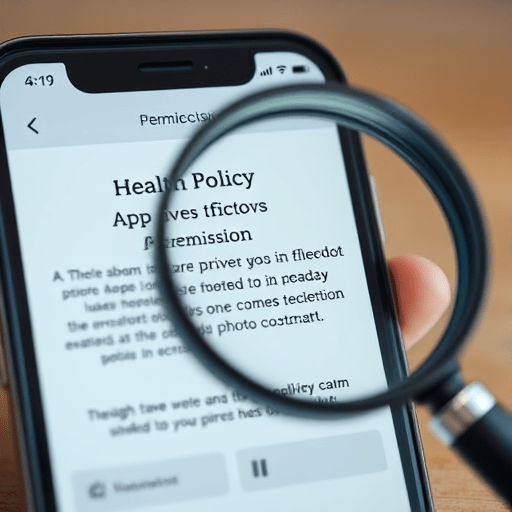
On your phone, the consent prompt lists the permissions the app wants. Go beyond the friendly icons and read the system-level description. For each permission, say out loud: “Why would a health app need this?” If the answer is anything other than a direct function of the health feature, flag it.
- Motion & fitness data — expected for activity tracking, but do they need to share it with “partners” for ad personalization?
- Microphone access — some mental health apps ask for this to analyze tone of voice. Is that promised in the marketing, or is it buried in a clause?
- Health records import — if an app wants to read Apple Health or Google Fit, note that it can see everything in that database, including data from other apps you use. It may not filter locally.
- Background location — a period tracker or mood logger has almost zero legitimate need for continuous location. If it’s there, you’re likely a data point in a mobility or advertising study.
Search for “De-identified” and “Aggregated” Language
App developers often justify data sharing by saying it’s de-identified. But the audit isn’t over. Look for a definition of de-identification in the privacy policy. In 2026, many apps still treat de-identification as stripping your name while keeping your ZIP code, phone model, and app usage times. That’s not anonymous; it’s easily re-identifiable. The more specific the data fields, the greater the chance your “anonymous” health profile can be linked to you after a data broker merger or a breach.
Step 2: Map the Data’s Journey to Third Parties
The second step in your audit is to ask: If I consent, who is downstream? A health app’s privacy policy usually lists categories of recipients, but the language is designed to be broad. Your goal is to turn that vague language into a concrete list of potential data destinations.
Look for “Service Providers” vs. “Business Partners”
- Service providers are supposed to process data only on the app’s behalf. That’s still a risk if they use subprocessors, but it’s the lesser evil.
- Business partners are often companies that license or share data for independent use. This is where hidden data-sharing clauses multiply. If the privacy policy says, “We may share your information with trusted business partners to enhance your experience,” assume that means ad networks, market researchers, and actuarial modelers.
Trace the “Research” Loophole
Many health apps include a clause about sharing data for scientific research. That sounds ethical, but the clause rarely specifies who conducts the research or whether it receives compensation. In 2026, some health apps have started selling “research-ready” datasets directly to pharmaceutical companies and insurance underwriters. The consent form you signed may be the only contract enabling that sale. During your audit, specifically search for the word “research” and see if an independent institutional review board (IRB) is named. If it doesn’t name one, it’s not peer-reviewed science; it’s data harvesting with a lab coat.
Don’t Forget Data Retention and Deletion
Data sharing doesn’t stop when you close the app. A hidden data-sharing clause often lives in a Retention or Data Storage section. Without a clear retention limit, your health data can be held indefinitely and then shared when the company sells its assets. The audit should include a simple search for “retention period,” “deletion,” and “asset sale.” If the app can transfer your data to a third party as part of a merger without a new consent, you might want to walk away.
Step 3: Decode the Legal Clauses That Hide Data Sharing
You’ve inventoried the data and mapped recipients. Now the final step: auditing the consent form itself as a legal document. Yes, it’s long. Yes, it uses absurd sentence structure. But the most dangerous data-sharing clauses are exactly the ones that are hardest to notice because they’re buried in legalese between sections you skip.
Flag Binding Arbitration and Class Action Waivers
If the consent form includes a binding arbitration clause, that’s a strong signal the app expects to be sued — and wants to make it impossible for you to join forces with other harmed users. This clause doesn’t have to be in the privacy policy; it’s often inside the Terms & Conditions. A company that forces arbitration is more likely to share data aggressively because the legal consequences are smaller. During your audit, look for language such as “any disputes will be resolved by binding arbitration” and note that this grants you no practical remedy if your data is sold to a shady broker.
Find the “No Opt-Out” Consent Trap
Some apps use a feature called “consent or pay” or “take-it-or-leave-it” data sharing. The audit should identify whether the app gives you a genuine choice. If the only way to use the app is to accept all data-sharing clauses, then you are not consenting — you are being conditioned. Search for whether the app has a “settings” option to limit data sharing, but also check if that option is empty or only toggles marketing emails. If the core data-sharing clause has no opt-out, then tapping “I Agree” is an act of trust, not informed consent.
Watch for “Subsequent Consent” and “Changes” Clauses
Even if the current privacy policy is clean, a hidden data-sharing clause often appears later. Look in the Terms for a line saying, “We may update this policy at any time; continued use constitutes consent.” That single sentence means the app can start sharing your health data tomorrow with a company that hasn’t even been named yet. For a truly robust audit, treat that clause as a veto. If the app refuses to guarantee 30-day notice before changes, the risk outweighs the reward.
Use Plain-English Translation Tools
By 2026, there are browser extensions and legal-tech AI tools that translate privacy policies into plain English. Before you consent, take a screenshot of the consent screen and paste the full policy into one of those tools. A good auditor will use every resource available. The goal isn’t to understand every comma; it’s to spot phrases like “may share,” “third parties,” “research,” and “survivability.” Those four phrases are the root of most hidden data-sharing clauses.
A Practical Recap: The 3-Step Checklist
- Step 1: Inventory — compare requested permissions to the app’s core health function and flag any data that is not strictly necessary.
- Step 2: Map — identify the named recipients and look for broad categories like “business partners” and unnamed “research” agreements.
- Step 3: Decode — scan for binding arbitration, no opt-out, and unilateral update clauses that allow the terms to change after your data is already inside.
You don’t have to repeat this audit for every app with equal intensity. But for any health app that senses, stores, or analyzes biological or behavioral data, this three-step checklist is the difference between a conscious decision and a blind guess.
Conclusion
Health app consent forms are not designed to be understood; they are designed to be accepted. Auditing health app data sharing before you consent is not about paranoia — it’s about treating your health data like the sensitive asset it really is. A few minutes of structured inspection before tapping that button can spare you months of regret after your data becomes a line item in a data broker’s spreadsheet. The next time an app asks for access, run the checklist, and then decide with both eyes open.