At the center of Paralympic sport sits a quiet contradiction: an athlete’s entire eligibility — who they can race against, which medals are within reach — is decided by human classifiers performing a short series of physical observations. It is a process that has drawn criticism for decades and produced some of the most emotional moments in the sporting calendar. As motion-capture cameras and sensor-packed wearables enter major events, the oldest debate in para sport is taking a new form. Will AI referees make Paralympic classification fairer, or simply exchange human imperfections for machine ones? The coming cycle of trials, running through the Milano-Cortina 2026 Games and beyond, could offer the first concrete answers.
The Subjective Roots of Classification: Why an Objective Upgrade Is Overdue
Para-sport classification is unlike any other rulebook in sport. It exists to ensure that athletes with different impairments — a swimmer with a single below-knee amputation versus one with full limb and trunk involvement — do not compete at a structural disadvantage. Trained classifier panels evaluate each athlete through physical inspection, muscle testing, and sport-specific functional tasks, then assign a class based on the severity of their impairment. This is the minimum impairment criteria process: below the threshold, an athlete competes against non-disabled counterparts; above it, they enter a class intended to equalize opportunity.
The trouble is consistency. Two experienced classifiers can reach different conclusions on the same athlete. Studies across track and field, swimming, and wheelchair basketball have documented substantial disagreement on identical assessments. For athletes, that variance carries enormous consequences: a single-point class shift can turn a medal favorite into a mid-field finisher. And the process itself is unforgiving — athletes often undergo classification hours before competition, under bright lights and tight schedules, with little room to show their true functional range.
This is the gap the new tools are meant to close. Rather than asking a human eye to estimate a shoulder angle or judge spasticity by feel, cameras can track limbs in three dimensions, and wearables can quantify muscular activation, tremor, and movement smoothness across dozens of repetitions. The necessary information has always existed in an athlete’s motion; the technology to record it objectively, reliably, and affordably has only recently caught up.
Computer Vision and Wearables: The Toolkit Behind the AI Referee
The next generation of classification instruments is not a single gadget. It is a layered sensing pipeline, with each element feeding a shared analytical model.
Computer Vision: Reading Movement in Three Dimensions
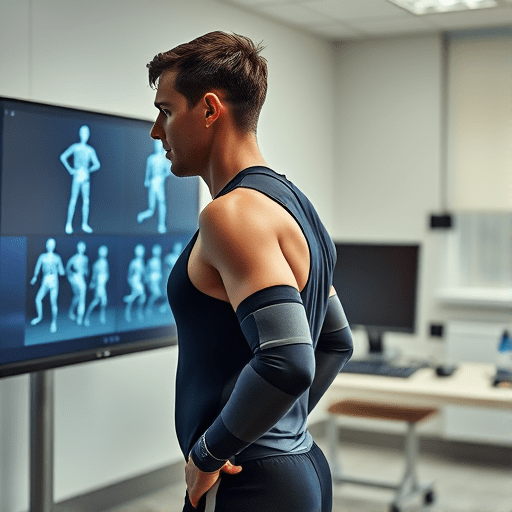
High-frame-rate cameras, depth sensors, and markerless pose-estimation algorithms reconstruct an athlete’s body in three dimensions without reflective suits or manual measurement. During standardized tasks — a seated throw, a knee-extension test, a sprint drive — the vision system extracts far more than a finish time: stride symmetry, trunk displacement, joint torque estimates, and time-to-peak force. Comparing these features against normative profiles for the athlete’s age, sex, and sport turns an evaluator’s subjective read into quantified, replayable evidence.
Wearables: Sensing What the Camera Cannot
Inertial measurement units sewn into sleeves and shorts capture linear and angular acceleration of every body segment. Surface electromyography electrodes reveal whether a muscle that appears weak on manual test is actually firing normally — a distinction that has confounded classifiers for years. Pressure insoles map gait dynamics to actual force percentages, converting phrases like “mild asymmetry” into exact data: 62 percent on the left limb, 38 percent on the right. Combined, these sensors describe an impairment in its full mechanical detail.
What makes this toolkit revolutionary is repeatability. A human classifier can tire, be rushed, or be swayed by presentation; an accelerometer cannot. And because sensors can be worn over longer stretches, classification could one day capture an athlete’s typical daily variability rather than a single anxious snapshot — arguably a truer representation of impairment.
From Measurement to Judgment: An AI Classification Pipeline
Building a useful AI referee is not a matter of feeding a model some data and letting it return a class. The pipeline must be structured so every step can be validated — and so athletes and panels can audit what happened, in plain language. The workflow resembles this:
- Standardized capture. Every athlete performs the same protocol, in the same order, under controlled conditions, with cameras and wearables synchronized and time-stamped.
- Feature extraction. Algorithms reduce raw signals to biomechanical features: joint kinematics, force asymmetries, coordination variability, and fatigue markers.
- Normative modeling. A model, trained on thousands of previously classified athletes, estimates a functional impairment score with confidence intervals — not a single rigid answer.
- Explainable output. The system flags precisely which measurements drove the score, allowing human classifiers to inspect, question, or override the result.
- Human-in-the-loop decision. The final class remains a human decision, but one backed by a reproducible evidence base instead of an impression.
This last step matters conceptually. The AI is not a referee waving a flag; it is a measurement instrument that lets the referee see accurately. It also changes the nature of appeals. If an athlete disputes a class, the prediction can be regenerated from the same raw data, in front of an independent panel, rather than rehashed as a battle of opinions.
How AI in Paralympic Classification Can Be Made Trustworthy
Any serious move toward AI referees has to confront a core dilemma: algorithmic objectivity is only as clean as the data that feeds it. Classification datasets are small — a few thousand complete records spanning impairment types from cerebral palsy to amputation to vision loss. If those records contain the biases of the old subjective system, the model will simply learn to replicate them with better marketing. The remedy is a deliberate data strategy: collect new reference data under uniform protocols, include underrepresented impairment groups, and run independent audits for impairment- and demographic-specific bias.
It is just as important to respect what measurement cannot capture. Some impairments — certain visual and cognitive conditions — do not reveal themselves in kinematic data. A purely physical AI system would either ignore those classes entirely or mischaracterize them. The honest design is a modular one: computer vision and wearables handle physical evidence, while other validated assessments feed separate streams into the same explainable framework.
Privacy also deserves a central seat at the table. The same sensor data that identifies an impairment can reveal a great deal more — fatigue patterns, medication proxies, injury history, and performance ceilings. Athlete consent will need to be informed, granular, and revocable, and federations must set data-sovereignty rules before a commercial partner’s model is allowed near classified athletes.
The Road to Milano-Cortina 2026 and Beyond
The International Paralympic Committee has already encouraged pilot research on objective measurement, and camera- and sensor-based assessments have been tested at multi-sport events during the current cycle. The next leap — moving from research to rulebook — will be the hard one. It demands an official timeline, athlete consultation, published benchmarks, and an appeals process that treats the algorithm as a piece of evidence, not an oracle.
The best version of this transition is one where athletes understand exactly what was measured, why it moved their score, and how to contest it. The worst version is a closed system that outsources careers to a black box. The difference will come down to transparency, independent review, and the willingness of human classifiers to have their judgment improved rather than replaced.
Conclusion
The question of AI referees in Paralympic classification deserves a nuanced answer. The capacity for greater fairness is real. Computer vision and wearables can remove much of the bias that comes from human observation, replace slogans with numbers, and give athletes an evidence trail their careers have always deserved. But fairness in this context is ultimately a product of governance, not mathematics. If the new systems are built openly, validated honestly, and tested with the athletes they claim to serve, the answer is a cautious, well-earned yes.