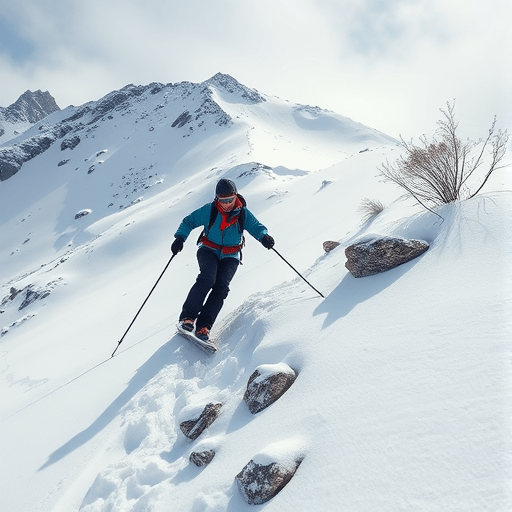
Early-season backcountry splitboarding on shallow snowpacks demands a terrain assessment framework that goes beyond simply checking the weather forecast. When the base depth reads thin on the caltopo map and the snotel station is still climbing toward its seasonal average, every feature on the slope becomes a question rather than an answer. Rocks, stumps, buried logs, and shallowly buried creeks all sit closer to the surface, and the margin between a fun opening day line and a season-ending ride to the hospital narrows dramatically. The framework below is built for riders heading out in November and December 2026, when coverage is promising but the ground is never far away.
Why Shallow Snowpacks Behave Differently
Thin snow behaves nothing like the deep, consolidated pack you ski in February. The depth hoar layer near the ground stays active for longer because the temperature gradient between the soil and the air remains steep. Brush that would normally be buried under three metres of white can still be holding up two centimetres of surface snow, creating a false sense of coverage. Buried rocks radiate heat and create localised melt-freeze crusts even when the ambient air temperature is well below zero. Every one of these factors changes how the slab reacts when a rider initiates a turn.
The classic early-season hazard list is short and ugly: rockfall, shallowly buried obstacles, terrain traps, and persistent weak layers that have not yet been compressed or rounded off by a deep load. Reading depth before you drop in is the only way to put reasonable boundaries around those hazards.
The Three-Tier Depth Framework
Rather than treating every slope as either “skinnable” or “not,” think in three tiers of snow depth and adjust your riding to match.
Tier 1: Under 40 Centimetres — Walk Only
If your probe reads less than 40 centimetres to ground, the slope is not a riding line, it is a walking line. The slab is too thin to absorb a typical rider’s weight without punching through to the vegetation layer, and any feature that releases will entrain the entire snowpack plus ground debris. Stick to low-angle terrain below 25 degrees and use the day to scout the run for later in the season. Probe multiple spots, not just one: a sheltered pocket beneath a cliff band may have 80 cm while the apron below holds 20.
Tier 2: 40 to 80 Centimetres — Low-Commitment Lines Only
This is the awkward middle zone where coverage looks tempting but structure remains suspect. In this tier, commit to terrain with clean runouts, no terrain traps, and featureless slopes that have not been loaded by wind. Stay off convex rolls, gully entries, and any rollovers where the snow depth drops off rapidly. This is also the tier where a snowmobile-ski-cut partner is most valuable, because the slab is just thick enough to produce a propagating fracture but thin enough that debris will be rocky and damaging.
Tier 3: Over 80 Centimetres — Evaluate Structure Before Riding
Once the pack exceeds 80 cm, depth alone stops being the controlling factor and structure takes over. Run a quick extended column test or a compression test on a representative slope to identify whether the early-season depth hoar has been bridged, whether facets near crusts are still reactive, and whether there is a cohesive slab sitting on a persistent weak layer. Even in a relatively deep pack, a result of easy propagating fractures in the upper 30 cm is a red flag for the open-steep terrain above.
Reading Terrain Features on a Thin Base
A shallow pack exaggerates everything. The wind-loaded pocket that would normally be a soft pillow becomes a hard wind slab sitting on depth hoar. The gully that funnels debris becomes a rock garden the moment the snow melts out. Spend a few minutes before each descent translating what you see into what the snow depth is actually doing.
- Cliff bands and rock outcrops: Expect shallow coverage within two to three metres of any rock face. Snow slides off and sublimates faster in these zones.
- Vegetation clusters: Willows and alders hold snow early but also create weak spots where the pack bridges unevenly. Probe between bushes before committing.
- Solar aspects in November: South-facing slopes may already be developing a melt-freeze crust at the surface, especially during warm spells. This crust changes slab behaviour significantly.
- Creek beds and drainages: Even when covered, these are the worst places to end up in a slide. Avoid their runouts whenever the pack is shallow.
Probing Strategy That Actually Works
Most riders probe too few spots and call it good. A useful early-season probing session has three phases. First, do a quick transect across the slope at the entry zone, probing every five metres from skintrack up to where you intend to drop. Second, probe the specific line you plan to ride, including any start zones and the runout. Third, probe any micro-feature that looks different — a wind scoured strip, a sun cup field, a track left by a previous rider.
Pay attention not just to depth but to resistance. A probe that punches through a soft layer into something hard often indicates a crust or ice lens, which can be a bed surface. A probe that hits a soft, hollow feeling at depth often indicates advanced depth hoar or buried vegetation. Both findings should slow you down.
Timing Your Lines Around the Early-Season Sun
Late November and early December bring a low sun angle that bakes south and west aspects during the day while leaving north and east aspects cold and faceted. On shallow snow, this matters more than usual because the sun has enough energy to weaken surface layers on solar aspects within an hour of direct exposure. Cold north-facing slopes hold powder longer but also preserve the weak layers that formed during the long dry autumn.
Build a habit of doing your assessments in the morning when the snow is still frozen solid from overnight radiational cooling. Slopes that are supportable on the skin up will likely be isothermal and sloppy by early afternoon, especially below 2,500 metres. Plan descents for the colder part of the day and use the soft afternoon slot for low-angle glades and meadows where a wet slide would not have grave consequences.
Group Habits for Thin-Cover Touring
Riding solo on a shallow snowpack is a bad idea even for experienced riders. Spread out when skinning so only one person at a time crosses a suspect slope, and never drop in together when the pack is less than 80 cm deep. Stagger descents by at least a minute, and pick a meeting point on the flank rather than in the runout, so a triggered slide from above does not catch the group below. Carry two probes each rather than one — one to test the snow and one for the companion rescue that hopefully never happens.
Decision Aids Worth Carrying
The avaluator card, the AIARE checklist, and the local avalanche bulletin all play a role, but on shallow early-season snow, a simple slope-angle filter is often the most useful tool in your pack. Anything over 30 degrees in a thin pack deserves an extra two minutes of evaluation, anything over 35 degrees warrants a deliberate stop to dig. Pair that with a quick mental check: would I be comfortable hitting this feature in March? If the answer is no, the early-season answer is definitely no.
Putting the Framework Together
The terrain assessment framework is not complicated, but it requires discipline. Probe transects across start zones and runouts. Classify the slope into one of three depth tiers. Identify terrain features that exaggerate shallow-pack hazards. Time your descent for the colder part of the day. Ride one at a time on suspect slopes. None of these steps replaces avalanche training, but together they convert an uncertain early-season window into a calculated one. The reward for doing the homework is being able to ride with confidence when the next storm finally stacks up on the thin base you have spent the autumn getting to know.
Early-season splitboarding on shallow snowpacks rewards the rider who treats every slope as a question worth asking. Depth, structure, terrain features, timing, and group spacing each contribute a piece of the answer. When all five line up, the line is worth riding. When any one of them is uncertain, the mountain will still be there next week, sitting under a deeper, more forgiving pack.