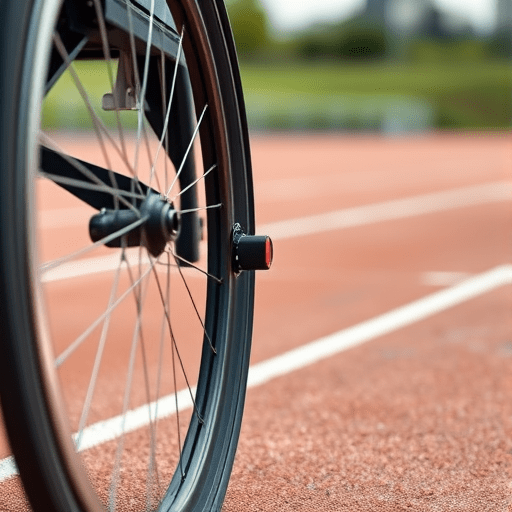
Elite wheelchair racers now wear sensor-laden armbands, their chairs fitted with accelerometers, gyroscopes, and even power meters. Yet the performance analytics that emerge from this hardware are often built on an implicit assumption: that the athlete moves by taking steps. For wheelchair athletes, that assumption distorts every metric—pace, cadence, load, strain—and undermines the promise of data-driven sport. In 2026, as adaptive athletics reach new levels of professionalization, the urgent missing piece is not another gadget but a shared foundation. Sports technology simply cannot become truly inclusive until adaptive sports adopt inclusive data standards designed around wheelchair propulsion, not upright locomotion.
The Data Gap Between Wheelchair and Able-Bodied Athletes
Mainstream sports analytics have been refined through millions of hours of running, cycling, and rowing data. Wearables from major brands use algorithms trained on step-based biomechanics to estimate distance, energy expenditure, and training load. When an athlete pushes a wheelchair, those algorithms misinterpret the motion. Step count becomes a meaningless number; vertical oscillation appears as an artifact of torso movement; heart-rate variability is blended with upper-body muscle exhaustion in ways the model never learned to handle.
This is not just a calibration problem. It is a structural one. Wheelchair propulsion involves a different kinetic chain: shoulder, elbow, and wrist joints generate force through a push rim, and the chair itself acts as a mechanical extension of the athlete’s body. Metrics such as push frequency, push symmetry, glide ratio, and rolling resistance are far more informative than cadence or stride length. Yet these metrics rarely appear in commercial analytics platforms because no common vocabulary defines them.
When Data Models Ignore the Equipment
An able-bodied runner’s shoes are relatively consistent. A wheelchair, however, is a highly variable piece of equipment. Tire pressure, wheel camber, hand rim diameter, frame stiffness, and cushioning geometry all affect performance. Two athletes with identical physical capacity may produce completely different race times because of equipment setup, yet current data systems treat the chair as a black box. Without standards for capturing this equipment metadata, any cross-athlete comparison is inherently biased. The result is a skewed analysis that often credits or blames the wrong factors.
How Missing Metrics Skew Performance Analytics
Performance analytics serve three major roles in elite sport: talent identification, training load management, and tactical decision-making. In adaptive sports, each role is compromised by missing wheelchair-specific metrics.
Talent Identification Relies on Unfair Benchmarks
Scouts and classification specialists often compare wheelchair athletes using generic endurance metrics—VO₂max, heart rate at threshold, and overall race splits. But these measures fail to distinguish between an athlete with efficient propulsion mechanics and one who simply pushes harder. A young wheelchair racer with poor technique but exceptional aerobic capacity may be overlooked, while a veteran with a well-tuned chair and decades of skill is overrated. Inclusive data standards would let talent identification systems incorporate technical efficiency parameters, such as push effectiveness (the percentage of propulsive force that actually accelerates the chair) and coasting efficiency.
Training Load Is Miscalculated, Driving Injury Risk
Upper-body injuries are the most common reason wheelchair athletes miss competitions, yet most load-monitoring tools still rely on heart rate and session RPE. These metrics do not directly capture the repetitive micro-trauma of push rim impacts, shoulder strain from asymmetric propulsion, or the accumulation of force on the wrist and elbow. A standard that includes push counts, peak push force, and braking events would allow coaches to see when a training session crosses a safe threshold. Without that data, athletes end up overtraining in subtle ways—no pulsing leg muscle to signal fatigue, just a dull ache that becomes a chronic injury.
Tactical Analytics Ignore the Environment
Race analytics in able-bodied running can reasonably assume a stable track surface. Wheelchair racing takes place on roads, tracks, and trails where wind drag, road camber, and tire rolling resistance vary dramatically from lap to lap. Current analytics packages treat every split as equivalent, ignoring that one section of the course may require twice as many pushes. A data standard that encodes course conditions and wheelchair configuration would allow coaches to make tactical decisions based on meaningful data—when to conserve energy, where to overtake, how to respond to changes in surface texture.
Toward Inclusive Data Standards: What Needs to Change
The good news is that the technology to capture wheelchair-specific metrics already exists. Inertial measurement units can be mounted on the frame, instrumented push rims measure tangential force, and seat pressure maps can indicate weight shift patterns. The challenge is not hardware but interoperability. Dozens of proprietary formats exist, each locked to a single manufacturer, making it impossible for researchers and coaches to combine datasets. Inclusive data standards would solve this by defining common fields, units, and metadata schemas for adaptive sport performance.
What would those standards look like in practice? At a minimum, they should include:
- Propulsion events: count, timing, and peak force of each push phase.
- Coasting phases: duration, speed decay, and glide ratio between pushes.
- Equipment metadata: wheel camber, tire pressure, hand rim type, frame design, and chair mass.
- Environmental context: surface type, incline, wind speed, and course conditions.
- Athlete-reported metrics: perceived shoulder fatigue, grip comfort, and nerve tension.
Critically, these standards must be developed with wheelchair athletes, not just for them. Athletes know that a standard which ignores their subjective experience of propulsion will fail in the field. Coaches, sports scientists, and device manufacturers need to sit at the same table and agree on a common ontology for adaptive performance data.
The 2026 Opportunity: From Fragmented Data to an Open Ecosystem
This year marks a turning point. Several international para-sport federations have begun to pilot digital performance logs, and academic sports science laboratories are publishing open datasets from instrumented wheelchairs. However, these efforts remain isolated. Without a shared standard, each new dataset adds to the fragmentation, not to the collective knowledge base.
A coordinated push toward open, inclusive data standards is the natural next step. Imagine a virtual repository where a wheelchair racer in Tokyo and one in Berlin can compare push-efficiency profiles using identical metric definitions. Coaches could identify technical patterns that predict podium finishes. Sports medicine researchers could analyze injury risk factors across thousands of training sessions, not just a single team. This is not a distant dream—it is an achievable goal if the stakeholders commit to a common framework.
Policy makers can accelerate this process by requiring data interoperability in any sports technology that receives national federation approval. Funding agencies can prioritize research projects that publish open, standardized datasets. And athletes themselves can demand that their performance data belongs to them—portable, transparent, and meaningful.
Conclusion
When wheelchair athletes are measured with the wrong ruler, the numbers lie. The gaps in adaptive sports data are not invisible; they are encoded in every misleading dashboard, every underestimated training load, and every young talent ignored because the analytics cannot see their true potential. Inclusive data standards for adaptive sports would change that. They would give wheelchair athletes the same analytical rigor already available to able-bodied competitors, but on terms that respect the physics of the chair and the physiology of the person who pushes it. In 2026, the technology is ready. The question is whether the sports world is bold enough to standardize it fairly.