It started as a desperate experiment: a two-week booking in a small onsen town in Nagano, with a spotty pocket Wi-Fi and a deadline calendar full of client work. I had been burned out by the endless grind of city cafés, co-working spaces, and the pressure of being “always on.” The plan was simple — keep my digital work alive, but wrap it in the slow rhythm of a hot-spring town. What I discovered was that this unusual combination of merging digital deadlines with daily onsen rituals completely changed how I approach work, rest, and time. This is not a generic manifest of remote work; it is a case study of how I slowed down in a Japanese onsen town (and worked) with surprising results.
Why an Onsen Town for Digital Work? Setting the Scene
Japan has long promoted workation programs, but the real magic is not in the amenities of a resort — it is in the absence of modern noise. The town I chose had a main street of wooden inns, a river running through the centre, and three public baths within a five-minute walk. There was no co-working hub, no 24-hour convenience store around the corner, and no temptation to pack my schedule with meetups. That containment was exactly what I needed.
My typical day was framed by the onsen schedule, not by Slack notifications. I woke up with the sun, walked in the cool morning air, and soaked before touching my laptop. That first hour of unhurried time became a deliberate buffer between the digital world and my own body. It sounds simple, but it reshaped my entire relationship with deadlines.
Designing a Slow Routine Around Work and Water
I structured the day in three segments: morning work, midday exploration, and afternoon deep focus — with an onsen at each transition. This was not a rigid Pomodoro technique. It was a softer version of time-boxing that leaned on the natural signals of the town: the temple bell, the opening of the bakery, the steam rising from the bathhouse at sunrise.
Morning: The Pre-Work Soak
The first bath of the day was non-negotiable. In the public bath, surrounded by elderly locals who barely acknowledged me, I learned to let go of the pressure to be productive every second. I would sit in the 42°C water, watch the mist roll over the mountains, and let my mind wander. By the time I opened my laptop, I was already calm and clear. Emails that once triggered anxiety were just messages waiting for a logical reply.
I still worked hard — perhaps harder than before — but the baseline of stress was much lower. The onsen ritual did not waste time; it gave me focus.
Midday: The Slow Lunch Reset
Instead of eating at my desk, I walked to a local soba shop or bought freshly steamed sweet buns from a tiny stall. Lunch became a real break. I intentionally left my phone in the room. Watching the shop owner grind wasabi or an old woman arrange pickles was a form of mindfulness I never found in a meditation app. That slow midday reset made the afternoon work block far more productive than any five-shot cortado.
Afternoon: Deep Work with a View of the River
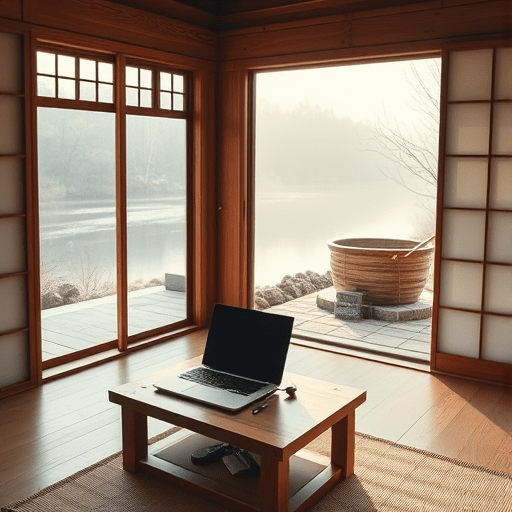
My workstation was a low table by a window that faced the river. The sound of water replaced the hum of air conditioning. I set a single focus for each two-hour block: draft the article, finish the client deck, reconcile the budget. With fewer distractions and a clear mind from the morning soak, deep work came more naturally. I rarely checked the clock. When I felt my attention waning, I did not scroll social media — I filled a kettle, made a cup of hojicha, and watched the river for a minute.
Evening: The Reward Soak
The late-afternoon onsen was the unofficial end of my workday. Whether the deadlines were done or not, I made a rule: after the bath, no heavy emails, no “quick checks.” This forced me to manage my time better during the day. The hot water washed away both sweat and the residue of digital tension. After dinner, I would write in a paper journal, read a novel, or simply listen to the quiet.
Connectivity, Time Zones, and the Reality of Remote Deadlines
It is easy to romanticize a digital detox, but the truth is that I had client calls and deadlines tied to Tokyo and sometimes New York. I needed to remain reachable. The onsen town had surprisingly good fiber optic in the inn, though the public Wi-Fi was unreliable. My solution was to treat connectivity as a resource, not a constant companion.
I held all calls during a fixed two-hour window in the late morning. The rest of the time, I muted notifications and checked messages in batches. For clients, I explained that I was in a “rural workation with slow response times” — and to my surprise, everyone was more understanding than I expected. They valued the quality of my output over the speed of my reply. The slow routine actually improved my responsiveness because I was not constantly context-switching.
I also used time differences to my advantage. When a New York client had a deadline, I worked in the early evening while the onsen town was quiet. Then I rewarded myself with a night soak under the stars. That reward cycle — work, soak, repeat — kept my motivation high even during intense crunch periods.
The Rituals That Changed My Work Style
Beyond the onsen itself, the slower rural routine introduced rituals that I have kept even after returning to the city.
- The “cold water” task starting practice: Before checking my phone each morning, I now write down one single goal for the day. No phones, no noise, just pen and paper.
- The walking call: Instead of a sitting video call, I now take some meetings as voiced-only walks. The onsen town’s quiet lanes and mountain paths were perfect for this.
- The 5 p.m. cutoff ritual: I learned to stop work without guilt by replacing the “end of the workday” chime with a literal bath. Now I take a bath or a long shower at 5 p.m., which signals my brain that work is done.
- The one-dish lunch rule: Eating a single, hearty bowl of rice, miso, and pickles instead of a desk salad or sandwich kept my energy stable and reduced afternoon crashes.
What I Learned About Work and Slow Living
Merging digital deadlines with daily onsen rituals is not about being lazy. It is about trusting that rest, silence, and routine can coexist with high-performance work. In the onsen town, every day had a natural rhythm: the baths were always at the same temperature, the locals always bowed when I passed, and the river always flowed. That predictability gave my nervous system a foundation that allowed my brain to do deeper, more creative work.
The biggest lesson was that slow time is not lost time. The hours spent soaking, walking, or staring at the river were never wasted. They built the mental clarity that made the working hours more valuable. I missed a few days of total productivity, but I gained weeks of sustained energy. I also came home with a new definition of productivity: not how much you cram into a day, but how much depth you can bring to the few things that matter.
The Takeaway for Remote Workers Who Crave Slowness
If you are thinking about taking work to a Japanese onsen town, do it — but don’t just bring your laptop and expect miracles. Design a routine that puts the onsen, the meals, and the walking at the center. Let the deadlines bend around the slow rituals, not the other way around. You do not need a fancy digital nomad visa or a high-tech setup. You need a willingness to let the water tell you when to rest and when to work.
In a world that celebrates hustle, the onsen town taught me that the best way to speed up your thinking is to first slow down everything else. That is the case study I will carry with me long after the bath water has cooled.
This article reflects a personal experience, not a universal prescription. But if you have ever wondered whether you can work effectively from a remote Japanese village, the answer is yes — with the right rituals and a gentle tolerance for the steam rising off your coffee and the onsen alike.