For decades, the discrete graphics card sat at the center of every enthusiast PC build. In 2026, that assumption is quietly unraveling. A growing wave of mid-range gaming rigs is shipping without a dedicated GPU, leaning instead on integrated neural accelerators, on-device AI upscaling, and smarter rendering pipelines. The result is a surprisingly capable machine that costs less, runs cooler, and still pushes frames well beyond what most casual players expected from a graphics-less box.
What Changed: AI Upscaling Moved to the Main Chip
The shift started quietly. For years, neural upscaling lived in the GPU’s own silicon, locked behind proprietary APIs and expensive hardware. By late 2025, both major CPU platforms had absorbed lightweight neural processing units capable of running real-time upscaling, frame generation, and texture reconstruction natively, without offloading to a separate graphics card.
This matters because the bottleneck was never raw pixel count. It was how efficiently a chip could reconstruct detail from a lower-resolution source. When a modern integrated neural accelerator handles that reconstruction, the CPU no longer needs to feed a discrete GPU millions of pixels per frame. It only needs to render the game at, say, 720p, and the neural block reconstructs it into something that looks and feels like 1440p.
Game engines are catching up too. Many 2026 releases ship with built-in hooks for neural asset generation, meaning developers can spend less time hand-tiling textures and more time tuning the model that reconstructs them at runtime.
The New Mid-Range: What a GPU-Less Build Actually Looks Like
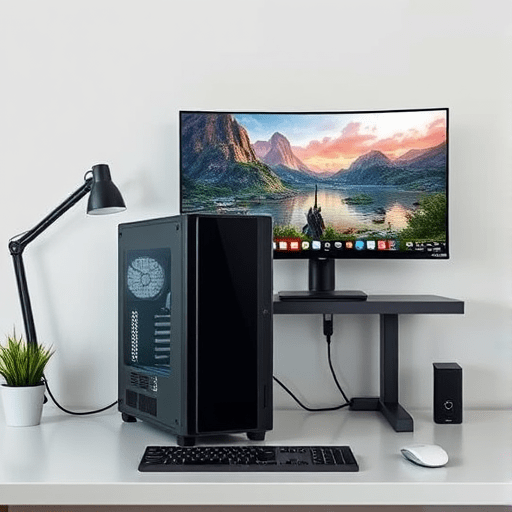
Picture a tower with a current-generation eight-core CPU, 32 GB of fast DDR5 memory, a quiet NVMe SSD, and integrated graphics that includes a dedicated neural engine. No add-in card. No oversized power supply. No exotic cooling.
On paper, this sounds like a regression. In practice, reviewers have been posting frame-rate charts that look more like a mid-tier laptop from 2023 than a budget desktop. Casual esports titles hit hundreds of frames at 1080p. Story-driven single-player games comfortably clear 60 frames at 1440p with neural reconstruction enabled. Even some open-world flagships are landing in the 40-50 frame range with modest quality settings.
For the first time, the integrated graphics on a flagship desktop chip is doing the job that used to require a $300 add-in card.
Why Memory Bandwidth Suddenly Matters More
Because the CPU and the neural accelerator share the same system memory, RAM speed and capacity are now the primary performance lever. Builders who spent years chasing GPU silicon are now chasing memory kits, dual-rank configurations, and tight timings.
A 32 GB dual-channel kit with reasonable latency is the new sweet spot. Going beyond 64 GB rarely helps unless the workflow also involves local AI tasks or heavy multitasking.
Neural Rendering Is Not Just Upscaling
The term neural rendering covers more than just making low-resolution frames look sharper. In 2026, it stretches across several techniques that previously required brute-force GPU muscle.
- Temporal reconstruction uses motion vectors and prior frames to fill in detail the engine never actually rendered, similar to how a video codec fills in missing frames.
- Path-traced lighting without the cost uses a small neural network to approximate how light would bounce in a fully ray-traced scene, then blends the result with traditional rasterized lighting.
- Asset compression ships lower-resolution textures, normals, and meshes, then reconstructs them at draw time using the neural block.
- Frame generation inserts synthesized intermediate frames between natively rendered ones, doubling perceived smoothness without doubling render cost.
None of these techniques are new in isolation. What is new is that they all run on the same small neural accelerator sitting next to the CPU cores. The GPU’s traditional role as the home for this work is no longer guaranteed.
Who Actually Benefits From Skipping the GPU?
This trend is not universal. Hardcore enthusiasts chasing maximum detail at 4K, competitive players demanding absolute minimum latency, and content creators running GPU-accelerated workloads will still buy a discrete card. Nothing about on-device AI changes that.
But the audience that benefits is bigger than the industry has been willing to admit.
Casual and Mid-Range Gamers
Players who mostly run indie titles, MMOs, racing games, and a few flagship releases a year are exactly the demographic that has historically overspent on GPUs. For them, a neural rendering rig delivers the experience they actually play at, for less money and in a quieter case.
Students and First-Time Builders
A complete system without a discrete GPU means a smaller budget can go toward a better screen, more storage, or a quieter case. For someone stepping into PC gaming for the first time, the value proposition is hard to argue with.
Living-Room and Small-Form-Factor Builds
Low-power, low-heat rigs have always been desirable for living-room PCs and compact enclosures. Removing the largest power draw in the system makes those builds more feasible than ever.
The Hidden Trade-offs Nobody Talks About
Dropping the GPU is not a free lunch. The approach has limits that buyers should understand before they commit.
First, neural reconstruction introduces a subtle softness during fast camera motion, especially in scenes with fine high-contrast detail. Most players do not notice, but competitive FPS fans will.
Second, software support is uneven. While major engines have integrated the necessary hooks, a long tail of older titles and niche sims still expects traditional rasterized pipelines. On those games, integrated graphics fall back to raw shader power, which is limited.
Third, the upgrade path is unusual. Adding a discrete GPU later is easy, but upgrading the integrated solution means replacing the entire CPU. That is a different mental model than the familiar GPU swap.
The Coming Hybrid Tier
Looking forward, expect a hybrid category to emerge: a mid-tier discrete GPU used primarily as a neural co-processor, doing the upscaling and reconstruction work while the CPU’s integrated graphics handles the base render. It sounds strange, but several motherboard makers have already shown reference designs that point in that direction.
What Builders Should Actually Buy in 2026
For someone planning a mid-range gaming build this year, the checklist has shifted.
- Prioritize a CPU with a strong integrated neural accelerator and the latest integrated graphics architecture.
- Spend the freed-up GPU budget on faster, higher-capacity DDR5 memory.
- Pick a case and cooler designed for low-noise, low-heat operation rather than high-airflow gaming aesthetics.
- Choose a power supply sized for the actual system load, not a future hypothetical GPU.
- Keep an open PCIe slot and reserve budget in case a discrete card becomes desirable later.
This configuration is not a compromise. It is a deliberate reallocation of budget toward the components that now carry the heaviest load in modern rendering pipelines.
Conclusion
The 2026 PC build is not the death of the graphics card. Enthusiast GPUs remain essential at the high end, and the discrete market continues to push the frontier. What has changed is the middle. Mid-range gamers no longer need a dedicated card to enjoy modern titles, because on-device AI upscaling, temporal reconstruction, and neural asset generation now live on the same chip as the CPU. The result is quieter machines, smaller bills, and a definition of “mid-range gaming” that looks very different from what it meant even two years ago. Builders who understand this shift will end up with a system that is better matched to how they actually play, and that has always been the point of building a PC in the first place.