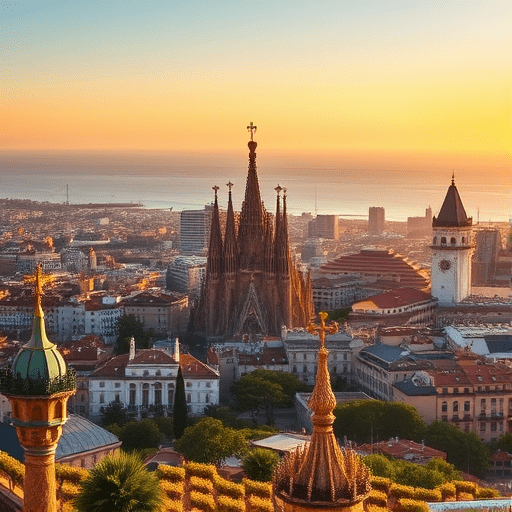
Most visitors arrive in Barcelona with a single mental image: the towering spires of Gaudí’s Sagrada Familia cutting through the skyline. While that view is unforgettable, the city hides a constellation of elevated vantage points that reveal a quieter, more layered portrait of the Catalan capital. From former factory chimneys turned observation decks to hidden terraces above neighbourhood markets, this guide maps seven rooftop perches that travellers consistently overlook — perfect for anyone seeking a fresh vertical-urban angle on Barcelona.
1. Bunkers del Carmel: The Hilltop That Locals Still Claim
Perched on the Turó de la Rovira hill in the working-class neighbourhood of El Carmel, the Bunkers del Carmel are the remains of an anti-aircraft battery from the Spanish Civil War. Locals have been gathering here for sunset long before the terraces of the Eixample became fashionable. The platform offers a full 360-degree sweep: the Mediterranean’s silver line to the east, the Collserola ridge to the west, and the clustered spires of Sagrada Familia floating in the foreground.
Arrive an hour before sunset and bring your own drinks — there are no kiosks, no barriers, no entrance fee. The gravel surface and crumbling concrete give the place a raw, untamed feel that contrasts sharply with the polished rooftop lounges in the city centre.
Getting There and What to Expect
- Take the L4 metro to El Carmel and walk 20 minutes uphill.
- Limited seating — a picnic blanket is useful.
- Best at golden hour; weekend evenings attract a friendly crowd.
2. Museu Nacional d’Art de Catalunya (MNAC) Esplanade
Few tourists think of a museum rooftop, yet the grand esplanade in front of the MNAC on Montjuïc hill offers one of the most cinematic panoramas in Catalonia. Looking eastward, the city unrolls like a scale model: the Plaça d’Espanya fountains, the twin Venetian towers, and beyond them the dense geometry of the Eixample ending at the sea.
The view is free, the crowds thin out after the museum’s midday rush, and the surrounding gardens of Montjuïc invite a slow descent through less-trodden paths.
3. Palau de la Virreina Rooftop Terrace (Cultural Pass-Only)
Hidden behind the ornate rose-pink facade on La Rambla, the Virreina palace occasionally opens its upper gallery for cultural programming. When access is granted, visitors step onto a balustraded terrace looking down on the leafy canopy of the boulevard and across to the Gothic Quarter’s tightly packed rooftops.
It is not a permanent public space, so check the Institut de Cultura de Barcelona listings for current exhibitions. The reward is a quiet, almost private angle on one of Europe’s busiest streets.
4. Fabra Observatory: Dinner Above the City
On the Tibidabo slope, perched at 415 metres, the Fabra Observatory combines scientific heritage with an unexpected evening experience. The venue hosts occasional public dinners and astronomical observation nights, allowing access to the domed roof and the adjacent terrace.
From this altitude, Barcelona becomes a constellation of orange streetlights tracing the grid of the Eixample, with the dark mass of Collserola behind. It is one of the few places where you can watch both the city and, on clear evenings, the rings of Saturn through a historic refracting telescope.
5. Las Arenas de Barcelona: The Converted Bullring Roof
Originally a neo-Mudéjar bullring from 1900, Las Arenas was transformed into a shopping centre while preserving its circular drum. Most shoppers never climb to the top, yet the uppermost deck offers a generous terrace with views across Plaça d’Espanya, Montjuïc, and the distant airport corridor.
It is one of the easiest elevated viewpoints in the city to reach, fully accessible, and almost entirely overlooked by international visitors. The circular geometry of the building itself makes the view feel uniquely framed.
6. Jardins de Mossèn Costa i Llobera: Cacti, Cliffs, and Cable Cars
Few guidebooks mention the cactus gardens on Montjuïc’s southern slope, yet these terraced botanic gardens sit on a cliff edge above the working harbour. From the upper paths, you look down on the Port Vell cranes, the cable car crossing to Barceloneta, and the immense blue plain of the Mediterranean stretching south.
The garden specialises in succulents, which means the elevated walkways remain fragrant and visually striking in summer when other viewpoints bake in midday heat.
Why This Spot Stands Out
- Combines horticulture, industrial harbour, and sea views.
- Far less crowded than Park Güell.
- Free entry, open daily until dusk.
7. Can Framis Museum Rooftop: The 22@ District’s Quiet Edge
In the rapidly evolving 22@ technological district, the Can Framis contemporary art museum occupies a restored nineteenth-century factory complex. Its rooftop terrace is rarely mentioned in tourist guides, yet it offers a striking contrast: behind you, the sharp angles of media studios and start-up offices; ahead, the older skyline of Poblenou with its chimneys, clock towers, and the unmistakable silhouette of the Torre Glòries (the bullet-shaped Agbar Tower).
This is the angle that captures Barcelona’s transformation from industrial city to innovation hub — a view that says more about the present and future of the city than any Gaudí postcard.
A Vertical Map: Choosing Your Skyline
Each of these vantage points answers a different question. The Bunkers give you the city’s emotional centre. MNAC offers a postcard-perfect sweep. Virreina delivers intimacy. Fabra gives altitude and stars. Las Arenas offers accessibility. Mossèn Costa i Llobera merges gardens and industry. Can Framis frames the future.
Spread across the district map, they form a quiet circuit that takes you from El Carmel in the north, down through Montjuïc, across to the harbour, and finally into the 22@ innovation zone. Together they suggest that Barcelona’s true skyline is not a single icon, but a layered conversation between hills, sea, grid, and chimney.
Conclusion
Sagrada Familia will always dominate the postcards, but the city rewards those who look beyond it. Whether you climb a Civil War bunker, sip wine on a museum terrace, or watch the sunset behind the Agbar Tower from a former factory roof, these seven perches reveal a Barcelona that is more textured, more surprising, and more quietly spectacular than the guidebook version. Bring comfortable shoes, a sense of timing, and the willingness to stand still — the skyline will do the rest.