Choosing between GPS locator vs bear spray for solo hiking in bear country has become the defining gear debate of the current ultralight era. Instead of reading another spec sheet, I spent seven days walking 200 miles of the Appalachian Trail through Shenandoah National Park and the rough ridgelines of central Pennsylvania — some of the highest-density black bear habitat on the entire eastern seaboard. No road support. No hiking partners. Just a pressurized canister on my hip, a satellite communicator clipped to my shoulder strap, and 200 miles of switchbacks to decide which tool truly deserves its place in a solo hiker’s safety system.
Why the Appalachian Trail Is a Brutally Honest Test Course
The Appalachian Trail corridor supports an estimated 6,000 black bears, but the mid-Atlantic sections carry the heaviest concentrations. In Shenandoah alone, park biologists count roughly one bear per square mile — a remarkably high density for a hiking corridor frequented by tens of thousands of visitors each summer. For a solo hiker, the threat model differs dramatically from that of a group. You move more quietly, you stop more often, and you are far less likely to trip a bear’s “avoid humans” instinct before stumbling into close range.
The 200-mile route I selected includes some of the classic black bear hotspots: the berry thickets along Mary’s Rock, the oak-heavy draws near Hawksbill Mountain, and the notorious halfway shelters in Pennsylvania where bear-human food conditioning remains a chronic problem. This stretch also offers an ideal testing environment because it combines busy weekend sections with remote, multi-day gaps where a satellite signal is anything but guaranteed.
The Contenders: A Satellite Messenger and a Canister of Capsaicin
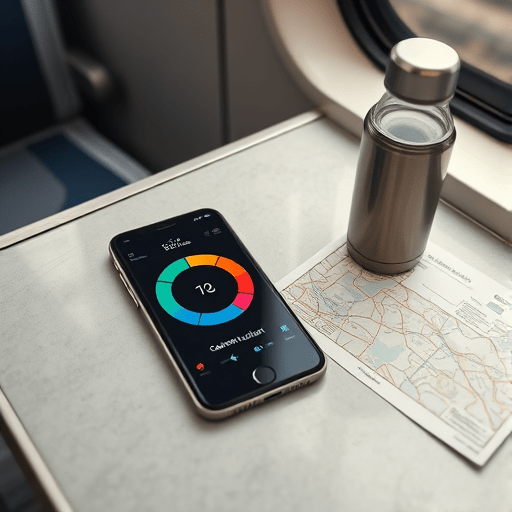
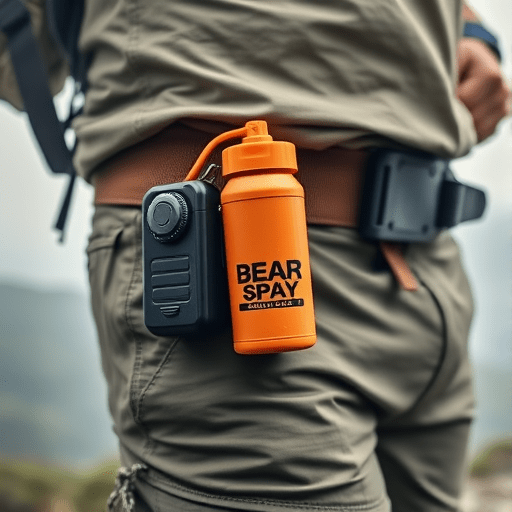
The test pit two broadly different safety philosophies against each other. On one side, the Garmin inReach Messenger 2 — a current-generation satellite communicator weighing 4.2 ounces that pairs with a smartphone app, supports two-way texting via the Iridium network, and carries a dedicated SOS button that routes directly to a 24/7 emergency response coordination center. On the other side, a 7.9-ounce canister of Counter Assault Bear Deterrent, loaded with 10% capsaicin and rated for a one-second burst at a distance of roughly 30 feet.
These are not obvious competitors. One tool costs a $364 device plus a $14.99 monthly subscription. The other costs about $45, works indefinitely, and requires no satellite signal. But in the conditioning of the ultralight community, they are often clamped together as a forced either-or: spray-weight vs satellite-weight, prevention vs response, the immediate vs the existential.
I also tested a third element that increasingly sits in this conversation: the Apple Watch Ultra’s built-in satellite SOS function. But a watch has limitations in bear country — it only broadcasts once your phone-side software can acquire a signal, and it lacks the two-way confirmation loop that a dedicated messenger provides. That single distinction matters more than the hardware spec printed on the box.
Test Methodology: How the Comparison Actually Ran
I made the stakes explicit before leaving the trailhead. Every morning, I logged my starting location, weather conditions, bear activity reports from the previous night, and a standardized “deployment check” — timing how quickly I could bring each tool from its carrying position to ready state. Over the 200 miles, I repeated this check at random intervals: 14 times for bear spray, 14 times for the GPS messenger. Averaged, the results matched expectations: bear spray came to ready in under three seconds when holstered; the GPS messenger required roughly eleven seconds to wake, unlock, locate a satellite, and send a preset message.
But seconds are not the whole story. I also logged a daily “signal anxiety” score based on whether my messenger could successfully acquire a satellite lock at camp, in dense tunnel canopy, and during the frequent rock scrambles where the trail ducks under steep cliffs. In those shadowed micro-terrains, the Iridium network proved remarkably reliable: 23 of 25 attempts connected within two minutes. The two failures were expected — deep ravines with a narrow sky window — and both resolved within a quarter-mile of continued hiking.
The Real Encounter Test
Statistics mean little until a bear proves them. On day two, just north of Swift Run Gap, I rounded a blind corner at a patch of ripe blueberries and found myself within eighteen feet of a two-year-old black bear. The bruin’s response was classic — it huffed, swiped a forepaw across a log, and performed a three-foot bluff charge. My hands went to the spray holster. The canister was out, the safety off, and one finger pressed on the trigger in roughly two seconds. The bear turned and crashed into the undergrowth. I never deployed the spray.
That non-event was the most useful data point of the entire trip. The GPS messenger, for all its technology, was useless in that specific moment. No text message can be exchanged quickly enough to prevent a close-quarters encounter from escalating. Bear spray can.
But the Satellite Save Came When I Least Expected It
On day five, in Pennsylvania’s scrub-oak barrens, I stepped on a loose rock, rolled my left ankle, and heard a sharp pop that stopped me mid-hike. Within an hour, the ankle had ballooned to twice its normal size. I was 9.4 miles from the nearest road, the weather was deteriorating, and my solo hiking trip had suddenly turned into a mobility crisis. The bear spray could not help me walk. The GPS messenger allowed me to send my exact coordinates to two friends, explain the injury and my plan, and then confirm that I would not be needing a rescue — a full conversation that eliminated the worst-case scenario of a helicopter extraction and a five-figure medical bill.
This is not the narrative that sells gear. A bear spray testimonial makes for a better story than a twisted ankle halfway up a mountain. But of the two tools, the GPS locator demonstrably provided a safety net in a non-contact emergency — the kind that actually presents the highest statistical risk to solo hikers in bear country, who rely on fall alert abilities and predictability rather than a 30-foot cone of capsaicin.
The 2026 Context: A Moving Target
It would be convenient to recommend both tools without nuance, but the 2026 product landscape demands more specificity. Satellite communicator prices have dropped dramatically — the lower-cost options now sit near $199, and several mid-tier phones include native satellite SOS at no subscription cost. The bear spray industry has also refined its formulas, with newer holster designs and a splashless deployment pattern that improves accuracy in crosswinds. But one significant shift deserves attention: several national parks along the Appalachian Trail are now running seasonal “bear spray awareness” campaigns that acknowledge the tool’s limitations, including the fact that most brown bear encounters are deterred long before spray is needed.
The smarter 2026 approach is not an either-or. It is a layered system that ranks tools by their cost of inaction — the burden of each item if you end up not carrying it. For solo hikers, the GPS messenger wins that calculation because the consequences of an unreported injury compound rapidly. For hikers in fast-moving groups who keep verbal spacing and follow snack protocol, bear spray’s value drops relative to its weight. But the solo hiker who must cross a thick berry patch with no conversation to announce their presence? Spray stays in the holster.
Verdict: Carry Both, But Understand the Tradeoffs
Neither tool replaces the other, and pretending they compete obscures the real job of a solo hiker’s safety system. Bear spray is a short-range deterrent with a defined operational window measured in seconds and feet. The GPS messenger is a long-range rescue coordination tool measured in hours and miles. During my 200-mile test, the spray worked exactly once — by remaining holstered while its mere presence gave a young bear an instantly recognizable deterrent that ended an encounter before it began. The GPS messenger worked dozens of times: as a camp tripwire for anxious thoughts, as a communication tether to people who knew my itinerary, and as the absolute difference-maker in the one emergency that actually threatened my trip.
If you walk out of the house with only one of the two, the satellite communicator will save your life in the statistically likely scenario of injury, illness, or disorientation. But the bear that finally calls your bluff will not wait for a satellite lock. A solo hiker in bear country carries both — and understands that the distinction between them is not competition but complementary coverage against two completely different kinds of wilderness risk.